







What Most Coaches Get Wrong About Selling Their Services
Why Do Coaches Avoid Selling Their Services?
Many coaches will advise you not to sell your coaching programme with excuses such as:
- “If clients are interested, they will get back to you when the time is right.”
- “Don’t write proposals, write invitations.”
- “Grow your coaching practice without ever selling to one client…”
Although I’m not denying that some coaches have succeeded this way, but let’s face it, when you graduate as a coach, the world is not actually running to your door to buy your programmes or 1-to-1 coaching.
In fact, the opposite is happening. During your studies, you may have learned that coaching is a growing market and more and more people are opening up to the possibility of getting coached, be it for their own personal purposes to achieve life goals and ambitions or for business purposes.
But what about experience? Say, you want to become a business coach, which industries are you going to target? What experiences do you have in those industries?
You may have heard that as a coach you don’t need industry-specific experiences, you don’t need to know anything about your clients business.
Performance coaches, for example, will tell you that a coach with no experience in the sports industry can become – by magic – a tennis or soccer/football coach. Never even played the game before, but suddenly you hear that you can do it, so you go for it…
SEE ALSO: If you’re a coach looking to streamline your administrative tasks and save time, check out our Coaching Administration Software. It’s a simple, effective solution designed to help you focus less on paperwork and more on what matters—coaching your clients. From scheduling to client management, our software gives you the tools to run your business efficiently. Ready to reclaim your time and boost productivity? Click or tap here.
Key Takeaways
- Selling is part of running a coaching business. Prospects need a clear path from interest to a decision instead of being left indefinitely to “get back to you when they’re ready.”
- Good selling is diagnostic, not coercive. Your job is to understand the prospect’s problem, test whether coaching fits, explain the value honestly, and leave room for a clear yes or no.
- Buyer hesitation usually has a specific cause. Questions about experience, price, timing, trust, or fit are signals to investigate rather than objections you need to bulldoze.
- Discovery calls work better with a question framework. SPIN gives you a practical structure for moving from the prospect’s current situation to the consequences of the problem and the value of solving it.
- Follow-up is part of selling. Agree on a next step, follow up when promised, address the actual concern, and close the loop instead of treating silence as automatic rejection.
How Do You Sell Coaching Services Without Being Pushy?
You sell coaching services without being pushy by helping a prospect make a clear, informed decision rather than trying to make the decision for them. That means asking good questions, understanding what they want to change, establishing whether you can genuinely help, explaining what working together would involve, and directly asking whether they want to proceed.
A strong sales conversation should make the decision clearer on both sides. Sometimes the right result is a yes. Sometimes it is a no. Sometimes the prospect needs a specific piece of information before deciding.
What matters is that you do not confuse giving someone room to choose with abandoning the sales process completely. Ethical selling still includes discussing the problem, explaining your offer, talking about money, answering concerns, asking for a decision, and following up when appropriate.
Why Do Prospects Question a Coach’s Experience?
Actually, most businesses and sports clubs are looking for coaches with experience in the industry. Now, I’m not denying that having no experience in a certain field can be an advantage, but let’s be honest here, you will be facing on a daily basis the art of classic REJECTION because you don’t have the experience, you don’t know how to handle the objection or simply said you don’t know how to sell it.
Fact is, that anybody who is willing to pay for coaching – no matter how big or small your fees are – will ask this question. They want to know what your experience is within the industry and how you intend to help them. This is because they feel that the only way you can relate to them is if you went through a similar experience. If you can’t address those questions, you will be out the door faster than you can say “Coaching…”
So, why is it that so many coaches, especially the famous ones, will tell you not to sell your services, but let clients get back to you when they are ready. Don’t we all need a push every now and then?
SEE ALSO: If you’re a coach looking to streamline your administrative tasks and save time, check out our Coaching Administration Software. It’s a simple, effective solution designed to help you focus less on paperwork and more on what matters—coaching your clients. From scheduling to client management, our software gives you the tools to run your business efficiently. Ready to reclaim your time and boost productivity? Click or tap here.
Here is an interesting fact:
Imagine you are currently coaching a client, what do you do? How do you challenge him/her to do the tasks that they need to do in order to achieve or create a better life for them or grow their business? You push them, right? You push them so far out of their comfort zone that if you weren’t there to hold their hands (metaphorically speaking), they would jump out the window never to be seen again.
What Is a Prospect Really Trying to Work Out Before Buying Coaching?
A coaching prospect is usually trying to reduce uncertainty before committing their money, time, and trust to you.
That is why questions that sound like resistance often make perfect sense from the buyer’s side. “Have you worked in my industry?” may really mean, “Will I spend half our sessions explaining things you need to understand before you can help me?”
Before buying, most prospects need answers to five practical questions:
- Is this relevant to my problem? They need to recognize their actual situation in what you are offering.
- Can I trust this coach to help me? Your experience, coaching approach, qualifications, examples, and ability to understand their situation all contribute to this decision.
- What am I actually buying? “Six coaching sessions” is less informative than a clear explanation of what the coaching is designed to work on, what happens between sessions, and what responsibilities sit with the client.
- Is the commitment worth it? The prospect is weighing the fee, time commitment, effort, uncertainty, and alternatives against the value of solving the problem.
- What happens if I say yes? They want to know the practical next step. Payment, agreement, first session, preparation, and what happens from there.
Imagine an executive approaches you about leadership coaching and asks whether you have ever coached a senior leader in her industry.
SEE ALSO: If you’re a coach looking to streamline your administrative tasks and save time, check out our Coaching Administration Software. It’s a simple, effective solution designed to help you focus less on paperwork and more on what matters—coaching your clients. From scheduling to client management, our software gives you the tools to run your business efficiently. Ready to reclaim your time and boost productivity? Click or tap here.
You could become defensive and tell her that coaches do not need sector expertise. Or you could investigate the concern.
“Is your main concern that I understand the technical side of the industry, or that I understand the kind of leadership problems you’re facing?”
Now you know what you are actually discussing.
If she needs a technical industry consultant and that is not your expertise, pretending otherwise will not help either of you. If the issue is leading a rapidly growing team, handling board-level pressure, or becoming more effective at delegation, you can explain relevant experience truthfully.
That is a much stronger sales conversation than trying to win an argument about whether industry experience should matter.
Should Coaches Push Prospects Out of Their Comfort Zone?
So, why do so many coaches have a problem to push a client during the “sales phase?”
SEE ALSO: If you’re a coach looking to streamline your administrative tasks and save time, check out our Coaching Administration Software. It’s a simple, effective solution designed to help you focus less on paperwork and more on what matters—coaching your clients. From scheduling to client management, our software gives you the tools to run your business efficiently. Ready to reclaim your time and boost productivity? Click or tap here.
Think about that for a moment. Selling is pushing people constantly out of their comfort zone. Not only helps this the seller to make a living, but the customer may need a push as well. We all come across the indecisive one… the client who can’t make a proper decision of what to buy, where to buy, when to buy etc. If you start pushing a little bit, provide limited time offers, even telling your client that yes, you could wait, but what good will it do you to wait for another week or month or even year? Will anything change for them if they wait? Are you able to take that responsibility?
Imagine a client is right in front of you stating, they need your help. Their business is drowning and they might need to close shop within a few months. They heard that business coaching might help and are there to listen to you.
If they close the business, 5 of their current employees will be unemployed if they don’t succeed within the next few months to bring in more revenue to the business, looking for new customers or whatever their issue is. Now, it will be your turn to pitch your business. You tell them, that you can help turn things around. Here is my price. And within the same breath you tell them: Why don’t you think about it and get back to me when you’re ready
The customer leaves and 4 months down the line their business closes.
Who’s fault is it in your opinion? The client because he didn’t get back to you? Or is it your fault for not following up and pushing the client at the right time to close the deal and finally taking matters into their own hands?
When Does a Helpful Challenge Become Sales Pressure?
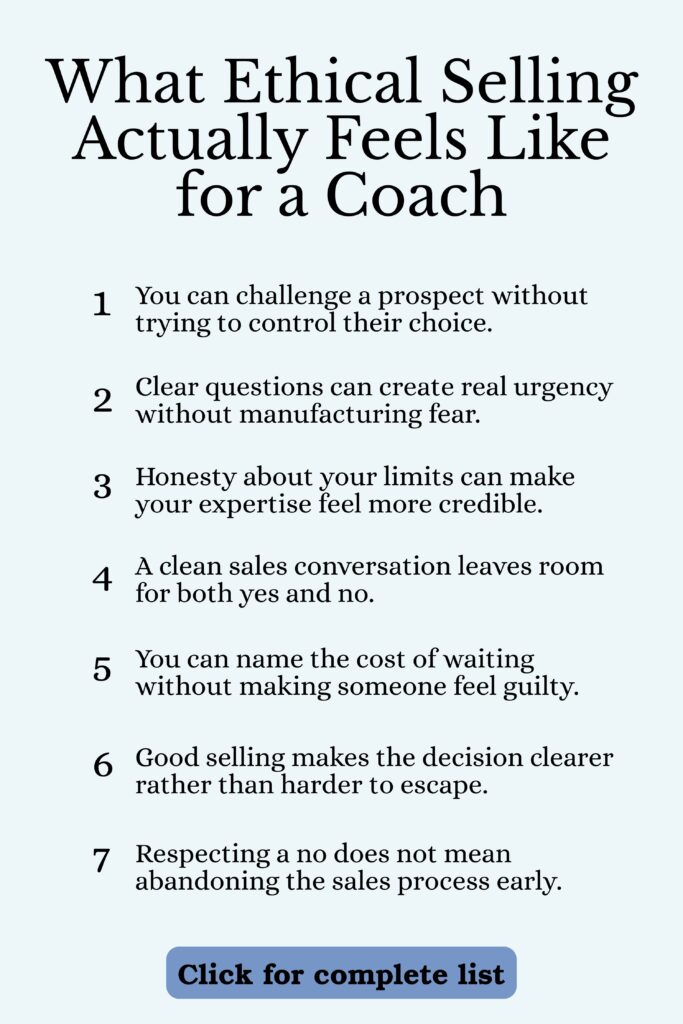
A helpful challenge makes the consequences of a decision clearer while preserving the prospect’s freedom to choose. Sales pressure tries to control that choice through fear, guilt, exaggerated urgency, or responsibility that does not belong to the coach.
SEE ALSO: If you’re a coach looking to streamline your administrative tasks and save time, check out our Coaching Administration Software. It’s a simple, effective solution designed to help you focus less on paperwork and more on what matters—coaching your clients. From scheduling to client management, our software gives you the tools to run your business efficiently. Ready to reclaim your time and boost productivity? Click or tap here.
That distinction matters.
Suppose a business owner tells you the company may run out of cash within four months.
A legitimate coaching question might be:
“What do you think happens if nothing changes during those four months?”
You might follow with:
“What have you already tried, and where do you think outside support could make a difference?”
SEE ALSO: If you’re a coach looking to streamline your administrative tasks and save time, check out our Coaching Administration Software. It’s a simple, effective solution designed to help you focus less on paperwork and more on what matters—coaching your clients. From scheduling to client management, our software gives you the tools to run your business efficiently. Ready to reclaim your time and boost productivity? Click or tap here.
Those questions make the situation harder to ignore. They do not dictate the answer.
Compare that with telling the prospect:
“If you walk away today and the company closes, that is your responsibility.”
Now you are no longer helping someone examine a decision. You are using a feared outcome to make saying no more difficult.
Research on psychological reactance helps explain why this distinction matters. Reactance describes the resistance people can experience when they perceive that their freedom is being threatened. A major review by Christina Steindl and colleagues found that threats to freedom can trigger attempts to restore that freedom, including resistance to social influence.
There is also a professional boundary here. The current International Coaching Federation Code of Ethics requires ICF professionals to make truthful statements about their qualifications and offers, remain aware of power differentials, and respect a client’s right to terminate a coaching relationship.
SEE ALSO: If you’re a coach looking to streamline your administrative tasks and save time, check out our Coaching Administration Software. It’s a simple, effective solution designed to help you focus less on paperwork and more on what matters—coaching your clients. From scheduling to client management, our software gives you the tools to run your business efficiently. Ready to reclaim your time and boost productivity? Click or tap here.
So challenge the prospect’s thinking. Ask what waiting costs. Explore what happens if the problem continues. Point out contradictions when you hear them.
But let the prospect own the decision.
That is not weak selling. It is cleaner selling.
How Can Coaches Use SPIN Questions in a Sales Conversation?
Coaches can use SPIN to turn a discovery call from a pitch into a structured conversation about whether there is a real problem worth solving.
SPIN was developed by Huthwaite International and Neil Rackham’s research into sales conversations. The four question types are Situation, Problem, Implication, and Need-payoff. Huthwaite describes the method as a way to uncover needs and develop value through questioning rather than simply pushing a product.
For a coach, it can look like this:
SEE ALSO: If you’re a coach looking to streamline your administrative tasks and save time, check out our Coaching Administration Software. It’s a simple, effective solution designed to help you focus less on paperwork and more on what matters—coaching your clients. From scheduling to client management, our software gives you the tools to run your business efficiently. Ready to reclaim your time and boost productivity? Click or tap here.
- Situation: Understand what is happening now.
“How is the business performing at the moment?”
“How big is the team?”
“What are you currently doing to bring in clients?” - Problem: Find the specific difficulty.
“Where are things getting stuck?”
“Which part of this is costing you the most time?”
“What have you tried that hasn’t worked?” - Implication: Explore what the problem is actually costing them.
“What happens to revenue if this continues for another six months?”
“How is this affecting the team?”
“What are you unable to do because so much of your time is going into this?” - Need-payoff: Let the prospect describe the value of solving it.
“If you fixed this, what would become possible?”
“What would a successful result look like three months from now?”
“What would change for you if you were no longer handling this alone?”
The order matters less than the quality of the conversation. You are not interrogating someone from a checklist.
You are helping the prospect move from “something isn’t working” to a much clearer understanding of what the problem is, what it is costing, and whether solving it now has enough value to justify action.
Only then does your offer belong in the conversation.
For example:
“You’ve said you’re losing two days a week to operational problems, the management team still depends on you for routine decisions, and that is stopping you from focusing on new business. I work specifically with owners on delegation, leadership systems, and accountability. Would it be useful if I explained how I would structure that work with you?”
Now the offer is connected to a problem the prospect has already described.
SEE ALSO: If you’re a coach looking to streamline your administrative tasks and save time, check out our Coaching Administration Software. It’s a simple, effective solution designed to help you focus less on paperwork and more on what matters—coaching your clients. From scheduling to client management, our software gives you the tools to run your business efficiently. Ready to reclaim your time and boost productivity? Click or tap here.
If you use LCH Core, the practical setup can support this without taking over the conversation. A Public Booking Page can give prospects a direct way to book a discovery call, while intake forms can give you useful context before you speak. Setup information is available through the LCH Core support center.
The technology handles the path into the conversation. You still have to conduct the conversation well.
What Should You Do When a Prospect Says “I Need to Think About It”?
When a prospect says “I need to think about it,” find out what they actually need to think about before you start answering an objection that may not exist.
“I need to think” is not one objection. It can mean several completely different things:
- Fit: “I’m not sure this is the right kind of coaching for me.”
- Trust: “I’m not convinced you are the right person to help me.”
- Money: “I understand the value, but I genuinely cannot justify this expense right now.”
- Timing: “I want this, but another commitment makes starting now impractical.”
- Decision process: “I need to discuss this with my business partner, spouse, manager, or another stakeholder.”
So clarify first.
A simple question is:
SEE ALSO: If you’re a coach looking to streamline your administrative tasks and save time, check out our Coaching Administration Software. It’s a simple, effective solution designed to help you focus less on paperwork and more on what matters—coaching your clients. From scheduling to client management, our software gives you the tools to run your business efficiently. Ready to reclaim your time and boost productivity? Click or tap here.
“Of course. What part do you feel you need to think through?”
If the answer is still vague, narrow it without putting words in their mouth:
“Is the hesitation mainly about the fit, the timing, the investment, or something else?”
Then deal with what they actually tell you.
If the concern is money, explain the payment or package options you genuinely offer. Do not relabel a real budget problem as a “limiting belief.”
If the concern is experience, explain the experience you actually have. Do not inflate your background.
SEE ALSO: If you’re a coach looking to streamline your administrative tasks and save time, check out our Coaching Administration Software. It’s a simple, effective solution designed to help you focus less on paperwork and more on what matters—coaching your clients. From scheduling to client management, our software gives you the tools to run your business efficiently. Ready to reclaim your time and boost productivity? Click or tap here.
If the concern is timing, establish whether there is a realistic future start point.
If the prospect needs approval from someone else, ask what information that person will need.
And if the person has decided it is not right for them, accept the no.
Handling objections well is not about developing a clever response to every possible resistance. It is about becoming good enough at sales conversations to identify the real decision barrier and respond appropriately. The related guide on how to improve your sales skills goes deeper into building those skills.
What Should Happen After a Coaching Discovery Call?
A coaching discovery call should end with an agreed next step, not a vague promise that somebody will “be in touch.”
If the prospect wants to think, speak to a partner, review the price, or compare options, that is fine. The mistake is ending the call without deciding what happens next.
SEE ALSO: If you’re a coach looking to streamline your administrative tasks and save time, check out our Coaching Administration Software. It’s a simple, effective solution designed to help you focus less on paperwork and more on what matters—coaching your clients. From scheduling to client management, our software gives you the tools to run your business efficiently. Ready to reclaim your time and boost productivity? Click or tap here.
Use a simple five-step follow-up process.
1. Agree on the next action before the call ends.
Instead of:
“Have a think and let me know.”
Try:
“You’d like to review this with your business partner on Wednesday. Shall I send you the package details today and check back with you on Thursday?”
Now both sides know what happens.
SEE ALSO: If you’re a coach looking to streamline your administrative tasks and save time, check out our Coaching Administration Software. It’s a simple, effective solution designed to help you focus less on paperwork and more on what matters—coaching your clients. From scheduling to client management, our software gives you the tools to run your business efficiently. Ready to reclaim your time and boost productivity? Click or tap here.
2. Send only what was promised.
If they asked for prices, send prices.
If they asked how the program works, explain the program.
Do not respond to one question by sending six PDFs, three testimonials, four videos, and your entire coaching philosophy.
3. Follow up when you said you would.
A promised follow-up is not pestering someone. You have already agreed that the conversation will continue.
The message can be simple:
“You were going to discuss the coaching with your partner yesterday. How did the conversation go?”
SEE ALSO: If you’re a coach looking to streamline your administrative tasks and save time, check out our Coaching Administration Software. It’s a simple, effective solution designed to help you focus less on paperwork and more on what matters—coaching your clients. From scheduling to client management, our software gives you the tools to run your business efficiently. Ready to reclaim your time and boost productivity? Click or tap here.
4. Respond to new information.
The follow-up may uncover the real issue.
Perhaps the business partner likes the idea but wants a shorter commitment. Perhaps the prospect has realized the fee is outside the current budget. Perhaps they are ready to start.
Work with the information you now have instead of repeating the original pitch.
5. Close the loop when the conversation is no longer moving.
Following up does not mean chasing someone forever.
If several attempts receive no response, send a final message that makes it easy for the person to close the conversation. You can make clear that you will leave it there for now and they are welcome to reconnect if circumstances change.
This is where thinking in terms of a complete coaching funnel becomes useful. Someone can discover you, make contact, have a conversation, decide not to buy immediately, return later, become a client, and eventually work with you again in another way. How to Master Funnels as a Coach (and Why You Need To) explains that wider client journey.
SEE ALSO: If you’re a coach looking to streamline your administrative tasks and save time, check out our Coaching Administration Software. It’s a simple, effective solution designed to help you focus less on paperwork and more on what matters—coaching your clients. From scheduling to client management, our software gives you the tools to run your business efficiently. Ready to reclaim your time and boost productivity? Click or tap here.
Visibility still matters at the beginning of that process. A free life coach directory listing gives coaches another place to be found by people looking for coaching. But being visible and being able to convert interest are two different business skills.
You need both.
Why Is Selling a Necessary Coaching Business Skill?
I’m not trying to put any blame or for you to feel bad about coaching. However, with any business, it is necessary to sell your services, push your clients out of their comfort zone and close the deal. Asking the right questions is important, but not asking the questions and just letting them go off on their way is simply wrong and won’t do you any good, nor will it benefit your customer.
As coaches, we help people become more confident in their approach about what they do and how they can achieve their goals. Unfortunately, many of us coaches simply lack the sales side of the business.
If you can’t sell, how do you intend to make money? How do you intend to get in front of decision makers? And as expert coaches, how can you justify telling your business clients not to sell?
These are just my thoughts on the topic, but I would be very interested to hear yours and the experience you’ve had with selling your coaching services.
SEE ALSO: If you’re a coach looking to streamline your administrative tasks and save time, check out our Coaching Administration Software. It’s a simple, effective solution designed to help you focus less on paperwork and more on what matters—coaching your clients. From scheduling to client management, our software gives you the tools to run your business efficiently. Ready to reclaim your time and boost productivity? Click or tap here.
Where LCH Core Fits
LCH Core fits best as the operating system around a sales process you already understand, not as a substitute for knowing how to sell coaching.
A simple sales path might look like this:
- Before the discovery call: Use a Public Booking Page to give prospects a clear booking route. Intake forms can collect useful background before you speak.
- During the decision stage: Keep the conversation focused on fit, the client’s problem, the intended outcome, the commitment involved, and the next step.
- When someone becomes a client: Client management (CRM) can keep client profiles, notes, and intake forms organized instead of scattering information across inboxes and documents.
- When the client is ready to buy: Payments, coaching packages, and billing give the commercial part of the relationship a defined process.
- When coaching begins: A Welcome Package can bring together the welcome letter, coaching agreement with electronic signature, and forms so expectations are established before the work gets underway.
- When a prospect is interested but not ready for coaching: A useful lead magnet can give them a lower-commitment way to learn from you and stay connected to your work.
The principle is simple. Define what should happen at each stage before choosing the tool that handles it.
A scheduler cannot fix a weak discovery call. A CRM cannot decide how you should respond to a price objection. A payment system cannot tell you whether someone is genuinely a good coaching fit.
Those remain coaching-business skills.
Once the process is clear, LCH Core can keep the practical pieces of that process organized instead of making you rebuild them for every new client.
SEE ALSO: If you’re a coach looking to streamline your administrative tasks and save time, check out our Coaching Administration Software. It’s a simple, effective solution designed to help you focus less on paperwork and more on what matters—coaching your clients. From scheduling to client management, our software gives you the tools to run your business efficiently. Ready to reclaim your time and boost productivity? Click or tap here.
Frequently Asked Questions About Selling Coaching Services

How do I sell coaching without sounding pushy?
Sell coaching by helping the prospect understand their problem, the value of solving it, and whether your service is a good fit. Ask direct questions and make a clear offer, but leave the final decision with the prospect.
What should I say on a coaching discovery call?
A coaching discovery call should focus on the prospect’s current situation, the problem they want to solve, the consequences of leaving it unresolved, the result they want, and whether your coaching can appropriately help. SPIN provides a useful structure for those questions.
How do I respond when a coaching prospect says they need to think about it?
Ask what specifically they need to think through. Once you know whether the concern is fit, trust, money, timing, or the decision process, you can respond to the actual issue instead of guessing.
How do I handle a price objection when selling coaching?
Handle a price objection by first establishing whether price is genuinely the problem. If it is, explain the payment, billing, or coaching package options you actually provide, then let the prospect decide whether the commitment is workable.
How many times should I follow up with a coaching prospect?
Follow up while there is a reasonable unfinished conversation to continue, especially when you have agreed on a next step. If repeated attempts receive no response, close the loop respectfully rather than continuing indefinitely.
Do I need experience in a client’s industry to sell business coaching?
You do not necessarily need experience in the client’s exact industry, but you should be honest about the experience and expertise you do have. If the client needs technical consulting rather than coaching, do not present yourself as having expertise you lack.
SEE ALSO: If you’re a coach looking to streamline your administrative tasks and save time, check out our Coaching Administration Software. It’s a simple, effective solution designed to help you focus less on paperwork and more on what matters—coaching your clients. From scheduling to client management, our software gives you the tools to run your business efficiently. Ready to reclaim your time and boost productivity? Click or tap here.
How do I turn a discovery call into a paying coaching client?
Turn a discovery call into a buying decision by diagnosing the real problem, establishing whether your coaching fits, explaining the offer clearly, addressing genuine concerns, asking whether the prospect wants to proceed, and agreeing on the next action.
Thank you and should you have any questions, please feel free to contact me.
Happy selling everyone
Carsten
Also check out:
The truth about building a coaching business
SEE ALSO: If you’re a coach looking to streamline your administrative tasks and save time, check out our Coaching Administration Software. It’s a simple, effective solution designed to help you focus less on paperwork and more on what matters—coaching your clients. From scheduling to client management, our software gives you the tools to run your business efficiently. Ready to reclaim your time and boost productivity? Click or tap here.
How to make your business stand out from the crowd
Coaching business plans: A quick template
How to set your life coaching fees
How to get past the gatekeeper in sales
How to improve sales skills: 5 tips to boost your sales today
Sources
Huthwaite International. “The SPIN Methodology.” Huthwaite International, n.d. Accessed 17 Sept. 2026. The SPIN Methodology
SEE ALSO: If you’re a coach looking to streamline your administrative tasks and save time, check out our Coaching Administration Software. It’s a simple, effective solution designed to help you focus less on paperwork and more on what matters—coaching your clients. From scheduling to client management, our software gives you the tools to run your business efficiently. Ready to reclaim your time and boost productivity? Click or tap here.
International Coaching Federation. “ICF Code of Ethics.” International Coaching Federation, 2025. Accessed 17 Sept. 2026. ICF Code of Ethics
Steindl, Christina, Eva Jonas, Sandra Sittenthaler, Eva Traut-Mattausch, and Jeff Greenberg. “Understanding Psychological Reactance: New Developments and Findings.” Zeitschrift für Psychologie, vol. 223, no. 4, 2015, pp. 205-214. PubMed. Understanding Psychological Reactance
Read this next

13 In Demand Lead Magnet Ideas for Coaches to Get Clients Fast
Effectively market your coaching business using these 13 in demand lead magnet ideas!
Read More
7 Proofs That Strong Public Speaking Can Attract Coaching Clients
Get more clients as a coach by using public speaking
Read More
A Bird in the Hand: The Simple Math of Client Lifetime Value (for Coaches)
Most advice to coaches can be summed up in three words: get more leads. It sounds logical. After all, more people in, more revenue out… But if you study the […]
Read More