





The Benefits Of Online Coaching

Online coaching is great for clients and coaches
Key Takeaways
- Online coaching can produce meaningful results. Workplace coaching research has found positive outcomes from both virtual and face-to-face delivery, with no statistically significant difference between the two formats.
- Privacy can make disclosure easier. Some clients speak more openly when they control their surroundings, camera use, physical distance, and the amount of personal information they reveal.
- Missing body language can be managed deliberately. Coaches can replace some visual information with clarification questions, summaries, intensity ratings, written reflections, and progress records.
- The format should match the coaching goal. Video supports emotional nuance, telephone coaching sharpens listening, and written formats give reflective clients more time to organize their thoughts.
- Professional systems protect the relationship. Clear agreements, reliable booking, structured onboarding, consistent records, and deliberate follow-through make online coaching easier to trust and manage.
What Are the Benefits of Online Coaching for Coaches and Clients?
Online coaching gives clients greater choice, convenience, privacy, and access to coaches outside their local area. It also removes travel time and makes sessions easier to fit around work, family responsibilities, health needs, and international time zones.
For coaches, online delivery creates a wider potential client base and makes it possible to build a location-independent practice. The strongest results come when that access is supported by clear agreements, intentional communication, structured follow-through, and a reliable client-management process.
Does Online Coaching Work as Well as Face-to-Face Coaching?
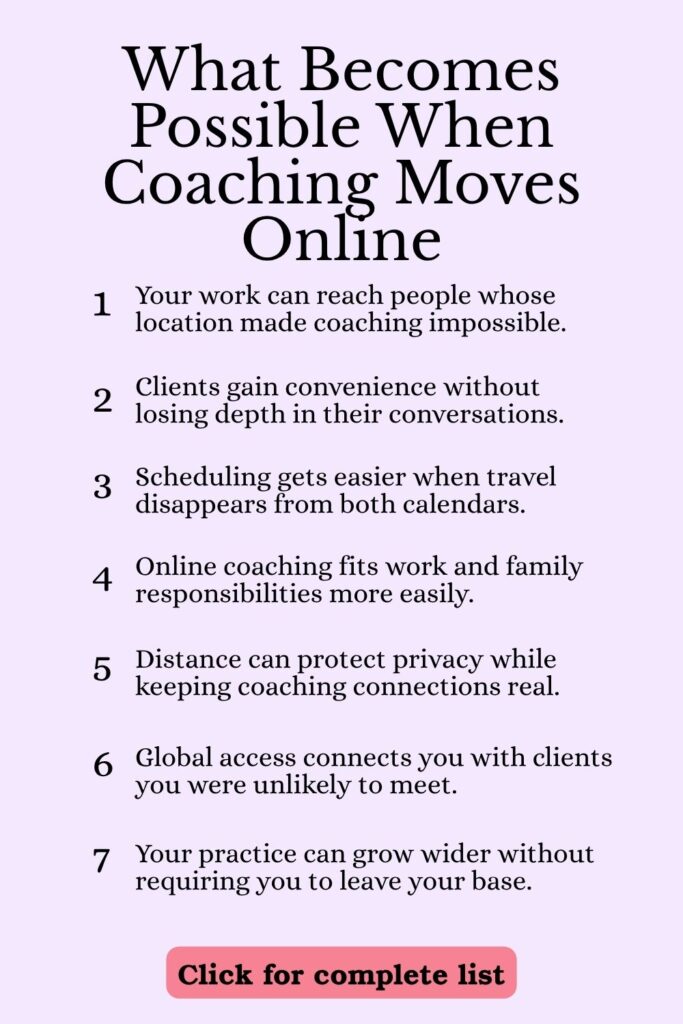
Online coaching can produce outcomes comparable to face-to-face coaching when the format fits the client, the goal, and the way the sessions are structured.
A 2023 meta-analysis published in Frontiers in Psychology found that both virtual and face-to-face workplace coaching produced significant positive outcomes. The difference between the two delivery formats was not statistically significant.
That does not mean the formats are interchangeable in every situation. It means the screen itself is not automatically a barrier to useful coaching.
SEE ALSO: If you’re a coach looking to streamline your administrative tasks and save time, check out our Coaching Administration Software. It’s a simple, effective solution designed to help you focus less on paperwork and more on what matters—coaching your clients. From scheduling to client management, our software gives you the tools to run your business efficiently. Ready to reclaim your time and boost productivity? Click or tap here.
A leadership coach working with a client on difficult workplace conversations might use video because facial expression and tone add useful information. A client reviewing career options may do equally well by telephone, especially if walking helps them think.
The more practical question is not, “Is online coaching as good?” It is, “What does this client need from the format for this conversation?”
Why Can Online Coaching Feel Safer and More Private?
I often hear how scary it can be for a new client to get coached face to face. There can be issues around getting to know the coach, feeling safe to open up and be fully honest, and the vulnerablity that comes with sharing our inner most goals. It is an honour as a coach to be trusted enough by someone to share their hopes and dreams with you.
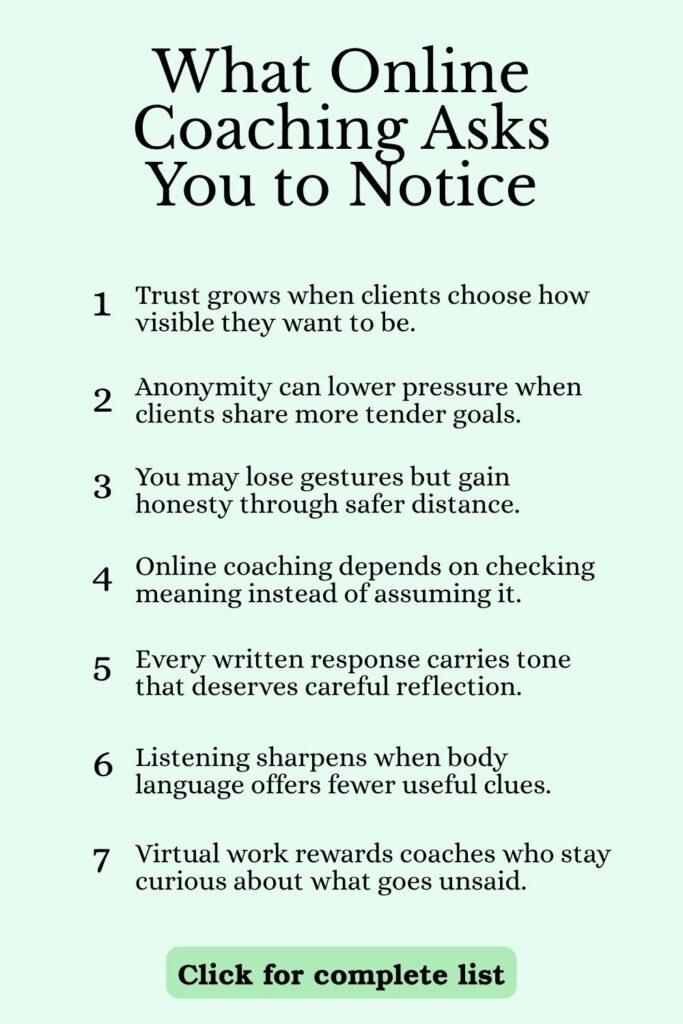
Online coaching can cut through a lot of the fears as it is completely up to you whether you want to remain anonymous or not. Research has shown that people feel able to express themselves more quickly and easily when there is an aspect of anonymity.
Why Can Clients Disclose More Online?
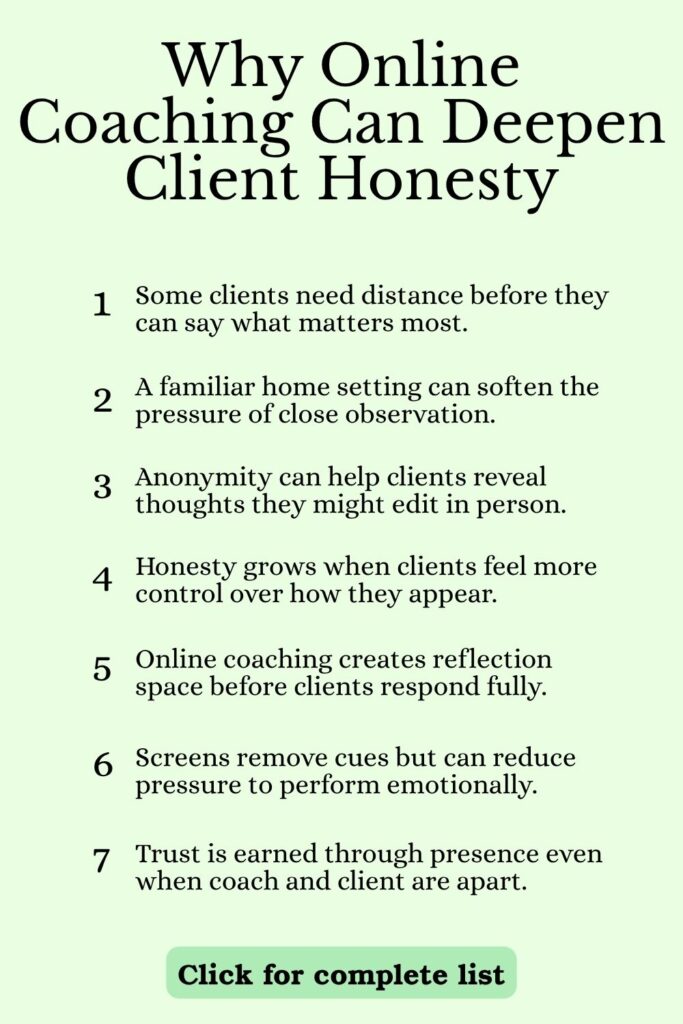
Clients can disclose more online because distance and reduced visibility sometimes lower the social pressure they feel during a difficult conversation.
Psychologist John Suler described this pattern as the online disinhibition effect. His model explains how factors such as anonymity, invisibility, and asynchronous communication can make people say things online that they might hold back in person.
SEE ALSO: If you’re a coach looking to streamline your administrative tasks and save time, check out our Coaching Administration Software. It’s a simple, effective solution designed to help you focus less on paperwork and more on what matters—coaching your clients. From scheduling to client management, our software gives you the tools to run your business efficiently. Ready to reclaim your time and boost productivity? Click or tap here.
This can be useful in coaching. A client may write honestly about their fear of leaving a career, then struggle to say the same words aloud during a video call.
Faster disclosure is not automatically deeper trust, however. A client can reveal something personal before they are ready to explore it, act on it, or understand its significance.
Useful follow-up questions include:
- “What made that easier to say in writing?”
- “How does it feel hearing those words reflected back?”
- “Would you like to explore this now, or simply acknowledge it today?”
- “What feels useful to do with this information next?”
The disclosure gives you information. The client still decides the pace.
What Changes When Nonverbal Cues Are Reduced?
This was surprising to me at first as I always felt that face to face coaching worked so much better; and indeed in a lot of ways there are many positive aspects to coaching in person. You can gauge a lot from a person’s body language: unsaid emotions, anger, resentment, witholding, and whether the words match what you is being conveyed. In my work with Alcohol and Drug Advisory I found that most of the information I gleaned from my clients was unspoken.
Perhaps online coaching makes the coach’s work slightly more challenging due to the loss of these non-verbal cues; however, if the client feels more confident and able to share, then the coach has an opportunity to hone their skills in new ways and get to the root of their focus more quickly.
SEE ALSO: If you’re a coach looking to streamline your administrative tasks and save time, check out our Coaching Administration Software. It’s a simple, effective solution designed to help you focus less on paperwork and more on what matters—coaching your clients. From scheduling to client management, our software gives you the tools to run your business efficiently. Ready to reclaim your time and boost productivity? Click or tap here.
Whlie it is not easy to gauge body language online, it can also sometimes be a challenge to interpret the feelings and emotions being conveyed through the written word, such as in an email. So checking back with each other throughout the session for clarity is more crucial.
How Can Coaches Replace Missing Nonverbal Cues Online?
Coaches can replace some missing nonverbal information with a deliberate cue replacement loop.
The loop has four parts:
- Observe: Name only what you can actually detect.
- Check: Ask whether your interpretation is accurate.
- Clarify: Invite the client to explain what is happening internally.
- Track: Record patterns that may matter across several sessions.
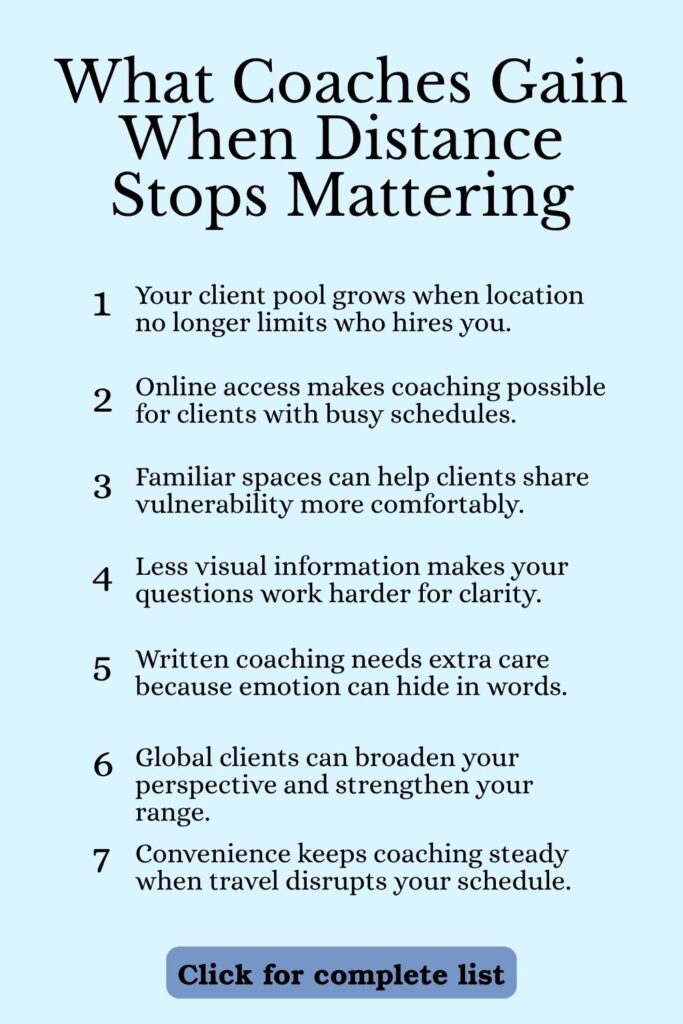
For example, a client says they are committed to applying for a promotion, but their answers become shorter every time you discuss the application.
Instead of concluding that they are afraid, you might say, “I noticed your answers became much shorter when we moved to the application. What is happening for you right now?”
You can also ask clients to give an emotion or decision an intensity rating from one to ten. That creates a reference point you can compare later.
SEE ALSO: If you’re a coach looking to streamline your administrative tasks and save time, check out our Coaching Administration Software. It’s a simple, effective solution designed to help you focus less on paperwork and more on what matters—coaching your clients. From scheduling to client management, our software gives you the tools to run your business efficiently. Ready to reclaim your time and boost productivity? Click or tap here.
Written reflections add another layer. A client who says little during a call may give a detailed answer in a journal entry the following morning.
LCH Core can support this pattern by keeping client profiles, notes, and intake forms together. Its Coaching Tools let you assign journals, worksheets, goals, action items, and resources between sessions.
The Progress Stream and Engagement Report can then help you review activity over time rather than relying on what you remember from one conversation.
The tools do not interpret the client for you. They give you a clearer record from which to ask better questions.
Which Online Coaching Format Fits the Client and the Goal?
The right online coaching format is the one that gives the client enough access, useful information, and space for the work in front of them.
A simple format decision can prevent avoidable friction.
SEE ALSO: If you’re a coach looking to streamline your administrative tasks and save time, check out our Coaching Administration Software. It’s a simple, effective solution designed to help you focus less on paperwork and more on what matters—coaching your clients. From scheduling to client management, our software gives you the tools to run your business efficiently. Ready to reclaim your time and boost productivity? Click or tap here.
Use video when:
- Facial expression and tone will help the conversation
- You are building an early relationship
- You plan to demonstrate a model or review a document together
- The client has a private space and reliable internet
Use telephone coaching when:
- The client thinks more freely while walking
- Camera use makes them overly self-conscious
- Internet access is unreliable
- Vocal tone is more relevant than visual presentation
Use live text when:
- The client needs a written record
- Speaking is difficult in their current environment
- The work involves precise wording, scripts, or decision options
- Both coach and client can maintain focus without visual cues
Use asynchronous written coaching when:
- The client benefits from reflection time
- Time zones make live sessions difficult
- The coaching includes journals, worksheets, or structured feedback
- Response expectations and boundaries are clearly agreed upon
Use a hybrid format when:
- The client needs live conversation plus written follow-through
- Different stages of the engagement call for different channels
- A video review, written reflection, and action check-in serve separate purposes
The format can change. A client may begin with video, use written reflection between sessions, and switch to telephone coaching during a period of frequent travel.
SEE ALSO: If you’re a coach looking to streamline your administrative tasks and save time, check out our Coaching Administration Software. It’s a simple, effective solution designed to help you focus less on paperwork and more on what matters—coaching your clients. From scheduling to client management, our software gives you the tools to run your business efficiently. Ready to reclaim your time and boost productivity? Click or tap here.
What Should an Online Coaching Agreement Cover?
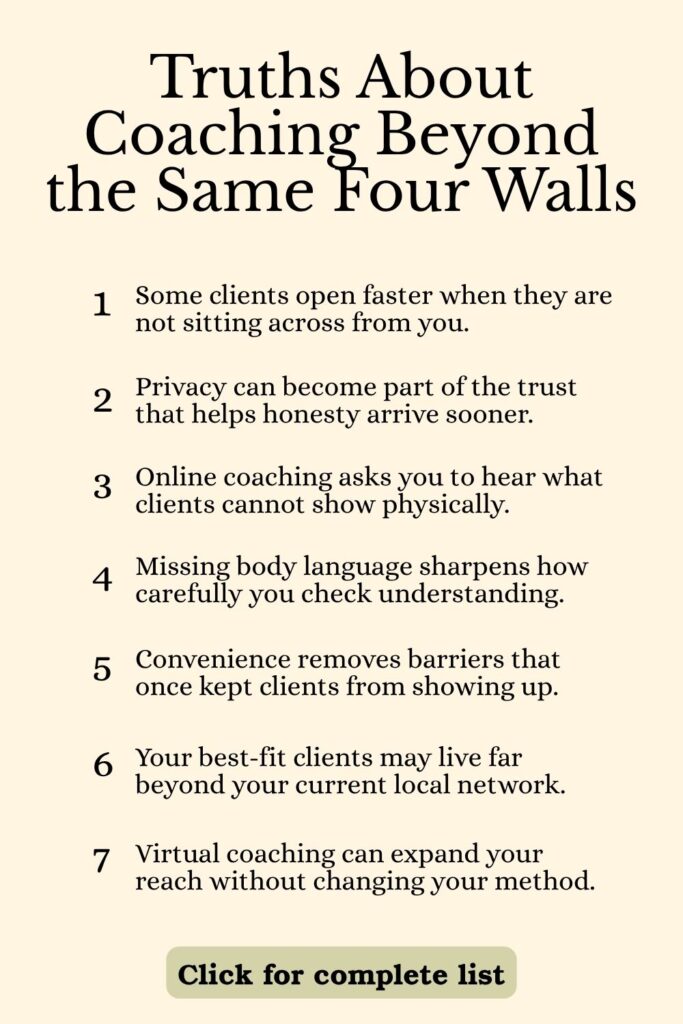
An online coaching agreement should explain how the relationship will work before sensitive information, money, or expectations become difficult to untangle.
The current ICF Code of Ethics, effective April 1, 2025, calls for coaches to establish agreements covering roles, responsibilities, confidentiality, financial arrangements, and other aspects of the engagement. It also addresses the handling of electronic records and a coach’s responsibilities when using technology systems.
For an online engagement, cover these points clearly:
- The client’s identity and reliable contact information
- The coaching format and session location
- Who is responsible for finding a private space
- Whether sessions may ever be recorded
- How confidential information and electronic records are handled
- What happens when technology fails
- The backup method for completing or rescheduling the session
- Session fees, coaching packages, billing, cancellation terms, and refunds
- Time-zone responsibility
- Communication boundaries between sessions
- Emergency procedures and referral boundaries
- The circumstances under which confidentiality may be limited
An LCH Core Welcome Package can bring the welcome letter, coaching agreement with electronic signature, forms, and first resources into one onboarding process.
That makes the agreement easier to deliver and retrieve. The coach still remains responsible for making sure the wording fits their services, location, clients, and professional obligations.
What Are the Main Practical Benefits of Online Coaching?
It seems to me that online coaching works well for everyone. It allows:
SEE ALSO: If you’re a coach looking to streamline your administrative tasks and save time, check out our Coaching Administration Software. It’s a simple, effective solution designed to help you focus less on paperwork and more on what matters—coaching your clients. From scheduling to client management, our software gives you the tools to run your business efficiently. Ready to reclaim your time and boost productivity? Click or tap here.
- Anonymity
- The safety of your own home
- Flexibility of scheduling (No need to go out)
- The opportunity to work with people from all over the world
- Convenience
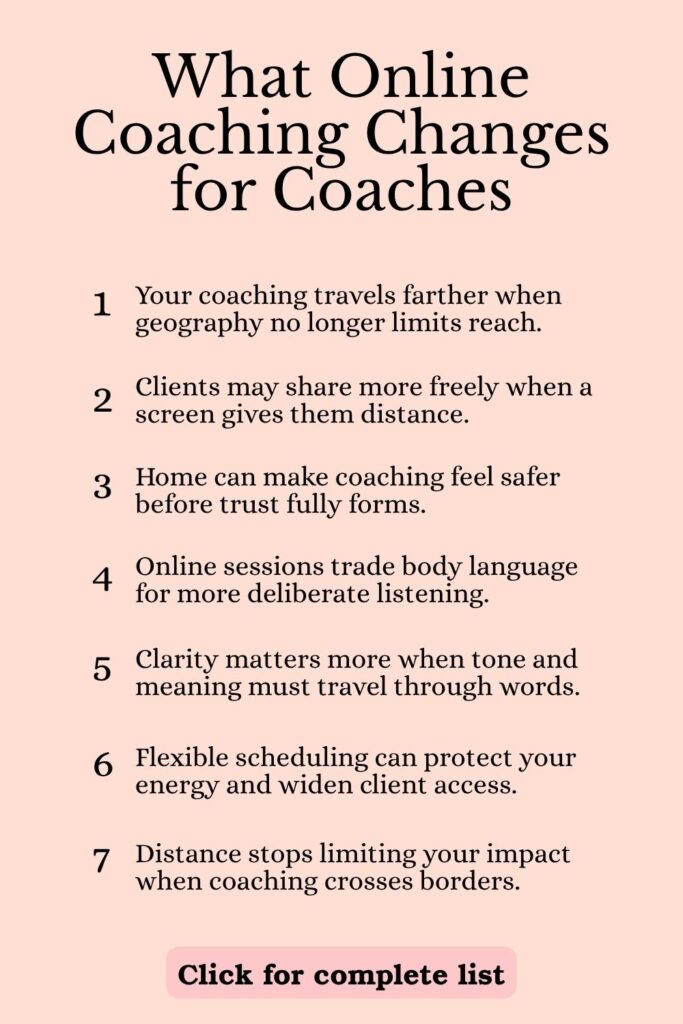
I have been able to work with people in Peru, Australia, China and the UK. None of that would have been possible without the online communities we are able to create.
How Do You Turn Online Access Into a Consistent Client Experience?
You turn online access into a consistent client experience by creating one clear path from first contact to measurable follow-through.
A workable online client path has seven stages:
- Be found
- Make booking simple
- Collect the right information
- Set expectations
- Deliver the coaching
- Support follow-through
- Review progress
Visibility begins where potential clients are already looking. A free life coach directory listing can give coaches another relevant place to be found, but discovery is only the first step.
The next step should be obvious. An LCH Core Public Booking Page can let an interested prospect choose an available time instead of starting a long email exchange.
Once they book, collect only the information you need to prepare. An intake form might ask what they want to change, why they are seeking coaching now, what they have already tried, and what a useful first conversation would produce.
SEE ALSO: If you’re a coach looking to streamline your administrative tasks and save time, check out our Coaching Administration Software. It’s a simple, effective solution designed to help you focus less on paperwork and more on what matters—coaching your clients. From scheduling to client management, our software gives you the tools to run your business efficiently. Ready to reclaim your time and boost productivity? Click or tap here.
Then set expectations through a Welcome Package. A welcome letter, coaching agreement with electronic signature, and focused forms give the client a clear starting point.
During the engagement, keep the work connected. Client profiles and notes protect context, while journals, worksheets, goals, resources, and action items give the client a practical next step between sessions.
The Progress Stream and Engagement Report can help you prepare for review conversations. You can look at what was assigned, where the client followed through, what repeatedly stalled, and what now needs attention.
LCH Core also keeps payments, coaching packages, and billing connected to the client journey. The client should know what they purchased, what it includes, and what happens when the package ends.
This turns online coaching from a series of video calls into a recognizable client process.
For a broader look at how visibility, nurturing, conversion, and retention connect, see how to build a coaching funnel.
SEE ALSO: If you’re a coach looking to streamline your administrative tasks and save time, check out our Coaching Administration Software. It’s a simple, effective solution designed to help you focus less on paperwork and more on what matters—coaching your clients. From scheduling to client management, our software gives you the tools to run your business efficiently. Ready to reclaim your time and boost productivity? Click or tap here.
Where LCH Core Fits
LCH Core fits where an online coaching business needs one connected process instead of a collection of unrelated documents and tools.
Before the first session, you can use the Public Booking Page, intake forms, payments, coaching packages, billing, and a Welcome Package to move a client from interest to a prepared first meeting.
During the relationship, client management keeps profiles and notes in one place. Coaching Tools such as journals, worksheets, goals, action items, and resources support the work between sessions.
The Progress Stream and Engagement Report give you a structured way to review participation and progress. That can make session preparation, progress reviews, and package-end conversations more specific.
Beyond one-to-one coaching, courses, lead magnets, and digital products can be delivered through the Public Store. These options let coaches package parts of their knowledge without forcing every offer into another private session.
The purpose is not to add more technology to the business. It is to make the path from booking to onboarding, coaching, follow-through, and review easier to see and manage.
SEE ALSO: If you’re a coach looking to streamline your administrative tasks and save time, check out our Coaching Administration Software. It’s a simple, effective solution designed to help you focus less on paperwork and more on what matters—coaching your clients. From scheduling to client management, our software gives you the tools to run your business efficiently. Ready to reclaim your time and boost productivity? Click or tap here.
For a detailed comparison framework, read what to look for when choosing coaching software.
Frequently Asked Questions About Online Coaching
Is Online Coaching as Effective as Face-to-Face Coaching?
Online coaching can be as effective as face-to-face coaching when the delivery format suits the client and the coaching goal.
Research on workplace coaching has found positive outcomes from both virtual and in-person delivery. A coach still needs to establish trust, maintain a clear agreement, listen carefully, and create meaningful follow-through.
Can Online Coaching Be Anonymous?
Online coaching can offer greater privacy, but most professional coaching relationships are not completely anonymous.
Payment processing, signed agreements, business records, and emergency planning may require identifying information. Coaches should explain exactly what information is collected and how it is handled.
Which Is Better for Online Coaching, Video or Telephone?
Video is useful when visual information supports the work, while telephone coaching can work well when the client thinks more freely without a camera.
SEE ALSO: If you’re a coach looking to streamline your administrative tasks and save time, check out our Coaching Administration Software. It’s a simple, effective solution designed to help you focus less on paperwork and more on what matters—coaching your clients. From scheduling to client management, our software gives you the tools to run your business efficiently. Ready to reclaim your time and boost productivity? Click or tap here.
The decision should be based on the client’s environment, access needs, internet reliability, and the purpose of the session.
How Do Online Coaches Read Body Language?
Online coaches read the cues available to them and check their interpretations directly.
On video, that may include facial expression, pace, gaze, posture, and pauses. On the telephone, it may include breathing, volume, rhythm, silence, and changes in tone.
What Should Be Included in an Online Coaching Agreement?
An online coaching agreement should cover roles, confidentiality, fees, scheduling, cancellation terms, technology failures, electronic records, communication boundaries, emergencies, and the limits of coaching.
Recording consent and international considerations may also need attention when clients and coaches are in different locations.

How Do Coaches Manage Clients in Different Time Zones?
Coaches manage different time zones by using one named booking time zone and confirming that their booking system displays the client’s local time correctly.
SEE ALSO: If you’re a coach looking to streamline your administrative tasks and save time, check out our Coaching Administration Software. It’s a simple, effective solution designed to help you focus less on paperwork and more on what matters—coaching your clients. From scheduling to client management, our software gives you the tools to run your business efficiently. Ready to reclaim your time and boost productivity? Click or tap here.
The agreement can also state who is responsible for checking time conversions. This prevents a missed session from becoming a dispute about which clock was correct.
How Do Online Coaches Find Clients?
Online coaches find clients by combining visibility with a clear next step.
A directory profile, relevant content, referrals, lead magnets, and professional networks can create awareness. A booking page, intake process, and specific coaching offer then give interested people a practical way to act.
What Tools Does an Online Coach Need?
An online coach needs tools for client management, intake, agreements, scheduling, payments, notes, follow-through, and progress review.
Courses, digital products, lead magnets, and a Public Store become relevant when the business expands beyond private coaching packages.
What Is Next for Online Coaching?
SEE ALSO: If you’re a coach looking to streamline your administrative tasks and save time, check out our Coaching Administration Software. It’s a simple, effective solution designed to help you focus less on paperwork and more on what matters—coaching your clients. From scheduling to client management, our software gives you the tools to run your business efficiently. Ready to reclaim your time and boost productivity? Click or tap here.
Sources
Cannon-Bowers, Janis A., et al. “Workplace Coaching: A Meta-Analysis and Recommendations for Advancing the Science of Coaching.” Frontiers in Psychology, vol. 14, 10 Oct. 2023, article 1204166. Frontiers, https://doi.org/10.3389/fpsyg.2023.1204166/.
International Coaching Federation. “ICF Code of Ethics.” International Coaching Federation, effective 1 Apr. 2025, https://coachingfederation.org/credentialing/coaching-ethics/icf-code-of-ethics/.
Suler, John. “The Online Disinhibition Effect.” CyberPsychology & Behavior, vol. 7, no. 3, June 2004, pp. 321-326. PubMed, https://pubmed.ncbi.nlm.nih.gov/15257832/.
Read this next

How to Manage Client Expectations in Coaching
It’s important you and your client both know what you’ll provide BEFORE you start working together.
Read More
Starting a Coaching Business Checklist – Your Ultimate Guide as a Life Coach
Set up your coaching business the right way, the first time. Use this ultimate guide to gear you towards success.
Read More
7 Best Coaching Business Models Proven To Boost Your Success
Adopt a profitable coaching business model today and let your company thrive!
Read More