




The Truth About Building A Coaching Business

Think you know how to build an amazingly successful coaching business? Here’s the TRUTH about building a coaching business.
What Does It Really Take to Build a Coaching Business?
So many coaches believe creating a coaching business is the easiest thing to do only to wake up one day and think that they have failed. Running a business requires not only determination but also the willingness to change.
A coaching business is like any other business. It requires you to do the following:
- Buy products and services
- Sell your own services
- Finance your business
- Manage the day to daily tasks of your business
- Manage your own finances
- Asking for payment and so forth
If you think you could just sit in hotel lobbies, sip coffee and get paid to talk to somebody then think again.
This may be the ultimate dream, but for many coaches this is not happening.
Heck, I was one of them when I started. I thought this is going to be a walk in the park. All I need to do is sit down and have a chat with somebody and make a few hundred quid an hour. Yay me, I thought.
SEE ALSO: If you’re a coach looking to streamline your administrative tasks and save time, check out our Coaching Administration Software. It’s a simple, effective solution designed to help you focus less on paperwork and more on what matters—coaching your clients. From scheduling to client management, our software gives you the tools to run your business efficiently. Ready to reclaim your time and boost productivity? Click or tap here.
Boy, was I wrong. My coach trainer made it look so easy and simple. All I wanted to do was to get away from my day job. No longer working for the man. No longer working in sales and getting paid a fortune.
Here is my story of how I made my coaching business a success, and the concrete lessons you can apply to your own coaching business.
My story….
Key Takeaways
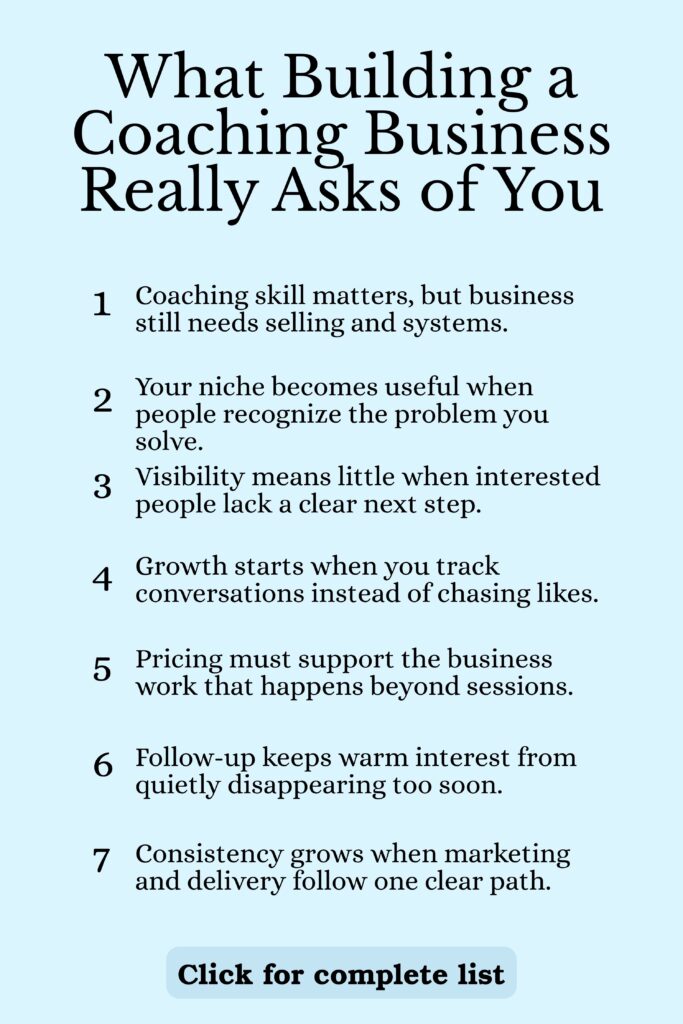
- A coaching business needs a client-getting system, not just coaching skill. A clear niche, visible offer, direct conversations, follow-up, delivery, and referrals work together to create revenue.
- Track the stages between attention and payment. Outreach volume means little unless you know how many prospects reply, book, show up, and become paying clients.
- Your niche needs an offer attached to it. Knowing whom you help is only useful when prospects can quickly understand the problem you solve, the outcome you work toward, and how they can work with you.
- Online and offline marketing should feed the same path. Networking, LinkedIn, workshops, webinars, articles, and directory visibility work better when each gives an interested person a clear next step.
- Pricing has to support the whole business, not just the coaching hour. Your fees must account for client delivery, preparation, administration, marketing, operating costs, and the realistic number of clients you can serve.
How Do You Build a Successful Coaching Business?
You build a successful coaching business by combining strong coaching with a repeatable business system. You need to know whom you help, what problem you solve, how people discover you, what happens when they show interest, how they become paying clients, and how you continue delivering enough value for the relationship to last.
That means client acquisition cannot be reduced to posting on social media or waiting for referrals. A workable system moves people from visibility to conversation to a clear offer, then gives you a process for follow-up, payment, onboarding, delivery, retention, and referrals.
The exact marketing channels can change. The underlying job does not. You have to create enough opportunities for the right people to discover you, give them a sensible next step, and track what happens until you know where your business is actually winning or losing clients.
SEE ALSO: If you’re a coach looking to streamline your administrative tasks and save time, check out our Coaching Administration Software. It’s a simple, effective solution designed to help you focus less on paperwork and more on what matters—coaching your clients. From scheduling to client management, our software gives you the tools to run your business efficiently. Ready to reclaim your time and boost productivity? Click or tap here.
How Do You Figure Out What Kind of Coach You Should Be?
First, I figured out quite quickly that the coaching I wanted to do was not for me at all. In the beginning I wanted to be a life coach, using spirituality and the law of attraction to make this work. When I started my coaching diploma, I thought I had it all figured out. But I realised quite quickly that this was not for me. On a different note, I have started coaching a few businesses along the way (it was all part of the training to become a coach, some pro-bono work).
Then I finally found my passion.
- It was something I’ve done my entire life. Sales and customer service coaching.
- Combined with consulting people on their business I realised that getting away from the one thing that I wanted to leave behind (selling) was the one thing that I could talk about with people for hours.
- The one thing I was really good at.
- So, my previous hatred for sales (that built up over time working for different companies) became my passion…
…But this still didn’t bring in the money that I wanted to make nor did it bring in the customers.
How Do Coaches Actually Make Money?
It was because of this that I started researching how other “successful coaches” built their business and what I found not only startled me, but it flabbergasted me completely.
Everything they teach of how they became successful was a complete and utter lie. Some of them didn’t even make the money that they promised you could make within a few months.
I mean seriously now, have you ever wondered how it is possible that a lot of coaches make six or seven figure incomes when you have coached for years and barely make a living? Is it really that simple to make a few hundred grand a year by coaching just a few clients, working ten hours a week and sipping Margarita’s in Tahiti the rest of the time?
SEE ALSO: If you’re a coach looking to streamline your administrative tasks and save time, check out our Coaching Administration Software. It’s a simple, effective solution designed to help you focus less on paperwork and more on what matters—coaching your clients. From scheduling to client management, our software gives you the tools to run your business efficiently. Ready to reclaim your time and boost productivity? Click or tap here.
Unfortunately, I have to blow the bubble here. For approximately ninety percent of all coaches, this is not the case. And somebody telling you that you can easily make 50 or 100K a month is simply not going to happen, at least not for most of us.
Now having said that, I don’t doubt that there are coaches out there who actually make this kind of money or have a super duper lifestyle. But today, I would like to keep it a bit real and tell you how you can make realistically 5 – 10K per month by simply working hard.
Now, if you think this post will open up doors for you and show you the secret of how to earn money the easy way, then please stop reading right now. This post is not for you. Please go visit some of the other places who promise you hundreds of thousands of dollars within a three months period all done through Facebook. I’m certainly not one of them.
However if you are willing to work hard, put the time in to make your business a success, and grow it in a reasonable fashion, then please do stay with me on this.
What Has Changed in the Coaching Business Since Then?
The coaching market is much larger now, but a growing market does not remove the need to run coaching like a real business.
According to the International Coaching Federation’s 2025 Global Coaching Study, there were an estimated 122,974 coach practitioners worldwide, generating approximately $5.34 billion in annual revenue. The research was conducted by PricewaterhouseCoopers and drew on more than 10,000 participants across 127 countries.
SEE ALSO: If you’re a coach looking to streamline your administrative tasks and save time, check out our Coaching Administration Software. It’s a simple, effective solution designed to help you focus less on paperwork and more on what matters—coaching your clients. From scheduling to client management, our software gives you the tools to run your business efficiently. Ready to reclaim your time and boost productivity? Click or tap here.
There is another useful finding for coaches building a business today. Many practitioners no longer earn only from private coaching. ICF found that 60% also provide training, 57% consulting, 55% facilitation, and 49% mentoring.
That does not mean you should bolt five new services onto your business. It means the old picture of a coach selling nothing but isolated hourly conversations is no longer the only model.
A career coach, for example, might keep one-to-one coaching as the core service but add a workshop for job seekers. A leadership coach might combine coaching with team training. A productivity coach might eventually turn a repeated process into a course or digital resource.
The fundamentals are still remarkably familiar. You need a defined market, something useful to sell, a way to reach people, a way to start conversations, and a business model that can support the amount of work you want to do.
The rules around outreach have also become more important. Cold calling, email marketing, and other direct marketing are regulated differently depending on the country, the type of prospect, and the communication method. A business-to-business call is not automatically unrestricted simply because you are calling a company. Check the rules that apply where you and your prospects are located.
What Did My First Year in Business Teach Me?
Before I get into the nitty gritty details of how you can accomplish building a solid business that will help you do the one thing you love the most (hopefully that will be coaching), I would like to tell you a bit about me and my business.
SEE ALSO: If you’re a coach looking to streamline your administrative tasks and save time, check out our Coaching Administration Software. It’s a simple, effective solution designed to help you focus less on paperwork and more on what matters—coaching your clients. From scheduling to client management, our software gives you the tools to run your business efficiently. Ready to reclaim your time and boost productivity? Click or tap here.
I started Coach-Clinic in 2013 out of the need that I saw here in Ireland, helping people to grow sales revenue and a much needed upgrade on customer service levels. My first year in business was pretty much a disaster. I made approx. 2,500€ (around $3000). Now, it wasn’t a failure as I did learn some very big lessons.
- Nobody was jumping out of their seats when they heard that I had the solution to help grow sales revenue.
- Nobody will come to your office or call you based on a few posts you do on Facebook, your website or any other online tool you may use.
Now, I have to clarify here. I didn’t have the money to put thousands or even hundreds of dollars into marketing and advertising my business. In fact, I had a 100 Euro budget per month (approx. $120) to get started and I set this budget for six months. So, my first business deed I did was to get 250 business cards printed for approx. 40€ ($50). When they arrived, yay me, I was in business. But more on that a bit later.
My first year in business was pretty much planning and organising things around. I build my own website (not everybodys’ preference but if you have no money to invest in a nice highly paid outsourced website designed by the worlds best web designers, then you have to do it DIY).
I started up a Facebook page, Twitter page and updated my LinkedIn profile. I went for my first training on how to use those online tools (sponsored by the local Enterprise board) and I started blogging.
So, most of my time was spend designing, redesigning, writing, rewriting, posting, re-posting and tweeting. And after months of doing all of that consistently, I noticed that I didn’t get one client out of it. Not one.
Now, some people might say, yeah, because you didn’t advertise properly and invest money in advertisement. And you are right, I didn’t… I invested my time, sweat and mind into building up the business… well building it to nothing really.
SEE ALSO: If you’re a coach looking to streamline your administrative tasks and save time, check out our Coaching Administration Software. It’s a simple, effective solution designed to help you focus less on paperwork and more on what matters—coaching your clients. From scheduling to client management, our software gives you the tools to run your business efficiently. Ready to reclaim your time and boost productivity? Click or tap here.
Why Did Creating a Coaching Business Plan Change Things?
Then it dawned on me. The one thing I haven’t been doing was actually going out and meeting some potential customers. That’s when things started to change for me.
I have to say, it didn’t change immediately. I still took my time to plan certain things.
One of the main things I did (which I hadn’t done before) was to finally create a business plan.
This plan helped me to not only get organised but to understand my business, create my vision and help me find my ideal clients. A focused target market was something that I needed. And finally after nearly one year of hard work (of making no money whatsoever…) I got my first client.
What Changed in My Second Year and Helped Me Reach €10K?
My second year in business started well. I had clients and I could finally prove that what I have is actually working. I’ve sold my services cheaply. Very cheaply. If anybody thinks that I made tens of thousands in my second year, well, let me tell you it was close to 10K. But from the first year, I’ve nearly quadrupled my sales revenue, so yay me. I worked hard for that 10,000€ ($11200) and many people told me it’s not worth it.
For me, it was. It was the best feeling in the world, finally making some sort of money. And everything I did was now working for me. My first fifteen clients all made their money with the service I provided. Many of them doubled their sales revenue with some even tripling it. However, I also had failures. Some didn’t take the consultation advice on board and all it did for them was wasted money, as well as their time and mine.
SEE ALSO: If you’re a coach looking to streamline your administrative tasks and save time, check out our Coaching Administration Software. It’s a simple, effective solution designed to help you focus less on paperwork and more on what matters—coaching your clients. From scheduling to client management, our software gives you the tools to run your business efficiently. Ready to reclaim your time and boost productivity? Click or tap here.
What I do is not for everybody and it certainly is not for the faint hearted. But even those failures helped me to define my target market even further. I knew now that there are some businesses that cannot be helped, at least not by me.
What Helped Me Break the €50K Mark?
Everything changed again in 2015 when I finally broke the 50K mark in revenue. We finished the year with 58,000€ ($65,000). This year all our clients except one doubled or tripled their sales (a total of ten clients in 2015), and we continue on this success as we grow the business.
The one client who didn’t double sales revenue made roughly forty percent more than in his previous year. The reason? He took his sweet time implementing some of the ideas that we talked about. However, he became the highest ranking sales agent of his company and that came with some nice benefits (achieving lifetime membership of the MDRT three months before his usual qualification – Million Dollar Round Table, which is in recognition for only the best insurance people).
How Did the Business Start Filling Its Client Spots?
Now, January of 2016, we’ve made 85,000 Euros simply because of the previous two years of hard work. Because word was now spreading that we actually helped our previous clients to grow their sales immensely, and we put a little bit of marketing out there to promote our exclusive “Double your sales within twelve months” programme, we opened up the first quarter for 2016 for only ten clients.
We filled all spots by the third week in January. Our next opening will be beginning of April and I reckon that it will fill up soon as well. We only take a maximum of ten clients on per quarter. Having said that, it might not happen, but at least we have nearly achieved our original target which was to double last year’s revenue.
How Did I Actually Start Getting Paying Clients?
The big question is, how did I get to the point to actually making money and making a living for my family?
SEE ALSO: If you’re a coach looking to streamline your administrative tasks and save time, check out our Coaching Administration Software. It’s a simple, effective solution designed to help you focus less on paperwork and more on what matters—coaching your clients. From scheduling to client management, our software gives you the tools to run your business efficiently. Ready to reclaim your time and boost productivity? Click or tap here.
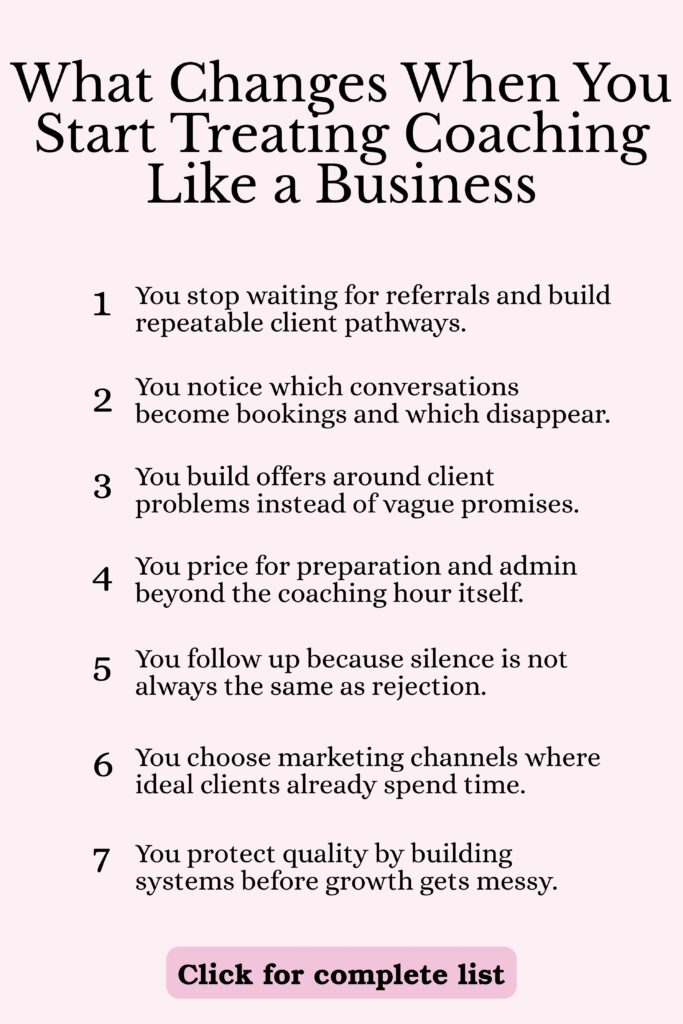
It’s hard work. Selling services, taking every opportunity to put myself out there. Here is a short list of things I have done:
- I created a letter marketing campaign (I listed a hundred companies that I wanted to work with and sent them a letter, customised to their needs).
- After sending a physical letter I followed up with a phone call, simply asking if the letter was received and started a conversation.
- I offered a free customised consultation report to show what I could bring to the table, how I understood their business and what could be done to grow sales and improve their service.
- I also offered free workshops and invited people that I knew and asked them to bring a friend.
- My next meeting was then combined with a free consultation, going through my report which took me nearly two days to complete per client. Combined with an offer to work with me.
- The signing up of the client was the next step.
After I did all of the above, I signed up my first few clients. Out of the hundred companies that I had contacted by post first and followed up after, thirty-eight agreed to a meeting and thirty-two meetings actually happened. I signed up fifteen clients through my approach.
What Do These Numbers Reveal About the Client-Getting Funnel?
The 100-company campaign shows that client acquisition is a series of conversion points, not one mysterious act called “marketing.”
The numbers were:
100 companies contacted.
38 agreed to a meeting.
32 meetings actually happened.
15 became clients.
That gives us something much more useful than “the campaign worked.”
SEE ALSO: If you’re a coach looking to streamline your administrative tasks and save time, check out our Coaching Administration Software. It’s a simple, effective solution designed to help you focus less on paperwork and more on what matters—coaching your clients. From scheduling to client management, our software gives you the tools to run your business efficiently. Ready to reclaim your time and boost productivity? Click or tap here.
About 38% of the original prospects agreed to meet. Roughly 84% of those agreed meetings actually happened. About 47% of the completed meetings became clients. Overall, 15% of the original 100 companies became clients.
Now imagine the numbers had looked different.
If 100 companies produced only three conversations, the first problem would probably be the list, message, offer, or outreach method. There would be little reason to spend weeks improving a closing script when hardly anyone was reaching the meeting.
If 40 people agreed to meetings but only 12 showed up, the problem would sit further down the path. Confirmation, scheduling friction, qualification, or follow-up would deserve attention.
If 30 qualified meetings took place but nobody bought, then the sales conversation, offer, proof, positioning, or price would become the obvious place to investigate.
This is why tracking your funnel changes how you make decisions. Instead of saying, “I need more clients,” you can say, “I need more qualified conversations,” or “I am getting conversations but not converting enough of them.”
SEE ALSO: If you’re a coach looking to streamline your administrative tasks and save time, check out our Coaching Administration Software. It’s a simple, effective solution designed to help you focus less on paperwork and more on what matters—coaching your clients. From scheduling to client management, our software gives you the tools to run your business efficiently. Ready to reclaim your time and boost productivity? Click or tap here.
The same principle applies whether your prospects come from networking, referrals, social media, a workshop, a lead magnet, or a website. For a deeper breakdown of that journey, How to Master Funnels as a Coach (and Why You Need To) walks through the stages from attracting leads through nurturing and conversion.
A simple CRM can also stop the numbers disappearing into notebooks and inboxes. Client management inside LCH Core gives you client profiles, notes, and intake forms, while the Public Booking Page gives interested prospects a defined way to move from “maybe” to an actual conversation.
The tool is not the funnel. The sequence is the funnel. The tool simply makes the sequence easier to run consistently.
Which Parts of the Business Should You Handle Yourself?
Now the big hurdle came. Once they signed up, I had to invoice them, asking for money. This was the one thing I always dragged out because I wasn’t really good at it, so I got my wife and now business partner to look after payments. She’s a tough cookie, exactly the person I needed to help in the business.
If somebody doesn’t or didn’t pay on the day the programme started, then I simply wouldn’t return until payment was received and the wife cleared it. I know what some of you may think. Why wouldn’t he ask for payment? You need to understand, that we all have strengths and weaknesses.
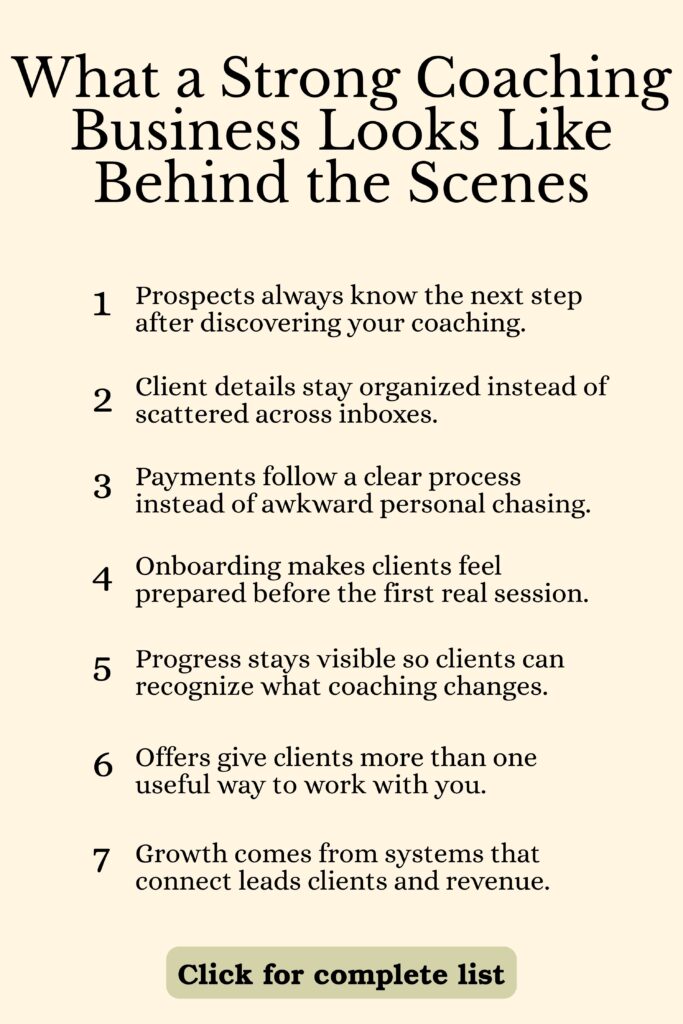
Giving is something I love to do, but asking people for money or payment is something I always hated. In fact I still don’t like it even after being in business now for over three years. I’m lucky to have a partner who is confident enough in dealing with this crucial business issue.
SEE ALSO: If you’re a coach looking to streamline your administrative tasks and save time, check out our Coaching Administration Software. It’s a simple, effective solution designed to help you focus less on paperwork and more on what matters—coaching your clients. From scheduling to client management, our software gives you the tools to run your business efficiently. Ready to reclaim your time and boost productivity? Click or tap here.
I did get better though, I do ask people nowadays for payment and have no hesitation to tell them that there is no service from my side if payment is not received. But it just shows that if you don’t ask for payment you will always be taken advantage of. It happened to me once and even though we do offer customers to pay monthly it is important to keep on top of it. If I am constantly distracted and would need to worry about getting paid, then my service, the work I do would not be as focused and in the end not only me but my clients would suffer. This, I cannot allow to happen as my clients pay money to receive my full attention.
Another thing I did was join a local networking group and the chamber of commerce. This helped really turn things around for me as I now received referrals, went to networking events and it all started to get a lot easier to make connections.
How Can You Apply These Lessons to Your Coaching Business?
So, the big question is what do you need to make your business work?
1. Who Is Your Coaching Actually For?
Don’t think that your service is for everyone. You may say, I’m a life coach and everybody can benefit from this service; however, let me assure you that this is not the case. If you drill down into your life coaching skills, you will find the issues you enjoy solving the most with your clients are the ones you can help with the most. This is your target market. Defining your target market is probably one of the biggest steps in getting your business up and running.
To give you an example, a client of mine is solely focusing on helping people de-clutter their homes. Now, she isn’t going in and physically removing bags of trash or organising the closet, all she does is coach people and finding ways of how to organise their private homes. She is brilliant at that and made it her core business. She is still doing other life coaching parts here and there but mainly her clients come to her when something in their home or business is building up or needs organising.
So, how much money is in this? Well, I can tell you that she is living her dream, making a living and still has free time on her hands. She serves approximately five clients a week for around $150 per client. And no, she would not even go near trying to sell this as a high ticket item. Her fees are reasonable and her business is growing.
SEE ALSO: If you’re a coach looking to streamline your administrative tasks and save time, check out our Coaching Administration Software. It’s a simple, effective solution designed to help you focus less on paperwork and more on what matters—coaching your clients. From scheduling to client management, our software gives you the tools to run your business efficiently. Ready to reclaim your time and boost productivity? Click or tap here.
Is she rich yet or does she even plan to get rich? No, she wants to make a good living for her and her children. She still works for approximately thirty– forty hours per week. She is only coaching for five to seven hours per week but her business requires her to put as much attention in it as any other business. If she would just sit back and relax, the business would decline. She is constantly promoting her business and being out there networking.
For roughly earning $800 per week. That’s commitment.
The thing is, when she came to me, she barely made $100 a week. Her fees were far too low, and had barely any clients to show for it. And one of the reasons was that she didn’t go after the right target market. She believed (like many other coaches) she could help anybody with their life problems.
Once she realised what she really liked to do was getting people organised in their homes and business, she started getting more and more into the habit of talking about her business and how it could solve a simple problem. Now she has a business that makes decent money and she is ready to grow further.
How Do You Turn a Target Market Into an Offer People Understand?
A target market becomes commercially useful when you connect who you help to a recognizable problem, a useful outcome, and a clear way to work with you.
Use this simple sequence:
SEE ALSO: If you’re a coach looking to streamline your administrative tasks and save time, check out our Coaching Administration Software. It’s a simple, effective solution designed to help you focus less on paperwork and more on what matters—coaching your clients. From scheduling to client management, our software gives you the tools to run your business efficiently. Ready to reclaim your time and boost productivity? Click or tap here.
Person → Problem → Outcome → Offer
Take the decluttering coach example.
“I’m a life coach” tells the prospect almost nothing.
“I help busy people who feel buried by household clutter” identifies a person and a problem.
“I help them create practical systems so their home becomes easier to manage” starts defining the outcome.
A structured coaching package then turns that promise into something a prospect can actually understand and buy.
SEE ALSO: If you’re a coach looking to streamline your administrative tasks and save time, check out our Coaching Administration Software. It’s a simple, effective solution designed to help you focus less on paperwork and more on what matters—coaching your clients. From scheduling to client management, our software gives you the tools to run your business efficiently. Ready to reclaim your time and boost productivity? Click or tap here.
The same applies to business coaching. “I do sales coaching” is broad. “I help small sales teams improve the conversations that are costing them deals” gives the buyer something concrete to recognize.
You do not need to promise a dramatic result you cannot control. You do need to make the work legible.
A useful test is whether somebody outside the coaching industry could explain your offer after hearing it once. If they can only repeat, “She helps people transform,” your positioning is probably still too vague.
Once the offer is clear, the operational side becomes easier too. Coaching packages inside LCH Core can give a defined coaching offer a structure for payments and delivery, rather than leaving every prospect to negotiate a different arrangement.
If your offer is still fuzzy, Coaching business plans: A quick template can help you connect the target market, services, marketing, and financial side of the business before you start promoting harder.
2. Where Do Your Ideal Coaching Clients Already Spend Time?
The next step is to look where your clients hang out.
SEE ALSO: If you’re a coach looking to streamline your administrative tasks and save time, check out our Coaching Administration Software. It’s a simple, effective solution designed to help you focus less on paperwork and more on what matters—coaching your clients. From scheduling to client management, our software gives you the tools to run your business efficiently. Ready to reclaim your time and boost productivity? Click or tap here.
If you target businesses, I can only recommend that you join your local or regional chamber of commerce, a local networking group such as BNI (Business Network International) – it doesn’t have to be BNI, I only mention them here as they are known and recognised worldwide.
There are plenty of other local groups which offer networking and business support opportunities.
Research it, and just a tip: Most groups allow you to visit once or twice for free, so make sure you have a good connection with a group and find out as much as possible about them. If you visit three or four groups before making a decision, you will benefit even further as you could simply connect with those people again as they become your (first) prospects.
3. Can LinkedIn Actually Bring You Coaching Clients?
If you think you will find great prospects on LinkedIn, then think again. It will take a long time to build relationships but that is ultimately what you need to do with LinkedIn. Keep building relationships.
If you have the money and time to wait for clients to come out of your LinkedIn connections, then great; however, if you want to make it faster, then going to live networking events. Joining a networking group and talking to people will make your business grow faster than you could ever achieve with any online tool.
Don’t get me wrong, I’m not saying that there aren’t professionals out there who can make LinkedIn or any other online tool work for them. It never worked for me and no matter what those experts are telling you, it’s not as easy as they make it look.
SEE ALSO: If you’re a coach looking to streamline your administrative tasks and save time, check out our Coaching Administration Software. It’s a simple, effective solution designed to help you focus less on paperwork and more on what matters—coaching your clients. From scheduling to client management, our software gives you the tools to run your business efficiently. Ready to reclaim your time and boost productivity? Click or tap here.
It requires a lot of time and energy and in the end it is all about building relationships. With any relationship, it takes time to build, especially if you don’t meet them in person and only communicate through messages and mails.
Personally I believe it is important to do both. You need to have a healthy online and offline approach to your business and if you are consistent, then something positive will come out of it eventually.
4. Can Free Workshops Help You Win Coaching Clients?
If your target market is consumers (or private individuals) you could create a small free workshop and start inviting people that you know and ask them to bring a guest along as well.
It’s important to make it clear what they will gain from your workshop. Always include an offer towards the end of working with you. The workshop is there to help you sell your services, make the most of it.
5. How Should Coaches Use Social Media to Attract Clients?
Using Facebook and Twitter is also a good approach for reaching potential customers. However, as with LinkedIn, don’t just solely rely on the online tools. Make sure you have a healthy balance of offline and online activity (can’t really say it enough).
6. Can Webinars Turn Interest Into Coaching Clients?
​Although this is a new tool for me in my business, I do believe that webinars are a great way to promote any coaching and consultation business out there.
SEE ALSO: If you’re a coach looking to streamline your administrative tasks and save time, check out our Coaching Administration Software. It’s a simple, effective solution designed to help you focus less on paperwork and more on what matters—coaching your clients. From scheduling to client management, our software gives you the tools to run your business efficiently. Ready to reclaim your time and boost productivity? Click or tap here.
The one thing I would urge you to do is to have a clearly defined offering in your webinars. No matter if they are free or paid. Always have something to sell at the end. This could be an additional service, a product or book or simply a (free?) consultation.
How Should Online and Offline Client Getting Work Together?
Online and offline marketing work best when they feed the same client path instead of behaving like separate businesses.
A simple path is:
Visibility → Capture → Conversation → Offer → Follow-Up
Visibility is wherever the right people first encounter you. That could be LinkedIn, a networking group, an industry event, a workshop, your website, a guest interview, a referral, or a free life coach directory listing.
The next question is more important: What can that person do now?
SEE ALSO: If you’re a coach looking to streamline your administrative tasks and save time, check out our Coaching Administration Software. It’s a simple, effective solution designed to help you focus less on paperwork and more on what matters—coaching your clients. From scheduling to client management, our software gives you the tools to run your business efficiently. Ready to reclaim your time and boost productivity? Click or tap here.
Consider a career coach who gives a free workshop on changing careers after 40. If the workshop ends with “follow me on Instagram,” the coach has created visibility but a weak next step.
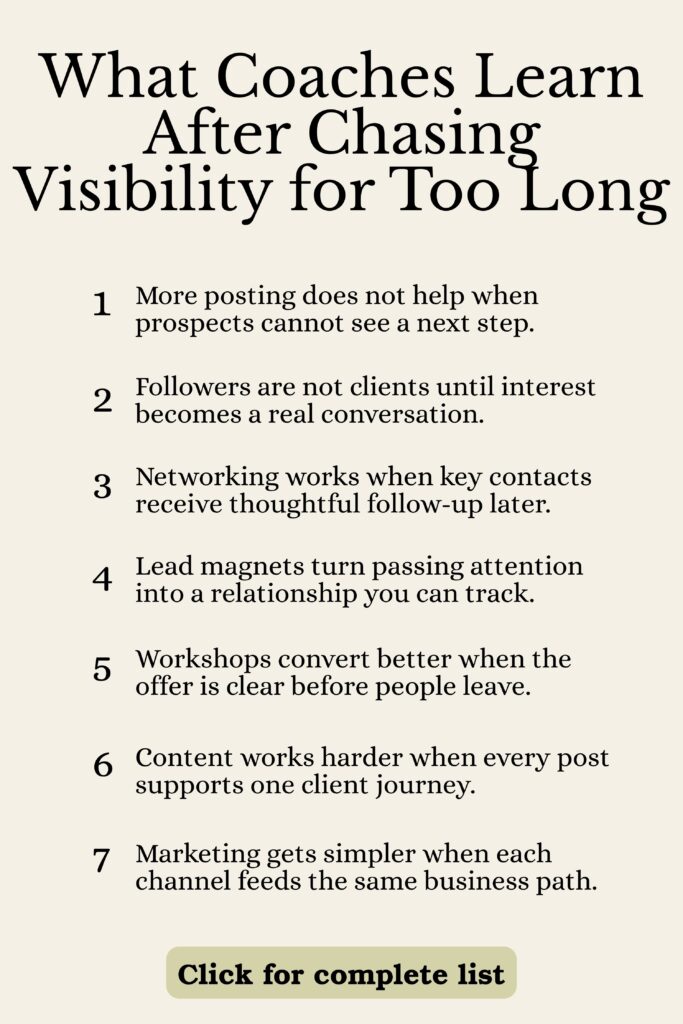
Instead, attendees could download a useful career-change worksheet, then receive an invitation to book a consultation. The worksheet captures the interest. The consultation creates the conversation. The coaching package gives the conversation somewhere to go.
The same thing can happen offline.
Imagine a business coach meets an HR director at a chamber event. The objective does not have to be closing a coaching contract over coffee. A better next step could be sending a short resource related to the problem they discussed and inviting the director to book a follow-up conversation.
That is where lead magnets and a Public Booking Page can become useful. One gives interested people a low-commitment next step. The other makes it easy to turn stronger interest into a booked conversation. If you use LCH Core for this, the LCH support center is the safest place to check current setup guidance for these features.
The channel matters less than the path.
SEE ALSO: If you’re a coach looking to streamline your administrative tasks and save time, check out our Coaching Administration Software. It’s a simple, effective solution designed to help you focus less on paperwork and more on what matters—coaching your clients. From scheduling to client management, our software gives you the tools to run your business efficiently. Ready to reclaim your time and boost productivity? Click or tap here.
Posting five times a week without a next step is activity. Attending six networking events without following up is activity. A client-getting system connects the activity to something measurable.
How Do You Reach Out to Business Coaching Prospects?
1. What Should a Coaching Outreach Letter Say?
Going back to a b2b approach, the next step is to create a letter (physical letter) that you send out by post. Make the letter simple and make sure you stand out. A sales letter should have several aspects included:
- A personalised greeting (Dear John, Hello Mr. Smith etc.)
- A subject line that promotes curiosity (e. g. There is nothing of interest in this letter/ Don’t read if you have no interest in x.) Make it compelling.
- An introduction and core message. The first two lines of your letter are the most important ones. Make sure that your core message is within the first two sentences (or lines) of your letter. (e. g. My name is Jane and I’m a specialist in providing x services.)
- The middle part is there to keep the reader interested: “I could go on and on about how my service will change your business or life around. However I don’t believe this is exactly what you would like to hear. Therefore I have decided to include a few testimonials of my previous/ current clients to show you exactly the outcome that they have achieved.”
- Add testimonials (one or two is more than enough).
- Closing: “I would like to arrange a ten min meeting with you in order to understand you and your business better and to see if we are a good fit for each other.”
- Call to action (inactive and pro-active): “If you are eager to learn more, please feel free to contact me on number 123-4567-89 (inactive call to action). However I understand that you may not have the time to get back to me, therefore I will contact you in a few days to arrange a meeting. (Pro-active call to action).”
Now, every business is different and of course you probably need to change the above sample to your business needs. One thing you could do is to even go into a bit more detail if you wish, but make sure you talk about your client’s business, not yours.
It is vital for your success to follow up on your promise and call within a certain time frame. (three to five days for physical letters, one to two days for email).
2. How Do You Turn Outreach Into a First Meeting?
Now arrange a meeting. You will hear “No” a lot, but equally if you continue with your letter marketing and follow up calls, you should hear plenty of “Yes” as well.
This will get you the meeting with a potential business customer. It is not guaranteed to sell your products or services yet. It’s an easy in. And it’s even easier if you are a member of a local (or regional) chamber of commerce and simply use this letter to introduce yourself to other members. The success rate will be even higher of meetings booked.
SEE ALSO: If you’re a coach looking to streamline your administrative tasks and save time, check out our Coaching Administration Software. It’s a simple, effective solution designed to help you focus less on paperwork and more on what matters—coaching your clients. From scheduling to client management, our software gives you the tools to run your business efficiently. Ready to reclaim your time and boost productivity? Click or tap here.
3. How Do You Turn the Meeting Into a Coaching Client?
Then there is the final step. How to sign up your next client. This is probably the most difficult part as many people believe that pushing for a sale is simply wrong. I wrote about how “Selling Coaching is a must” previously. Have a look if you would like to learn more on how to close that deal.
What Happens When a Coaching Prospect Says “Not Yet”?
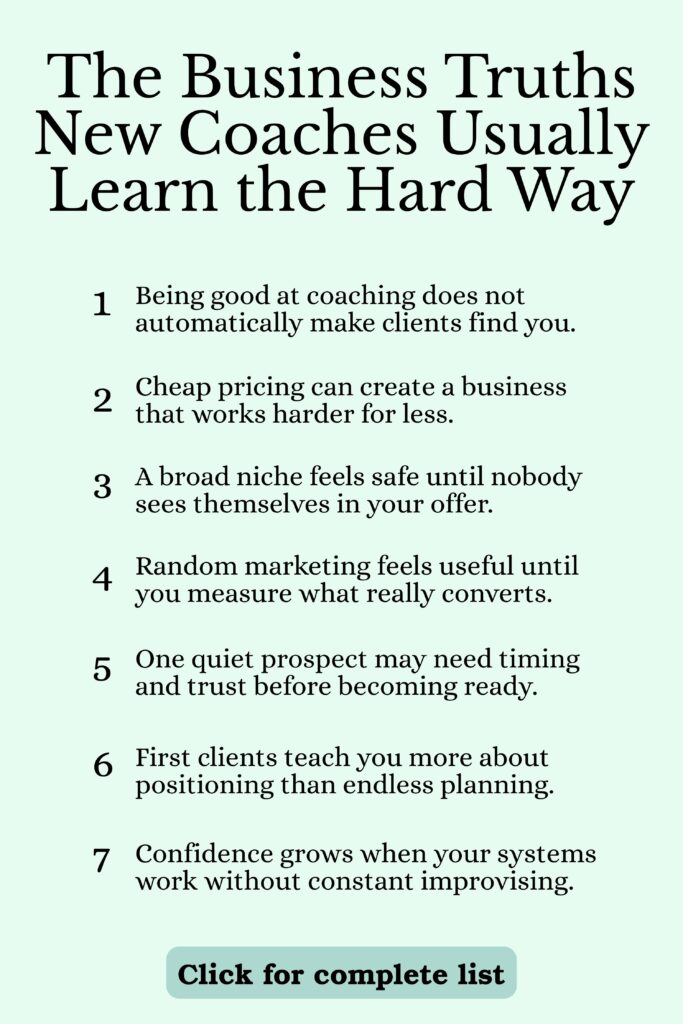
“Not yet” should usually trigger a follow-up process, not an immediate decision that the prospect is lost.
Some prospects know they want coaching but are comparing options. Some want help but cannot start this month. Some enjoyed the consultation and then got pulled into work, family, travel, or another priority.
Treat those situations differently from a clear no.
A practical follow-up sequence can be very simple. After the conversation, record what the person actually wanted help with and the next step you discussed. Send a short recap while the conversation is fresh. If they are not ready to buy, give them one useful way to stay connected.
For example, imagine a leadership coach speaks with a new manager who wants help handling difficult conversations but says she needs to wait until the next quarter.
SEE ALSO: If you’re a coach looking to streamline your administrative tasks and save time, check out our Coaching Administration Software. It’s a simple, effective solution designed to help you focus less on paperwork and more on what matters—coaching your clients. From scheduling to client management, our software gives you the tools to run your business efficiently. Ready to reclaim your time and boost productivity? Click or tap here.
The coach does not need to chase her every three days.
The coach can make a note of the timing, send the promised resource, and reconnect around the date they discussed with a message that refers to the actual problem: “You mentioned Q4 would be when you revisit support around those team conversations. Has that become more urgent, or has the situation changed?”
That is follow-up. It is specific, contextual, and connected to something the prospect already said.
The mistake is treating every contact as a brand-new stranger each time.
Client management with client profiles and notes can make this easier because the context stays attached to the person. A Public Booking Page can then give a returning prospect an easy way to resume the conversation without another chain of scheduling emails.
A person who is not ready today is not automatically a future client either. Follow up because there was genuine interest and a sensible reason to reconnect, not because every name in your database needs to be pursued forever.
SEE ALSO: If you’re a coach looking to streamline your administrative tasks and save time, check out our Coaching Administration Software. It’s a simple, effective solution designed to help you focus less on paperwork and more on what matters—coaching your clients. From scheduling to client management, our software gives you the tools to run your business efficiently. Ready to reclaim your time and boost productivity? Click or tap here.
Should Coaches Still Use Cold Calling?
Other tools you can use (if you feel comfortable with the phone) is to simply cold call or use a walk-in strategy.
Now, both are tough to do but if you exhaust all your other possibilities then this might just be another option for you. You need to be aware of local laws as cold calling is not allowed anymore in many countries.
There is a way around that by simply asking the other party if it is alright for you to talk to them for a minute or two. But again, please be careful as you don’t want to end up with a lawsuit because you are disturbing someone. Private consumers are definitely a no-go on cold calling and door calling.
However, in my opinion, going for business clients is fair game. They had to start somewhere as well and if you actually do the above mentioned letter campaign (or email campaign) then automatically your cold call becomes a (luke-)warm call. If you are nice, forthcoming and upfront with your audience, then you shouldn’t have a problem.
In this case you just follow up if they have received it, and this is allowed. A physical letter is better in this case as many people may see your email as spam if they don’t know you. Make sure your letter is personalised and addresses somebody within the organisation.
How Should Coaches Promote Themselves?
I have also mentioned in previous articles how important self-promotion is.
SEE ALSO: If you’re a coach looking to streamline your administrative tasks and save time, check out our Coaching Administration Software. It’s a simple, effective solution designed to help you focus less on paperwork and more on what matters—coaching your clients. From scheduling to client management, our software gives you the tools to run your business efficiently. Ready to reclaim your time and boost productivity? Click or tap here.
To keep it short, it is important for people to see who you are. The person behind a letter, a business card, an email. So, always include your picture and contact details in any promotional material that you use or send. Be it on your business card, flyers, brochures, sales and marketing letters and your email. People will remember your face rather than your name.
You can read about it in my 5 Tips to boost your sales.
How Should You Set Your Coaching Fees?
As a final note I would like to add a little bit on pricing. I won’t go into too much detail as I will be writing my next article of how to establish the correct price. There is a belief that when you start out your coaching business that you can only charge a low fee.
This is not true.
I have done it and it nearly broke my neck.
And it’s not true even though many coaches tend to only charge $25 or $50 an hour. It’s a good way to get started but within a few months you need to up your game and double or even triple the amount.
SEE ALSO: If you’re a coach looking to streamline your administrative tasks and save time, check out our Coaching Administration Software. It’s a simple, effective solution designed to help you focus less on paperwork and more on what matters—coaching your clients. From scheduling to client management, our software gives you the tools to run your business efficiently. Ready to reclaim your time and boost productivity? Click or tap here.
From experience I can tell you that most people will not appreciate anything you do for them if you don’t charge them properly. They will not see the results because they are not behind the concept.
Money is a funny trigger for people to actually invest the time afterwards to grow. Even though you may charge an hourly rate or have a package deal, selling it cheap will not help you nor will it help your client.
They will simply not engage with any programme.
Now, having said that, there is always exceptions to the rule. If you are targeting unemployed people to coach them for interviews, charging an arm and a leg might also not get you anywhere. But that shows, again, that defining your target market is very important as this can help you establish the correct price for your type of coaching.
What Does Your Coaching Price Actually Need to Cover?
Your coaching price needs to cover the business around the session as well as the time you spend face to face with the client.
An hour of coaching is rarely only an hour of work.
SEE ALSO: If you’re a coach looking to streamline your administrative tasks and save time, check out our Coaching Administration Software. It’s a simple, effective solution designed to help you focus less on paperwork and more on what matters—coaching your clients. From scheduling to client management, our software gives you the tools to run your business efficiently. Ready to reclaim your time and boost productivity? Click or tap here.
There may be preparation, notes, follow-up, client resources, scheduling, payment administration, marketing, sales conversations, bookkeeping, software, professional development, and the hours you spend running the business when nobody is paying you directly.
That is why starting with “What are other coaches charging per hour?” can give you the wrong number.
Start with capacity.
Suppose you want the business to gross $8,000 per month and you can realistically serve ten active private clients without damaging the quality of the work. On average, those client relationships need to generate $800 per month.
If your typical client receives four sessions a month, that works out to $200 per session before you adjust for how your packages are actually structured.
Now change the capacity.
SEE ALSO: If you’re a coach looking to streamline your administrative tasks and save time, check out our Coaching Administration Software. It’s a simple, effective solution designed to help you focus less on paperwork and more on what matters—coaching your clients. From scheduling to client management, our software gives you the tools to run your business efficiently. Ready to reclaim your time and boost productivity? Click or tap here.
If you can sustainably serve only six private clients because your work requires more preparation and between-session support, the economics change immediately. Selling the same $200 sessions would not produce the same business.
This does not tell you what you should charge. It tells you whether the numbers behind your current offer can support the business you are trying to build.
Your target market still matters. Your offer still matters. Your experience, positioning, demand, costs, scope of service, and local market still matter.
But the number needs to work from both directions: it has to make sense to the client and it has to make sense for the business.
That is also why coaching packages can be more useful than thinking exclusively in hourly rates. A package lets you price the full piece of work, including the structure and support around the sessions. How to set your life coaching fees goes further into the pricing question.
Payments, coaching packages, and billing inside LCH Core can handle the operational side once you have decided what the offer and price actually need to be. They cannot decide the economics for you.
SEE ALSO: If you’re a coach looking to streamline your administrative tasks and save time, check out our Coaching Administration Software. It’s a simple, effective solution designed to help you focus less on paperwork and more on what matters—coaching your clients. From scheduling to client management, our software gives you the tools to run your business efficiently. Ready to reclaim your time and boost productivity? Click or tap here.
Where LCH Core Fits
LCH Core fits after you have decided how your coaching business should work and need a cleaner system for running that process.
A coaching business typically moves through several different jobs. Someone discovers you. They show interest. They book. They become a client. You collect the information you need. You get paid. You coach them. You assign work between sessions. You track what is happening. Eventually they finish, renew, refer somebody, or move into another appropriate offer.
LCH Core can support those stages without changing the underlying business strategy.
For client acquisition, lead magnets can give prospects an initial reason to engage, while the Public Booking Page gives them a direct way to book. Client management can keep client profiles, notes, and intake forms together rather than spreading them across inboxes and documents.
Once somebody becomes a client, a Welcome Package can bring together the welcome letter, coaching agreement with electronic signature, and forms. Journals, worksheets, goals, action items, and resources can then support the actual coaching work between sessions.
The Progress Stream and Engagement Report are useful later in the relationship because they give you ways to review client activity and progress instead of relying entirely on memory from the last conversation.
SEE ALSO: If you’re a coach looking to streamline your administrative tasks and save time, check out our Coaching Administration Software. It’s a simple, effective solution designed to help you focus less on paperwork and more on what matters—coaching your clients. From scheduling to client management, our software gives you the tools to run your business efficiently. Ready to reclaim your time and boost productivity? Click or tap here.
If you eventually move beyond one-to-one work, courses and digital products can be sold through the Public Store. That is one way to add another delivery format without pretending every coach needs to become a course creator.
The useful distinction is strategy first, system second.
A Public Booking Page cannot rescue an unclear offer. A CRM cannot make weak outreach compelling. A Public Store cannot create demand by itself. But once you have a working client path, putting the moving pieces in one place can make that path much easier to manage.
For a broader comparison of what coaches actually need from a platform, see Best Coaching Software for Life Coaches: What to Look For Before You Choose. The LCH support center is also the place to check current setup guidance when you are using individual features.
Frequently Asked Questions About Building a Coaching Business
How long does it take to build a profitable coaching business?
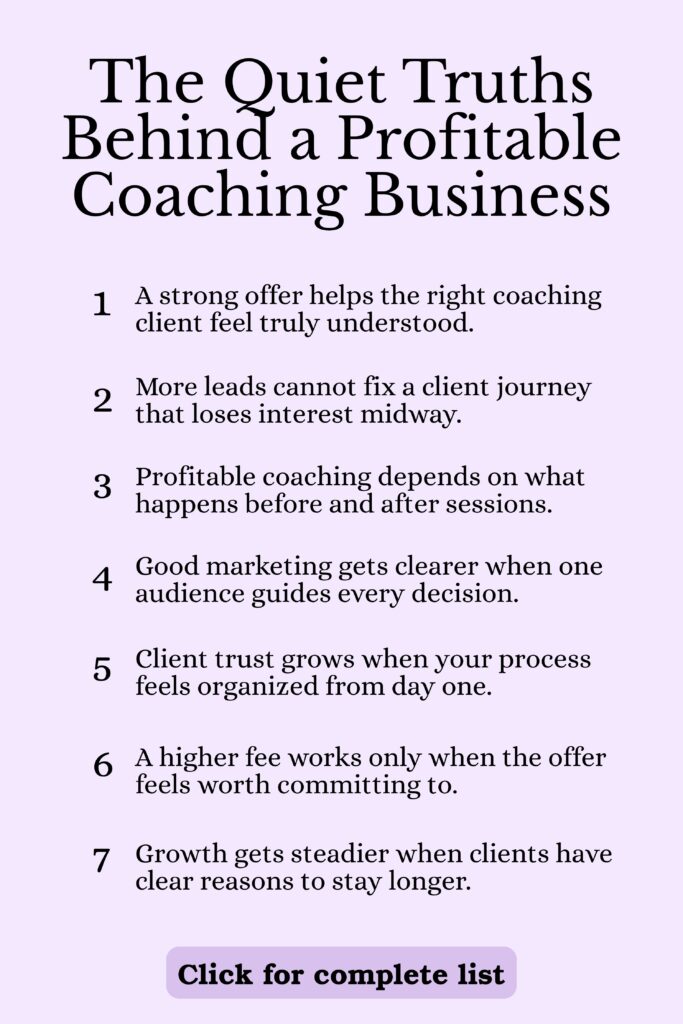
There is no fixed timetable for building a profitable coaching business. The useful measure is whether your client-getting numbers are improving: more qualified conversations, better show-up rates, stronger conversion, repeat business, referrals, and enough revenue per client to support your costs.
A coach with a strong existing network may gain traction faster than a coach starting with no audience or professional connections. Track the business rather than judging yourself against somebody else’s launch story.
SEE ALSO: If you’re a coach looking to streamline your administrative tasks and save time, check out our Coaching Administration Software. It’s a simple, effective solution designed to help you focus less on paperwork and more on what matters—coaching your clients. From scheduling to client management, our software gives you the tools to run your business efficiently. Ready to reclaim your time and boost productivity? Click or tap here.
How do new coaches get their first paying clients?
New coaches usually need direct conversations with people who fit the problem they solve. That may come through professional networks, referrals, workshops, local groups, targeted outreach, online visibility, or a combination of channels.
Choose one target market, one clear offer, and one or two ways of reaching those people. Then measure conversations and conversions instead of trying ten marketing tactics at once.
Do you need a niche to start a coaching business?
You need enough focus that a potential client can recognize whether your coaching is relevant to them. That does not require choosing a microscopic niche for the rest of your career.
Start with the problems you are equipped and interested to solve, the people who actually experience those problems, and the outcomes your coaching is designed to support. Your positioning can become more specific as you learn from real clients.
Can you build a coaching business using only social media?
You can generate coaching clients through social media, but social media still needs a conversion path. Followers need a reason to move from consuming content to downloading something, contacting you, booking a conversation, or considering an offer.
The business problem is not simply “How do I get more followers?” It is “What happens when the right follower becomes interested?”
SEE ALSO: If you’re a coach looking to streamline your administrative tasks and save time, check out our Coaching Administration Software. It’s a simple, effective solution designed to help you focus less on paperwork and more on what matters—coaching your clients. From scheduling to client management, our software gives you the tools to run your business efficiently. Ready to reclaim your time and boost productivity? Click or tap here.
Should coaches sell individual sessions or coaching packages?
Coaching packages often make sense when the work requires multiple sessions to address a defined goal, while individual sessions can make sense for focused or standalone needs. The structure should match the work rather than being chosen purely because one format sounds more profitable.
A package should make clear what the client receives, how long the work lasts, and what kind of support sits around the sessions.
How much should a new life coach charge?
A new life coach should choose a price that makes sense for the target market, offer, experience, costs, capacity, and scope of service rather than automatically charging the lowest amount possible.
Work backward from the economics of the business, then compare that number with what your intended clients are being asked to buy. Low pricing is not automatically easier to sell, and high pricing is not automatically evidence of value.
Do I need coaching software when I am starting out?
You do not need coaching software to prove that people will pay for your coaching, but a system becomes more useful as bookings, clients, forms, payments, notes, packages, and follow-up begin multiplying.
The point is not to add technology for its own sake. It is to stop routine business processes from becoming harder to manage as the practice grows. A platform such as LCH Core can bring client management, booking, payments, onboarding, coaching tools, progress tracking, and offers into the same workflow.
SEE ALSO: If you’re a coach looking to streamline your administrative tasks and save time, check out our Coaching Administration Software. It’s a simple, effective solution designed to help you focus less on paperwork and more on what matters—coaching your clients. From scheduling to client management, our software gives you the tools to run your business efficiently. Ready to reclaim your time and boost productivity? Click or tap here.
Is cold calling legal for coaches?
Cold calling can be legal in some situations, but coaches must follow the laws that apply to the caller, the person or business being contacted, and the type of call being made.
In the United States, the Federal Trade Commission says most business-to-business calls are exempt from many provisions of its Telemarketing Sales Rule, but there are exceptions, and other federal and state rules can still apply. In the UK, the Information Commissioner’s Office says B2B live marketing calls are covered by PECR requirements, including rules involving TPS and CTPS registrations and prior objections.
Do not assume that calling a business automatically makes the call unrestricted. Check the current rules in the jurisdictions involved before building cold calling into your acquisition strategy.
If you would like to learn more of how you can finally get your business up and running and making the money you deserve, please feel free to contact me. I promise, I won’t bullshit you around with unrealistic goals and targets. Keep it real and if you are willing to put in the hard work that is needed in any business, let me know. Visit me at www.coach-clinic.com.
To your success,
Carsten
SEE ALSO: If you’re a coach looking to streamline your administrative tasks and save time, check out our Coaching Administration Software. It’s a simple, effective solution designed to help you focus less on paperwork and more on what matters—coaching your clients. From scheduling to client management, our software gives you the tools to run your business efficiently. Ready to reclaim your time and boost productivity? Click or tap here.
Also check out:
How to make your business stand out from the crowd
Coaching business plans: A quick template
How to set your life coaching fees
How to get past the gatekeeper in sales
SEE ALSO: If you’re a coach looking to streamline your administrative tasks and save time, check out our Coaching Administration Software. It’s a simple, effective solution designed to help you focus less on paperwork and more on what matters—coaching your clients. From scheduling to client management, our software gives you the tools to run your business efficiently. Ready to reclaim your time and boost productivity? Click or tap here.
Sources
International Coaching Federation. “2025 ICF Global Coaching Study Executive Summary.” International Coaching Federation, 15 Sept. 2025. 2025 ICF Global Coaching Study Executive Summary.
Federal Trade Commission. “Complying with the Telemarketing Sales Rule.” Federal Trade Commission. Complying with the Telemarketing Sales Rule.
Information Commissioner’s Office. “Business-to-Business Marketing.” Information Commissioner’s Office. Business-to-Business Marketing Guidance.

Read this next

7 Best Coaching Business Models Proven To Boost Your Success
Adopt a profitable coaching business model today and let your company thrive!
Read More
How to Manage Client Expectations in Coaching
It’s important you and your client both know what you’ll provide BEFORE you start working together.
Read More
Starting a Coaching Business Checklist – Your Ultimate Guide as a Life Coach
Set up your coaching business the right way, the first time. Use this ultimate guide to gear you towards success.
Read More