





Best Books for Life Coaches: 18 Books That Will Take your Coaching to the Next Level (2022)

A good coach is an expert in their field. An amazing coach is also an expert in coaching. It doesn’t matter how good you are in your discipline if you cannot effectively communicate the principles of your discipline to your clients.
For many, the skill of coaching is hard-earned through years of grinding. It can take as long to become an amazing coach as it took you to become an amazing tennis player or business owner or behavioralist.
Luckily, you don’t have to make all the mistakes yourself. With a solid investment of time, you can accelerate your growth by learning from some of the best books in the field.
That’s why we put together this list of the 18 most essential books that every aspiring life coach should read.
Key Takeaways
- Start with your weakest coaching skill. The right book is the one that targets a real gap in your sessions, such as weak questions, rushed goal setting, over-advising, or unclear client follow-through.
- Use frameworks as flexible maps, not scripts. Models such as GROW are most useful when they help you notice what the client needs next, not when they force every conversation through fixed steps.
- Separate popularity from evidence. A widely taught method can still have a thin research base, so distinguish an author’s claims from findings supported by controlled studies or systematic reviews.
- Practice one behavior at a time. Testing one questioning habit, reflection technique, or goal-setting move across several sessions creates more useful learning than trying to apply an entire book at once.
- Track what changes for clients. Strong coaching development shows up in client ownership, clearer actions, better follow-through, and visible progress, not in how many coaching books sit on your shelf.
What Are the Best Books for Life Coaches?
The best books for life coaches are the ones that strengthen a specific part of your coaching practice. Co-Active Coaching is useful for relationship-centered coaching, Coaching for Performance gives you the GROW framework, Coach the Person, Not the Problem develops reflective inquiry, Coaching Questions sharpens questioning, and the Evidence-Based Coaching Handbook helps you examine the research behind coaching methods.
If you coach groups or teams, Effective Group Coaching adds a different set of skills. If your coaching is strong but your business is not, The Prosperous Coach, Guerrilla Marketing for Coaches, and Make Money as a Life Coach focus more directly on client attraction and practice growth.
SEE ALSO: If you’re a coach looking to streamline your administrative tasks and save time, check out our Coaching Administration Software. It’s a simple, effective solution designed to help you focus less on paperwork and more on what matters—coaching your clients. From scheduling to client management, our software gives you the tools to run your business efficiently. Ready to reclaim your time and boost productivity? Click or tap here.
A useful way to choose is to compare your skill gap with the current ICF Core Competencies. ICF introduced its refreshed competency framework in 2025 after a global job analysis involving more than 3,000 coaches, giving you a current professional benchmark for areas such as ethical practice, coaching mindset, listening, evoking awareness, and facilitating client growth.
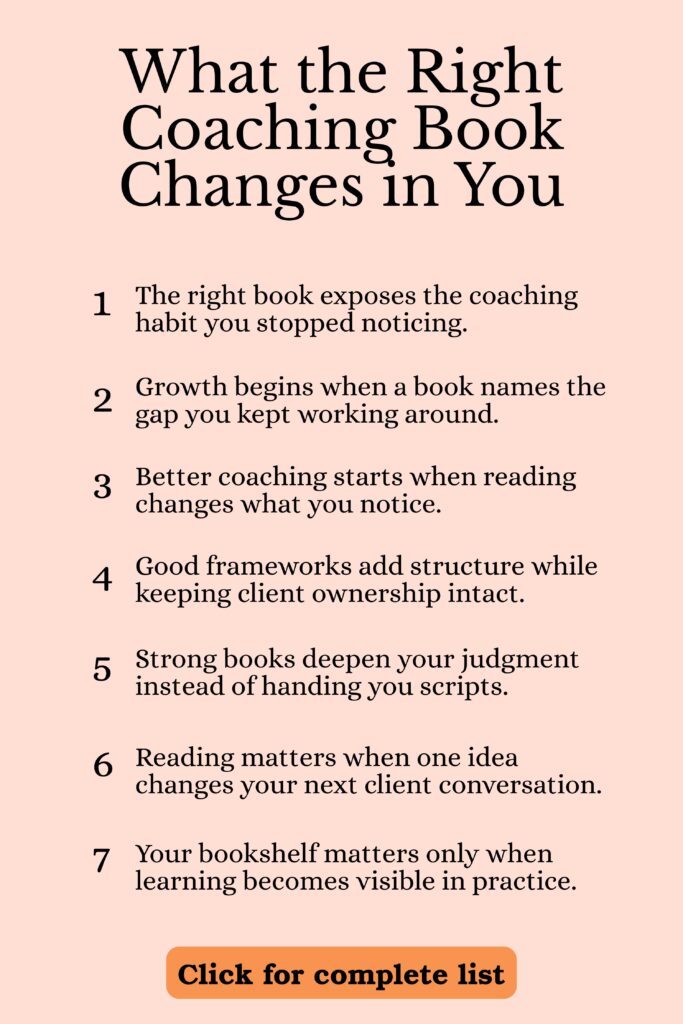
Which Coaching Book Should You Read First?
Read the coaching book that matches the problem you can actually observe in your work right now. Reading based on a specific skill gap is more useful than following a fixed sequence.
- Your sessions wander or finish without a clear next step: Start with Coaching for Performance. GROW gives you a practical structure for moving from a desired goal to current reality, possible options, and committed action.
- You catch yourself solving the client’s problem: Read Coach the Person, Not the Problem or Effective Modern Coaching. Both push you toward inquiry rather than becoming the person with all the answers.
- Your questions feel repetitive or surface-level: Go to Coaching Questions or The Coaching Habit. Use them as practice material, not as a script to fire questions at clients.
- You want to coach groups or teams: Read Effective Group Coaching, then study the additional dynamics involved in coaching a collective rather than one person.
- You want stronger professional rigor: Read the Evidence-Based Coaching Handbook and Becoming a Professional Life Coach, especially if you need to strengthen how you think about evidence, ethics, boundaries, and client responsibility.
- You coach well but struggle to build the business: Read The Prosperous Coach, Guerrilla Marketing for Coaches, or Make Money as a Life Coach. Pair the ideas with a clear client journey so visibility has somewhere to lead. Life Coach Hub’s guide to mastering coaching funnels is a useful next step for mapping attraction, nurturing, conversion, retention, and future offers.
Choose one problem and one book. That gives you something specific to practice in your next five sessions instead of a shelf full of ideas you never test.
What Can Co-Active Coaching Teach Life Coaches? 
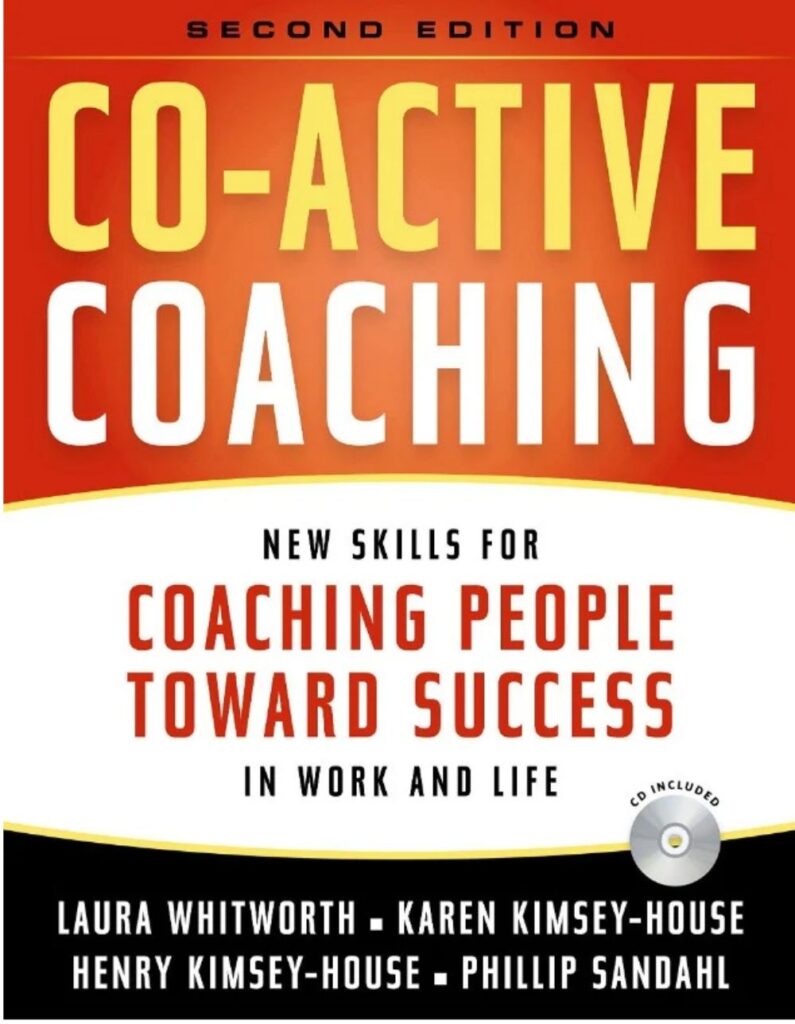
Co-Active Coaching is a transformational communication process that helps you, as a life coach, build strong, collaborative relationships with your clients. It is based on the three principles of fulfillment, balance, and process.
Every client you help as a coach has many, sometimes competing, aspirations. These may be making more money, traveling freely, getting in shape, or taking their career to the next level.
Most people are unbalanced in their goals, they passionately pursue one or more distinct goals while neglecting others.
SEE ALSO: If you’re a coach looking to streamline your administrative tasks and save time, check out our Coaching Administration Software. It’s a simple, effective solution designed to help you focus less on paperwork and more on what matters—coaching your clients. From scheduling to client management, our software gives you the tools to run your business efficiently. Ready to reclaim your time and boost productivity? Click or tap here.
You should be able to coach your client for balance to extend their vision. As the coaching progresses, you should be able to recognize the client’s movement toward or away from balance and adapt your communication approach.
Luckily, you don’t have to make all the mistakes yourself. With a solid investment of time, you can accelerate your growth by learning from some of the best books in the field.
When it comes to lifestyle improvement, the path to better habits and outcomes is never straight. Co-Active Coaching teaches that coaching is as much about the process as the results.
There are days one of your clients might slide back into bad habits, but that doesn’t mean you’re doing something incorrectly. Improvement is never linear.
Being an effective coach is about understanding when your client needs support, companionship, or just someone with whom to celebrate their wins.
If you find yourself disconnecting from your coaching journey, consider using Co-Active Coaching’s Coach’s Toolkit. The toolkit contains new coaching demonstrations, more than 35 updated exercises, questionnaires, and reproducible forms.
The book also pushes you towards a more optimistic attitude. It helps you see your client’s opportunities instead of limits, to expect greatness rather than failure, and to focus on strengths rather than weaknesses.
SEE ALSO: If you’re a coach looking to streamline your administrative tasks and save time, check out our Coaching Administration Software. It’s a simple, effective solution designed to help you focus less on paperwork and more on what matters—coaching your clients. From scheduling to client management, our software gives you the tools to run your business efficiently. Ready to reclaim your time and boost productivity? Click or tap here.
Implemented correctly, this results in a coaching style that will change your client’s life.
How Does the GROW Model Work in Coaching for Performance?

Coaching for Performance teaches you step-by-step how to coach your clients to do their best work under pressure.
Author Sir John Whitmore focuses on the GROW model, which stands for goals, reality, options, and will. The GROW model fosters self-assurance and motivation, which boosts output and improves a sense of personal fulfillment.
Help your clients achieve success by asking these questions:
- Grow. What do you want to achieve? This stage is all about understanding your client’s desires, no matter how ridiculous they perceive them to be. Get them to express or write down their aspirations without fear of judgement or self-criticism.
- Reality. Where are you right now? To get where they want to go, your clients need to understand where they are. At the reality stage, get to know your client’s mental, physical, emotional, and financial situation. Once you both better understand the internal and external obstacles stopping them from achieving their dreams, you can tackle them together.
- Options. What could you do? At the options stage, discuss your client’s skills and abilities with them. To implement an effective plan, you need to understand the resources (intangible and tangible) that they can deploy.
- Will. How will you move ahead? Will is the motivator that drives action from desire. Your clients must realize that acting is necessary to reach their objectives. A great coach helps his clients discover their own will and guides them toward their desired goals.
Reading Coaching for Performance will make you a more transformational coach, raising your level of awareness that will help you encourage sustainable change and performance improvement.
How Do You Use the GROW Model Without Turning Coaching Into a Checklist?
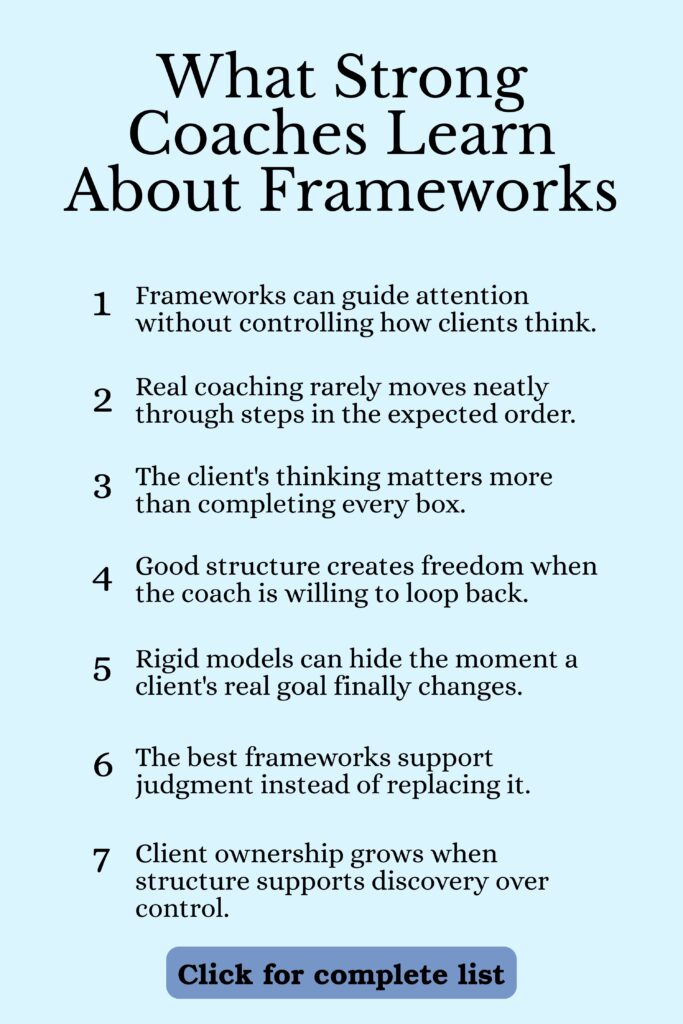
Use GROW as a map of the client’s thinking, not as four boxes you must complete in order. Goal, Reality, Options, and Will are useful because they show the kinds of thinking that move a client toward action, but real conversations often loop backward and forward.
SEE ALSO: If you’re a coach looking to streamline your administrative tasks and save time, check out our Coaching Administration Software. It’s a simple, effective solution designed to help you focus less on paperwork and more on what matters—coaching your clients. From scheduling to client management, our software gives you the tools to run your business efficiently. Ready to reclaim your time and boost productivity? Click or tap here.
A client may name a Goal and then discover, while discussing Reality, that the original goal was borrowed from a boss, partner, or old version of themselves. Going straight to Options at that point would create action around the wrong target. The better move is to revisit the Goal.
The same problem happens when coaches rush into Options. Imagine a career client says, “I want a new job because nobody here respects me.” You could immediately brainstorm employers, networking tactics, and applications. Or you could stay in Reality long enough to ask what “not respected” looks like, when it happens, what the client has tried, and what they are assuming about the situation.
Will should also belong to the client. “What will you do before we meet again?” is stronger than handing the client a task list you designed for them.
Once the client has chosen the action, LCH Core can help you make the follow-through visible. You can capture goals, assign agreed action items, and review activity in the Progress Stream before the next session. The system records the decision. It should not make the coaching decision for the client.
How Do You Coach the Person, Not Just the Problem?

Coaches often focus on specific problems and concrete solutions. There’s nothing wrong with focusing on the immediate, but you also need to engage with the human being who will enact those solutions.
Dr. Marcia Reynolds, Master Certified Coach, writes about the value of reflective inquiry in altering your client’s perspective to facilitate behavioral change. Drawing on cutting-edge brain research, she argues you should intentionally mirror your client’s words and expressions to help them better deconstruct their beliefs as if they were the third person.
SEE ALSO: If you’re a coach looking to streamline your administrative tasks and save time, check out our Coaching Administration Software. It’s a simple, effective solution designed to help you focus less on paperwork and more on what matters—coaching your clients. From scheduling to client management, our software gives you the tools to run your business efficiently. Ready to reclaim your time and boost productivity? Click or tap here.
The objective of this practice is to help your clients see themselves, their problems, and their environment from a different perspective. She offers tactics, ideas, and frameworks for facilitating breakthrough conversations.
Coach the Person provides five questions to ask yourself in order to analyze how their thinking influences their goals.
- What is the well-being of the client? Pay attention to the person, not the issue.
- What is the client trying to say? Summarize what was said and heard.
- What does the client believe they can achieve? Determine the underlying assumptions and beliefs
- What aspirations or goals does the client have? Let them talk about their desired result.
- What is the client going to do about it? Let them state their commitments and insights.
The objective is to make your clients feel seen and protected so they can open up to you. Once you’ve built up trust, you can explore their problems more meaningfully. In the long term, you empower them to solve their own problems.
When Should You Reflect a Client’s Thinking Instead of Solving Their Problem?
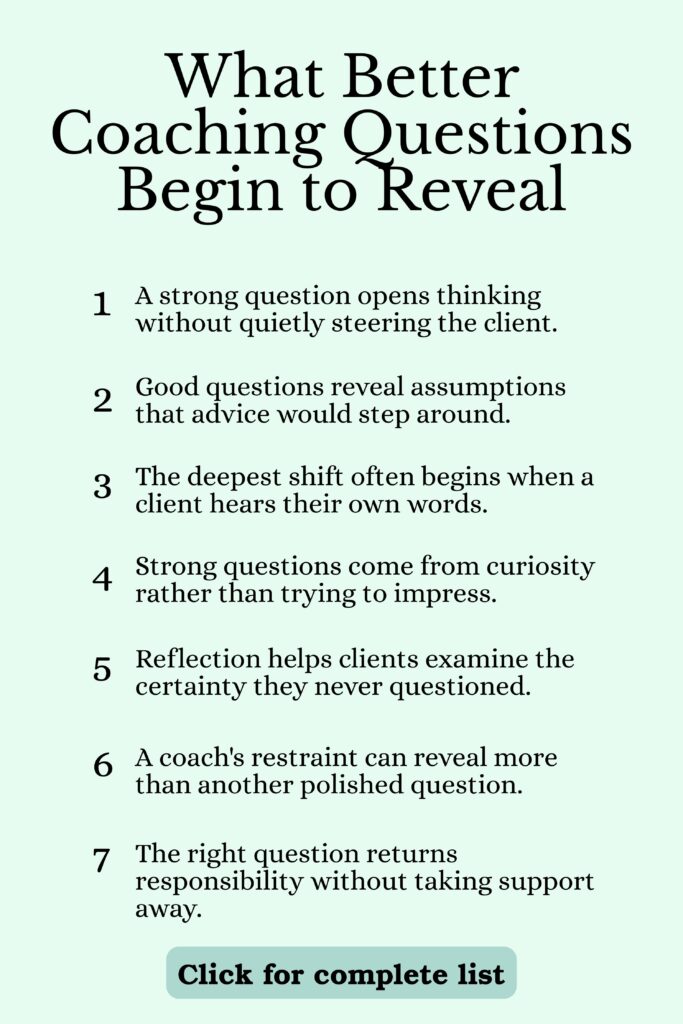
Reflect the client’s thinking when the real obstacle is how they are seeing the situation, not a shortage of advice. Reflective inquiry helps a client hear their own assumptions, contradictions, language, and patterns clearly enough to examine them.
Suppose a client says, “I have no choice. I either keep this job and stay miserable, or quit and wreck my finances.” Advice mode starts solving the employment problem. Reflective inquiry stays with the thinking.
You might say, “You said you have no choice, then named two choices. What feels unavailable between those two extremes?” Or, “Every option you’ve described assumes this has to be decided immediately. What changes if that assumption is not true?”
SEE ALSO: If you’re a coach looking to streamline your administrative tasks and save time, check out our Coaching Administration Software. It’s a simple, effective solution designed to help you focus less on paperwork and more on what matters—coaching your clients. From scheduling to client management, our software gives you the tools to run your business efficiently. Ready to reclaim your time and boost productivity? Click or tap here.
The reflection should give the client’s thinking back to them without quietly inserting your preferred answer. That is what separates “I notice you become much more certain when you talk about leading a team” from “I think you should apply for management roles.”
Some reflections need more time than a live conversation allows. In LCH Core, a journal prompt can give the client space to continue exploring a belief or pattern between sessions, while client notes can help you reconnect that reflection to the next conversation.
What Makes Group Coaching Effective?

Group coaching offers many benefits to coaches and clients. It allows you to have an impact on more people and can make clients feel safer and less pressured. For teams, this style of coaching is essential.
But it’s not always easy to design a group coaching program that works for everyone.
Jennifer Britton, a Professional Certified Coach, offers tested methodologies, tools, and tips for group coaching in Effective Group Coaching.
The book is indispensable if you plan to coach groups or host workshops and/or webinars. It explains the different dynamics in groups, core skills, best practices, and how to design your group program.
SEE ALSO: If you’re a coach looking to streamline your administrative tasks and save time, check out our Coaching Administration Software. It’s a simple, effective solution designed to help you focus less on paperwork and more on what matters—coaching your clients. From scheduling to client management, our software gives you the tools to run your business efficiently. Ready to reclaim your time and boost productivity? Click or tap here.
Effective Group Coaching provides a practical roadmap that leads to growth for new and seasoned coaches. The book also includes case studies highlighting how these programs are delivered globally through corporate and public programs, virtually and in person.
What Changes When You Move From 1:1 Coaching to Group or Team Coaching?
Moving from 1:1 coaching to group or team coaching changes who and what you are listening to. You are no longer tracking only one person’s goal, language, energy, and choices. You also have to notice participation, alliances, silence, conflict, shared assumptions, and the effect members have on one another.
In group coaching, participants may be working on individual goals while learning alongside one another. In team coaching, the collective itself becomes central. ICF’s Team Coaching Competencies build on the Core Competencies while adding considerations such as team cohesion, conflict, full participation, shared goals, team autonomy, ethics, and confidentiality.
That distinction becomes obvious in the room. If one participant answers every question first, the issue is not simply that they are “engaged.” Their speed may be shaping what everyone else is willing to say. If a quiet member finally offers a dissenting view and three colleagues immediately explain why it will not work, the coach has information about the team’s decision-making pattern.
A few practical shifts follow:
- Contract for the group dynamic, not just the topic. Clarify confidentiality, participation, decision-making, and what happens when tension appears.
- Listen for patterns across people. Notice who speaks after whom, whose ideas get picked up, where the room goes quiet, and what the group repeatedly avoids.
- Do not turn coaching into facilitation by accident. A coach can structure the conversation, but the team’s learning and choices still need to belong to the team.
The same coach who is excellent 1:1 can need additional practice before taking on teams. More people does not simply mean more of the same coaching.
SEE ALSO: If you’re a coach looking to streamline your administrative tasks and save time, check out our Coaching Administration Software. It’s a simple, effective solution designed to help you focus less on paperwork and more on what matters—coaching your clients. From scheduling to client management, our software gives you the tools to run your business efficiently. Ready to reclaim your time and boost productivity? Click or tap here.
What Can Coaches Learn From The Coaching Habit?

Michael Stainer’s book The Coaching Habit is for you if you love short, fun books that pack a healthy dose of actionable advice.
The book is not written for coaches per se but for managers and leaders who want to implement coaching techniques into their management practices.
Every chapter of the Coaching habit revolves around a question. Stanier then shows you how to form a new habit based on the primary goal of the query. A “Masterclass” chapter that follows delves further into the why of each coaching question.
The book focuses on fundamental coaching techniques such as listening, validating, and empowering the client to make their own informed decisions over time.
What Is Non-Directive Coaching in Effective Modern Coaching?

In Effective Modern Coaching, Downey communicates the essentials of coaching in an easy-to-follow manner.
This book focuses on non-directive coaching, a method of helping clients find their own path to improvement. You open the door for them to explore their own problems, how they view the obstacles they face, and whether they think they can improve them.
SEE ALSO: If you’re a coach looking to streamline your administrative tasks and save time, check out our Coaching Administration Software. It’s a simple, effective solution designed to help you focus less on paperwork and more on what matters—coaching your clients. From scheduling to client management, our software gives you the tools to run your business efficiently. Ready to reclaim your time and boost productivity? Click or tap here.
Only then do you help them find solutions by letting them follow their areas of interest and passion.
A core teaching of the book is how to achieve a state of flow as a coach. In flow, you are fully immersed in your present activity. Work and focus come easily.
When you are in the flow state as a coach, it is easier to show your client how to be intentional in whatever they try to achieve since they will know what it looks or feels like.
What Should Coaches Know About NLP in The Life Coaching Handbook?

The Life Coaching Handbook covers Neuro-Linguistic Programming (NLP) techniques and exercises, an approach to changing behavior developed by Richard Bandler and John Grinder in the 1970s.
NLP techniques seek to harness an alleged connection between neurological processes, language, and behavioral patterns learned over time to improve client behavior and outcomes.
If you’re interested in these approaches, this book is a great introduction that can help you with everything from building rapport with your clients to handling difficult situations.
SEE ALSO: If you’re a coach looking to streamline your administrative tasks and save time, check out our Coaching Administration Software. It’s a simple, effective solution designed to help you focus less on paperwork and more on what matters—coaching your clients. From scheduling to client management, our software gives you the tools to run your business efficiently. Ready to reclaim your time and boost productivity? Click or tap here.
The Life Coaching Handbook has practical tips, stories, and examples that help illustrate core concepts in the coaching field. It’s accessible. Even if you’re not a seasoned coach, you should still be able to pick up a lot of helpful information from this book.
How Do You Ask Better Coaching Questions?

Among the most powerful tools of a great life coach are meaningful questions that prompt moments of realization from clients. Coaching Questions is designed for coaches of all levels who struggle to come up with the right questions to ask in a coaching conversation.
Stoltzfus identifies the most common mistakes coaches make when asking questions. He then provides an easy-to-follow method for generating powerful questions.
He provides almost 1200 examples of powerful questions to ask with Destiny Discovery Tools. These tools are organized into passion, design, experience, and calling.
Providing even more resources, he lists 15 popular coaching niches with a tool and example for each. The book will offer you a ton of beneficial information as it includes a schedule of training exercises to help you become a “Master of Asking”.
What Does The Prosperous Coach Teach About Getting Clients?

Being a successful life coach is about much more than the act of coaching itself. The Prosperous Coach focuses on the other side of coaching -business. The best part is that it doesn’t just tell you what you need to do to build your coaching businesses but also gives you the tools and techniques for success.
SEE ALSO: If you’re a coach looking to streamline your administrative tasks and save time, check out our Coaching Administration Software. It’s a simple, effective solution designed to help you focus less on paperwork and more on what matters—coaching your clients. From scheduling to client management, our software gives you the tools to run your business efficiently. Ready to reclaim your time and boost productivity? Click or tap here.
Chandler identifies three distinct types of coaches: the professional, part-time, and personal growth coach. He says that it is crucial to be clear on what you want to get out of coaching.
He also shares his secrets on securing clients. To get more clients, he proposes that you offer free introductory sessions and make them an unforgettable experience for clients, so they feel compelled to sign up.
He also suggests taking new clients on invitation and referral only, which he claims will help you create more value for clients.
The Prosperous Coach is also an advocate for deep work strategies that help you succeed in your mentoring business.
What Is Evidence-Based Coaching?

The Evidence-Based Coaching Handbook by Dianne R. Stober and Anthony M. Grant is a great read if you’re interested in evidence-based coaching. Evidence-based coaching uses scientific research to inform the process of coaching clients.
Written by two of the most respected names in the coaching field, this book includes an overview of the evidence-based coaching movement.
SEE ALSO: If you’re a coach looking to streamline your administrative tasks and save time, check out our Coaching Administration Software. It’s a simple, effective solution designed to help you focus less on paperwork and more on what matters—coaching your clients. From scheduling to client management, our software gives you the tools to run your business efficiently. Ready to reclaim your time and boost productivity? Click or tap here.
The authors also provide a thorough introduction to the principles behind evidence-based coaching, along with steps you can take to implement them in your practice. It also offers practical tips on how to apply them when working with clients who may be unable or unwilling to give you direct feedback.
How Do You Know Whether a Coaching Technique Is Actually Evidence-Based?
Treat evidence as a ladder of confidence, not a label a method earns because a book calls it effective. For claims about whether an intervention produces an outcome, controlled studies, replicated findings, systematic reviews, and meta-analyses generally give you more confidence than testimonials, case studies, popularity, or a compelling theory.
That distinction matters when you read books that mix practical tools with broad claims about why those tools work. Ask:
- What outcome was actually measured?
- Was there a comparison or control group?
- How many people were studied?
- Has the finding been replicated by researchers independent of the method’s promoters?
- Does the research population resemble the clients you coach?
- Is the claim about a specific technique, or about coaching more broadly?
NLP is a useful example. A systematic review by Jackie Sturt and colleagues examined 10 experimental studies of NLP for health-related outcomes, including five randomized controlled trials. The authors found little evidence that NLP improved those health outcomes and noted that risk of bias was high or uncertain across the included studies. They also stressed that the evidence base was limited, rather than claiming definitive proof that NLP can never have value in any context.
That is different from saying coaching itself has no evidence base. A 2023 meta-analysis of workplace coaching reviewed 11 papers and concluded that coaching interventions were associated with a medium positive effect across workplace outcomes, while also noting that the controlled research literature remains limited.
For your practice, the standard is simple: describe a technique with the level of certainty the evidence supports. You can experiment thoughtfully without presenting a disputed mechanism as settled science.
SEE ALSO: If you’re a coach looking to streamline your administrative tasks and save time, check out our Coaching Administration Software. It’s a simple, effective solution designed to help you focus less on paperwork and more on what matters—coaching your clients. From scheduling to client management, our software gives you the tools to run your business efficiently. Ready to reclaim your time and boost productivity? Click or tap here.
What Does Becoming a Professional Life Coach Teach About Ethics and Client Differences?

Becoming a Professional Life Coach is a helpful resource for new and experienced coaches who want to change how they work with their clients. Patrick Williams and Diane S. Menendez help you understand the many different aspects of coaching like:
- How to become a professional life coach
- How to guide clients
- How to deal with difficult situations in your own life and work as a life coach
Becoming a Professional Life Coach also discusses the ethical responsibilities that come with being a life coach, including legal issues such as confidentiality.
The authors show that every coaching client has a unique personality type and approach. Coaches and clients need to understand what kind of personality they have before embarking on this journey with their clients.
Williams and Menendez also provide an excellent further reading list if you’re interested in learning more about coaching or working with clients professionally.
What Can Executive Coaches Learn From Transformational Executive Coaching?

If you’re a leader in any organization, you know that the best leaders are those who can elevate the entire team. A transformational executive coach is trained to help leaders do just that—to take their teams to new heights.
Ted M. Middelberg helps executives learn how to take their team members on deep dives into their strengths and weaknesses. Then, they can help their team members identify new ways of seeing themselves and their world.
SEE ALSO: If you’re a coach looking to streamline your administrative tasks and save time, check out our Coaching Administration Software. It’s a simple, effective solution designed to help you focus less on paperwork and more on what matters—coaching your clients. From scheduling to client management, our software gives you the tools to run your business efficiently. Ready to reclaim your time and boost productivity? Click or tap here.
The exercises are not meant to make your clients feel bad about their shortcomings. Instead, they’re designed to help them think more clearly about how to solve problems and make decisions in their life.
Then when it’s time for some real work, you will help your client figure out what steps they need to take to realize their dreams. You can then work with them on planning those steps, making sure they’re realistic and achievable enough to happen.
How Does Guerrilla Marketing for Coaches Approach Client Attraction?

Guerrilla Marketing for Coaches is filled with strategies that can help coaches of all kinds improve their business and their personal lives without costing them a fortune or taking up too much time. The authors of this book, Jay Conrad Levinson and Andrew Neitlich, are both experts in the field of marketing.
They break down six key steps for coaches that will help them attract clients and fill their practice with desirable clients. The book also shows coaches how to close deals quickly and easily, so they can get hired immediately.
The authors also share the top conversations they use to close deals fast, making it easy for coaches like you to get hired immediately. You’ll learn a lot of ideas here like:
- How and what kind of things should you do as a coach to get started
- How to structure your coaching sessions
- How and what types of questions to ask
- How much time it takes on average
What Does Coaching for Leadership Teach About Coaching Leaders?

Coaching for Leadership is for any coach who helps leaders get the most out of their teams.
SEE ALSO: If you’re a coach looking to streamline your administrative tasks and save time, check out our Coaching Administration Software. It’s a simple, effective solution designed to help you focus less on paperwork and more on what matters—coaching your clients. From scheduling to client management, our software gives you the tools to run your business efficiently. Ready to reclaim your time and boost productivity? Click or tap here.
Marshall Goldsmith and Laurence S. Lyons have spent decades studying and coaching leaders from all walks of life. In this book, they offer a practical guide on how to work with your team as a coach to help them grow. It has three main parts:
● Part 1. Looks at the role of coaching in business
● Part 2. Focuses on the process of coaching
● Part 3. Provides advice on how to get the most out of your coaching relationship to achieve long-term success.
The authors also explain that successful leaders are not born; they are built through coaching relationships with their teams. A coach helps you become more effective by identifying your strengths, weaknesses, and blind spots.
How Does Make Money as a Life Coach Approach the Business Side of Coaching?

Coaching is just one half of the equation, building a successful business is the other. To be reach your full potential, you must do both.
SEE ALSO: If you’re a coach looking to streamline your administrative tasks and save time, check out our Coaching Administration Software. It’s a simple, effective solution designed to help you focus less on paperwork and more on what matters—coaching your clients. From scheduling to client management, our software gives you the tools to run your business efficiently. Ready to reclaim your time and boost productivity? Click or tap here.
Make Money as a Life Coach walks you through getting certified, finding a niche market, building an online platform, selling your services online, and much more. It also includes guidance on creating an online schedule that works for you and gives you enough time to succeed.
The authors also discuss the importance of building a solid network of potential clients through social media, referrals from other coaches and business owners, and word-of-mouth advertising.
The book is not just about getting clients—it’s about becoming a better coach and helping people fulfill their dreams or find their career paths.
You’ll learn how to identify your ideal life coaching niche, how to attract the right clients, and how to conduct discovery calls so that you can secure your first paying customers.
What Makes Transformational Life Coaching Different?

If you’re looking for a book that will help you uncover your true potential as a life coach, Transformational Life Coaching by Dr. Cherie Carter-Scott and Lynn U. Stewart is the one for you.
Transformational Life Coaching teaches you how to help your clients accept responsibility for their happiness and accept that transforming themselves will take time. This is not a one-size-fits-all solution, each client’s journey is different, but each requires personal responsibility.
SEE ALSO: If you’re a coach looking to streamline your administrative tasks and save time, check out our Coaching Administration Software. It’s a simple, effective solution designed to help you focus less on paperwork and more on what matters—coaching your clients. From scheduling to client management, our software gives you the tools to run your business efficiently. Ready to reclaim your time and boost productivity? Click or tap here.
It also advocates narrowing your specialization. The more specialized you are, the more equipped you will be to help clients with their specific issues. If you want to help your clients with their relationships, you need a nuanced understanding of how relationships work.
Which Core Coaching Skills Does Developing Coaching Skills Teach?

In Developing Coaching Skills, Dietmar Sternad gives you everything you need about executive coaching and life coaching to make educated decisions about the best options for yourself and your clients.
Sternad offers 200 powerful coaching questions that you can apply right away and master all phases of the coaching process to conduct effective conversations in a goal- and solution-oriented way.
You’ll also learn essential skills like questioning, active listening, goal setting, giving constructive feedback, coaching for performance, dealing with emotions, and supporting behavior change.
Why Is The Coaching Manual Useful for New and Experienced Coaches?

Easily one of the most accesible books on this list, The Coaching Manual by Julie Starr is a great way to accelerate your growth as a coach whether you’re a novice or an experienced mentor.
The Coaching Manual is a comprehensive, practical, and illustrated coaching source. It teaches you how to empower your clients to take responsibility combined with a powerful, realistic skillset.
SEE ALSO: If you’re a coach looking to streamline your administrative tasks and save time, check out our Coaching Administration Software. It’s a simple, effective solution designed to help you focus less on paperwork and more on what matters—coaching your clients. From scheduling to client management, our software gives you the tools to run your business efficiently. Ready to reclaim your time and boost productivity? Click or tap here.
Whether you’re just starting your coaching career or have been practicing for years, this book will help you get there faster and more effectively. The book is filled with all the tools, techniques, and guidance you need to take you from where you are now to where you want to be.
It’s all woven into a complete learning experience that’s an instant source of fresh insight and tips. Every chapter demonstrates how this material can be applied in real-life situations immediately.
How Do You Turn a Coaching Book Into Better Coaching Sessions?
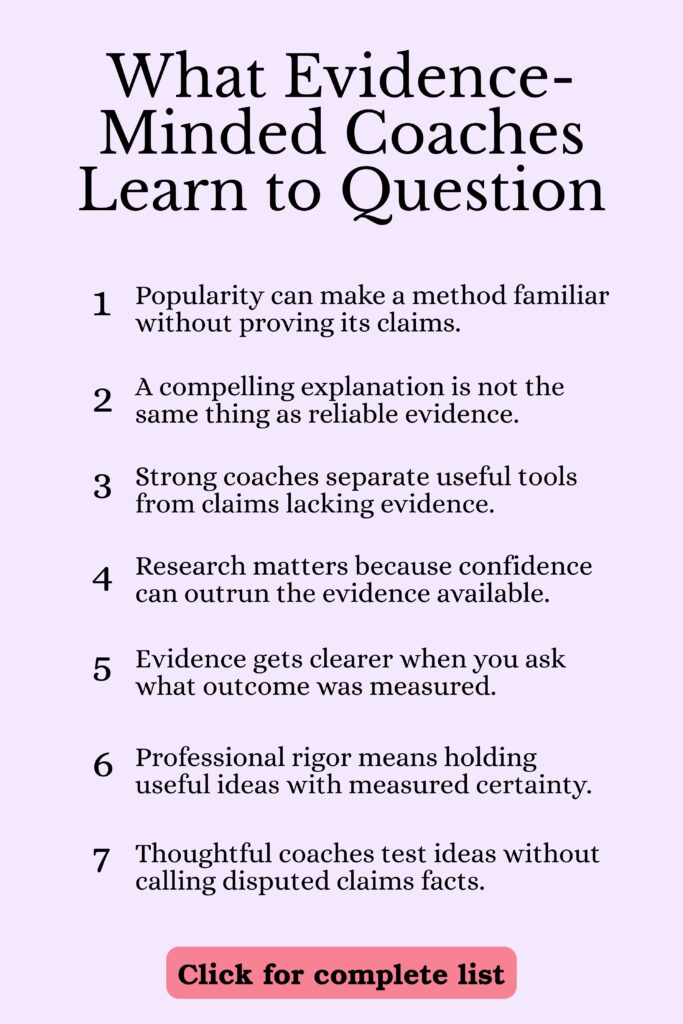
Turn a coaching book into better sessions by practicing one observable coaching behavior at a time. Trying to use an entire book usually produces vague intentions. A narrow practice target gives you something you can actually notice, repeat, and improve.
Use a simple four-step loop:
- Choose one behavior. For example, stay in the Reality stage of GROW longer before brainstorming, reflect a client’s exact language before asking another question, or end every session with a client-owned action.
- Choose where you will practice it. “In my next five career coaching sessions” is more useful than “I will ask better questions.”
- Review what happened for the client. Did the client generate more of their own options? Did the action become more specific? Did they follow through? Did a reflection create new thinking, or just sound clever?
- Adapt before repeating. Keep what changed the quality of the coaching. Drop what felt forced. Refine what almost worked.
For example, after reading Coach the Person, Not the Problem, you might track every moment you feel the urge to give an answer. Instead of suppressing advice automatically, ask what triggered the urge. Was the client stuck, were you uncomfortable with silence, or did you assume expertise meant providing a solution?
This kind of deliberate practice also matches the current ICF emphasis on ongoing learning and reflective practice. The 2025 Core Competencies explicitly include continued professional development and an ongoing reflective practice as part of embodying a coaching mindset.
SEE ALSO: If you’re a coach looking to streamline your administrative tasks and save time, check out our Coaching Administration Software. It’s a simple, effective solution designed to help you focus less on paperwork and more on what matters—coaching your clients. From scheduling to client management, our software gives you the tools to run your business efficiently. Ready to reclaim your time and boost productivity? Click or tap here.
If you want a record of what happens after the session, coaching tools can help. Reusable worksheets, goals, action items, resources, client notes, and the Progress Stream give you concrete evidence of what the client did between conversations, which is much more useful than judging a new technique only by how good it felt in the room.
Where LCH Core Fits
LCH Core fits after you have chosen the coaching method, by helping you run the repeatable client work around it. A framework such as GROW, reflective inquiry, or a questioning model still depends on your skill as a coach. The platform can organize what happens before, between, and after those conversations.
For example:
- Before coaching begins: A Welcome Package can combine a welcome letter, coaching agreement with electronic signature, and forms, while client management keeps intake information and notes attached to the client profile.
- Between sessions: Journals, worksheets, goals, action items, and resources can turn a session insight into something the client can reflect on, complete, or revisit.
- When you need to see follow-through: The Progress Stream and Engagement Report can help you review client activity and engagement instead of relying only on memory from the last call.
- When business-focused books push you toward a clearer client journey: A Public Booking Page can handle scheduling, while payments, coaching packages, and billing support the paid relationship.
- When you create scalable resources: Courses, digital products, and lead magnets can be offered through the Public Store.
- When visibility is the issue: A free life coach directory listing gives prospects another place to find you. Visibility still needs a clear next step, which is why a directory profile works better as part of a broader client journey than as a stand-alone marketing plan.
For a wider look at how those pieces fit together, Best Coaching Software for Life Coaches: What to Look For Before You Choose maps the full path from client management and scheduling to progress tracking and scalable offers.
Frequently Asked Questions About Books for Life Coaches

What is the best book for a new life coach?
Co-Active Coaching or Coaching for Performance are strong starting points because they give new coaches a clear foundation for the coaching relationship and session structure. Choose Coaching for Performance if you want a more explicit model to practice.
SEE ALSO: If you’re a coach looking to streamline your administrative tasks and save time, check out our Coaching Administration Software. It’s a simple, effective solution designed to help you focus less on paperwork and more on what matters—coaching your clients. From scheduling to client management, our software gives you the tools to run your business efficiently. Ready to reclaim your time and boost productivity? Click or tap here.
What is the best book for learning the GROW coaching model?
Coaching for Performance by Sir John Whitmore is the foundational book associated with the GROW model. Use it to understand Goal, Reality, Options, and Will as a coaching process rather than a rigid checklist.
Which book will help me ask better coaching questions?
Coaching Questions by Tony Stoltzfus is directly focused on building a larger, more intentional questioning repertoire. The Coaching Habit is also useful if you want a smaller set of questions to practice repeatedly.
Which books are best for coaches who give too much advice?
Coach the Person, Not the Problem and Effective Modern Coaching are strong choices for coaches who notice themselves moving too quickly into solutions. Both help shift the focus back toward client thinking, perspective, and ownership.
SEE ALSO: If you’re a coach looking to streamline your administrative tasks and save time, check out our Coaching Administration Software. It’s a simple, effective solution designed to help you focus less on paperwork and more on what matters—coaching your clients. From scheduling to client management, our software gives you the tools to run your business efficiently. Ready to reclaim your time and boost productivity? Click or tap here.
What should I read before starting group coaching?
Effective Group Coaching is a direct starting point for learning group-coaching practice. If you plan to coach intact teams, add current team-coaching competency guidance because team dynamics, confidentiality, and collective goals create issues that do not appear in the same way in 1:1 coaching.
What are the best evidence-based coaching books?
The Evidence-Based Coaching Handbook is an evidence-focused choice for coaches who want to understand the research behind practice. It is especially useful if you want to distinguish research-supported coaching from techniques that are popular but less well studied.
Which books can help me grow my coaching business?
The Prosperous Coach, Guerrilla Marketing for Coaches, and Make Money as a Life Coach focus most directly on client attraction, offers, networking, discovery conversations, and practice growth. Read them alongside coaching-skills books so business growth does not outpace the quality of your delivery.
SEE ALSO: If you’re a coach looking to streamline your administrative tasks and save time, check out our Coaching Administration Software. It’s a simple, effective solution designed to help you focus less on paperwork and more on what matters—coaching your clients. From scheduling to client management, our software gives you the tools to run your business efficiently. Ready to reclaim your time and boost productivity? Click or tap here.
Can coaching books replace coach training or certification?
No. Books can deepen your knowledge and give you frameworks to practice, but they do not replace live practice, feedback, ethical training, mentoring, supervision where appropriate, or the requirements of a professional credentialing pathway.
Which Life Coaching Book Should You Read Next?

That’s a wrap for now. Whether you’re starting out wanting to become a coach, or looking to hone your coaching skills, any of these books will be a great addition to your coaching library.
Sources
International Coaching Federation. “2025 ICF Core Competencies.” International Coaching Federation, 2025. 2025 ICF Core Competencies
International Coaching Federation. “Team Coaching Competencies.” International Coaching Federation. Accessed 10 Sept. 2026. ICF Team Coaching Competencies
Sturt, Jackie, et al. “Neurolinguistic Programming: A Systematic Review of the Effects on Health Outcomes.” British Journal of General Practice, vol. 62, no. 604, Nov. 2012, pp. e757-e764. PubMed. PubMed record
SEE ALSO: If you’re a coach looking to streamline your administrative tasks and save time, check out our Coaching Administration Software. It’s a simple, effective solution designed to help you focus less on paperwork and more on what matters—coaching your clients. From scheduling to client management, our software gives you the tools to run your business efficiently. Ready to reclaim your time and boost productivity? Click or tap here.
Cannon-Bowers, Janis A., et al. “Workplace Coaching: A Meta-Analysis and Recommendations for Advancing the Science of Coaching.” Frontiers in Psychology, vol. 14, 10 Oct. 2023, article 1204166. Frontiers in Psychology article
Read this next
Why Journaling Is One of the Most Underrated Client Retention Tools in Coaching
Journaling is a must for all your coaching and courses to help your clients reach their best. Find out why.
Read More
Make Your Students More Receptive
It doesn’t matter if you are teaching adults in a boardroom or tiny tots in a preschool; you need a strategy.
Read More
Powerful Coaching Questions Gallery
These powerful coaching questions will help you act as your own life coach. Ask them and listen to your inner voice.
Read More