


Talk to a coach about Confidence coaching

Crystal Faulk
ACC
I help overwhelmed women in transition gain clarity, confidence, and...

Stephanie Peers
Somatic Coach | Midlife Transitions, Self-Trust & Personal Growth --> (Download my free Body-Led Clarity Guide in My Store!)
Body-led coaching for midlife women ready to trust themselves, set...

Charity Archie
Several Life Coaching Certifications-Intentional Holistic Life Coach
Charity Aumora dedicated to promoting a positive clear & intentional...

Menna Jones
Certified Health & Wellness Coach (Real Balance Global Wellness)
Health & Wellness Coaching For Women Going Through Menopause

Daryll Mackey
Coach, speaker and DISC Practitioner JohnC. Maxwell
Empowering growth through knowledge and connection. Unlock your potential and...

Alena Zhaliazniak
MSc, holistic life coach, PQ Positive Intelligence
"A ray of light shining through iron" is the meaning...

Mak Estill
Anxiety, Panic & Life Coach dedicated to coaching you into a life of lesser and lighter anxiety!
Founder and owner of Actionable Anxiety, a private coaching practice...

Maria J Brando
Psychosynthesis Life Coach and Financial Coach. BCC, MBA.
Reconnect with your intuition. Look within, listen deeply, and discover...


What Most People Get Wrong About Learning From Failure
Is failing always a bad thing?
So many people are not living their dreams because they are afraid of what will happen if they fail.
But is failing to achieve something you want the worst thing that can happen?
Does failing on the first try mean you can never succeed? Do we really learn more from failure than success?
Every person experiences failure. Anyone who claims otherwise is leaving something out.
People fail in different ways and with different consequences, but nobody escapes unsuccessful attempts entirely.
How would that even work?
Would you stay inside because you might make a mistake at work?
If you want to get more from your life, and are looking for concrete action steps to get you there, check out our Request a Coach page. It’s a “cut the fence-sitting and take action” way to tackle your issues and actually find success. To get off the fence and start to take action, click or tap here.
Would you avoid learning anything new because you might not understand it immediately?
What would the world look like if nobody dared to fail?
Key Takeaways
- Failure is not automatically bad. A setback can expose a weak strategy, a missing skill, an unrealistic timeline, or a goal that no longer fits your life.
- Failure does not teach you by itself. Learning happens when you separate facts from self-judgment, identify what was controllable, and change your next attempt.
- One failed attempt is not a failed identity. Rejection from one school, job, or relationship describes what happened in that situation, not who you are.
- Persistence is only one useful response. Depending on the evidence, you may need to retry the same goal, revise your method, or release an unattainable goal.
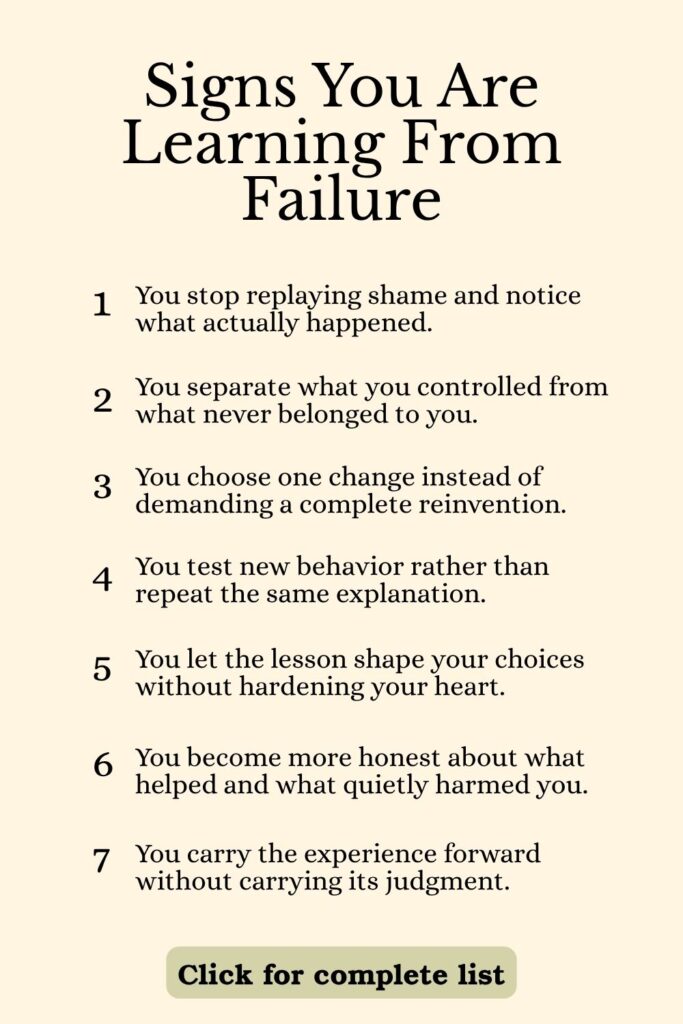
- Real learning appears in behavior. A lesson counts when it changes a boundary, decision, preparation step, or action you can observe the next time a similar situation appears.
Is Failure Always a Bad Thing?
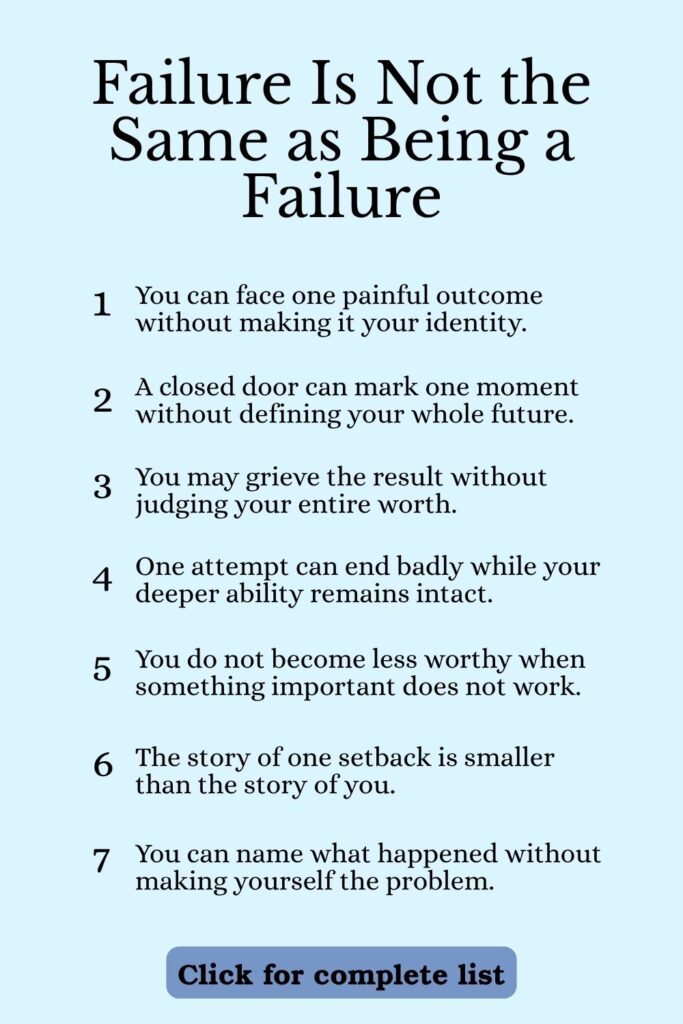
Failure is not always a bad thing, but it is not automatically good either. Its value depends on what the experience reveals and what you do with that information.
A failed attempt may expose a skill you need to develop, a strategy that needs to change, or a goal that no longer suits you. It may also reflect circumstances outside your control rather than a personal weakness.
Failure becomes useful when it leads to a more accurate decision. Sometimes that decision is to try again. Sometimes it is to change direction.
What Can Failure Teach You?
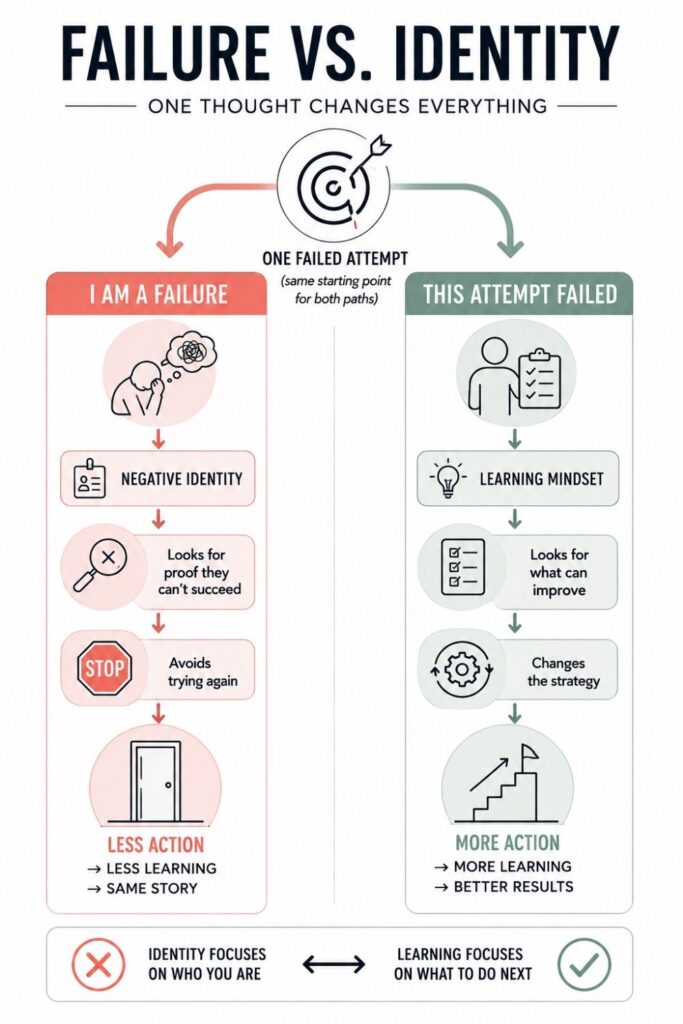
I have learned a lot about failure over the years (mainly because I had so much of it). During my senior year of college, I was Failure can teach you what matters, what needs to change, and what you are capable of surviving.
I have learned a lot about failure over the years, mainly because I experienced so much of it.
During my senior year of college, I was dealing with severe depression and mania. I was accepted into several graduate programs for social work, but I was unable to attend because my parents realized that I could not manage graduate school in that condition.
If you want to get more from your life, and are looking for concrete action steps to get you there, check out our Request a Coach page. It’s a “cut the fence-sitting and take action” way to tackle your issues and actually find success. To get off the fence and start to take action, click or tap here.
It felt like an enormous failure.
I had worked hard to take the next step toward becoming a therapist. Then I watched that plan collapse before my eyes.
I did not know how I would recover. I wanted to become mentally healthy immediately, but recovery took years.
That experience did not feel useful while I was living through it. It hurt.
Over time, however, it changed how I approached my life.
I learned not to take happiness for granted. I stopped treating happiness as something that would simply arrive when my circumstances improved.
If I had found the strength to get through a day while I was ill, I could put deliberate effort into building a meaningful life when I was healthier.
I would not be the person I am now without those experiences. That does not mean I am glad they happened. It means I can see how they influenced the person I became.
If you want to get more from your life, and are looking for concrete action steps to get you there, check out our Request a Coach page. It’s a “cut the fence-sitting and take action” way to tackle your issues and actually find success. To get off the fence and start to take action, click or tap here.
The same pattern can appear in less serious situations.
Failing to make friends may force you to examine where you spend your time, how you approach people, and whether you are choosing relationships that fit you. It may also teach you how to enjoy your own company without giving up on connection.
Not getting the job you wanted may lead you to study what you actually want from your work. You might discover that you were pursuing a title, company, or field that did not match the life you wanted.
Failure can provide useful information. But only if you are willing to examine it accurately.
How Do You Learn From Failure Instead of Just Reliving It?
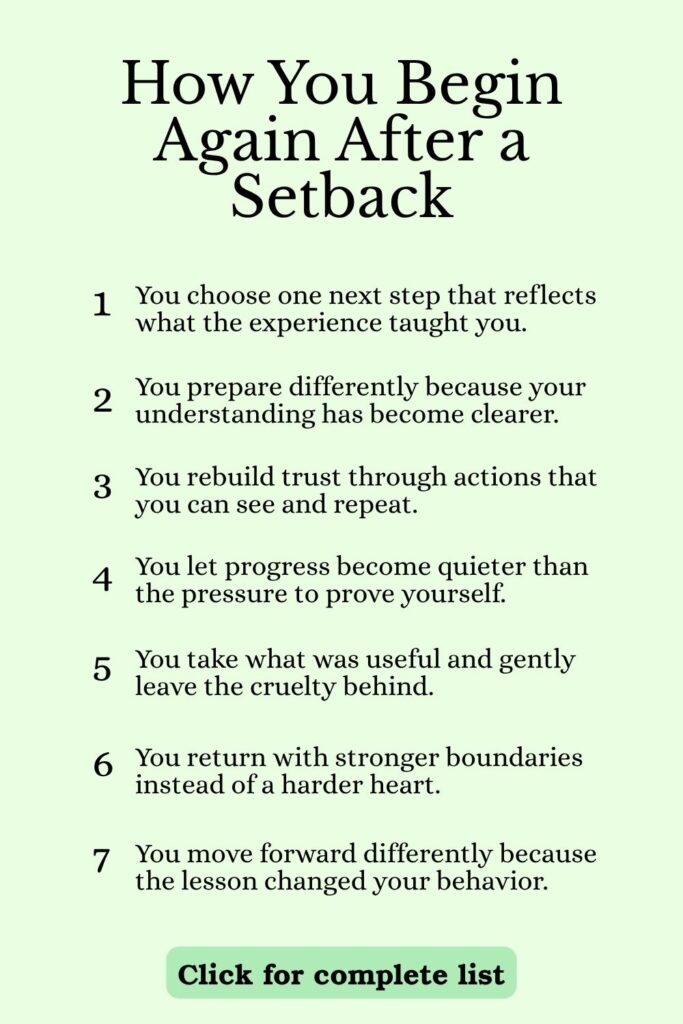
Failure does not automatically teach you anything. It becomes useful when you examine what happened closely enough to change what you do next.
In a 2019 study published in Psychological Science, Lauren Eskreis-Winkler and Ayelet Fishbach found across five studies involving 1,674 participants that people learned less from personal failure feedback than from success feedback. Their experiments suggested that failure can threaten the ego and cause people to disengage from information that could help them improve.
That finding makes sense when you consider what often happens after a setback.
You focus on the embarrassment. You replay the worst moment. You decide the outcome proves something about you.
If you want to get more from your life, and are looking for concrete action steps to get you there, check out our Request a Coach page. It’s a “cut the fence-sitting and take action” way to tackle your issues and actually find success. To get off the fence and start to take action, click or tap here.
None of those reactions tells you what to do differently.
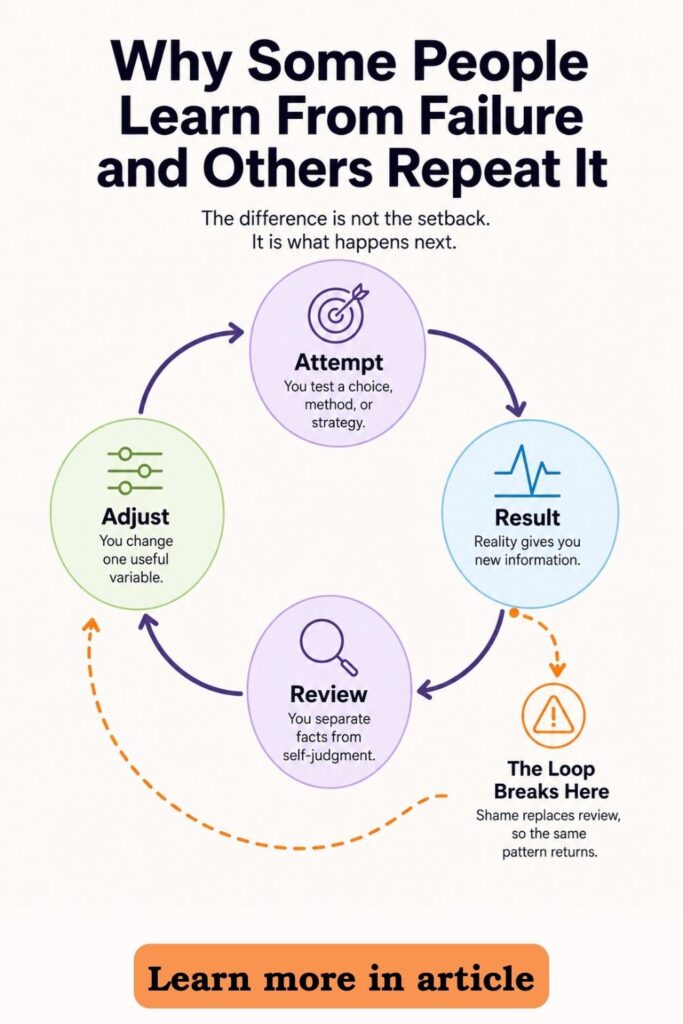
A simple Failure Debrief Cycle can make the experience more useful:
- Describe what happened. Use observable facts rather than labels. “I was rejected after the final interview” is more useful than “I am terrible at interviews.”
- Separate control from constraint. Identify your decisions and preparation, then list the circumstances and other people’s choices you could not control.
- Choose what needs to change. Name one skill, behavior, assumption, or part of the strategy that deserves attention.
- Test a different attempt. Decide what you will do differently and where you will test it.
Imagine that someone has been rejected after three job interviews.
Their first conclusion might be, “Nobody wants to hire me.”
A closer review shows that they consistently reach the final interview. The problem appears when they are asked for examples of leadership, and their answers become vague.
That is useful information.
Their next move is not simply to “believe in themselves.” It is to prepare three specific leadership stories, practise saying them aloud, and use them in the next interview.
A career coach might role-play the questions, interrupt unclear answers, and help the person replace general claims with evidence. The next interview then becomes a test of a revised approach, not another repetition of the same attempt.
If you want to get more from your life, and are looking for concrete action steps to get you there, check out our Request a Coach page. It’s a “cut the fence-sitting and take action” way to tackle your issues and actually find success. To get off the fence and start to take action, click or tap here.
Was It Really Failure, or Was It a Constraint?
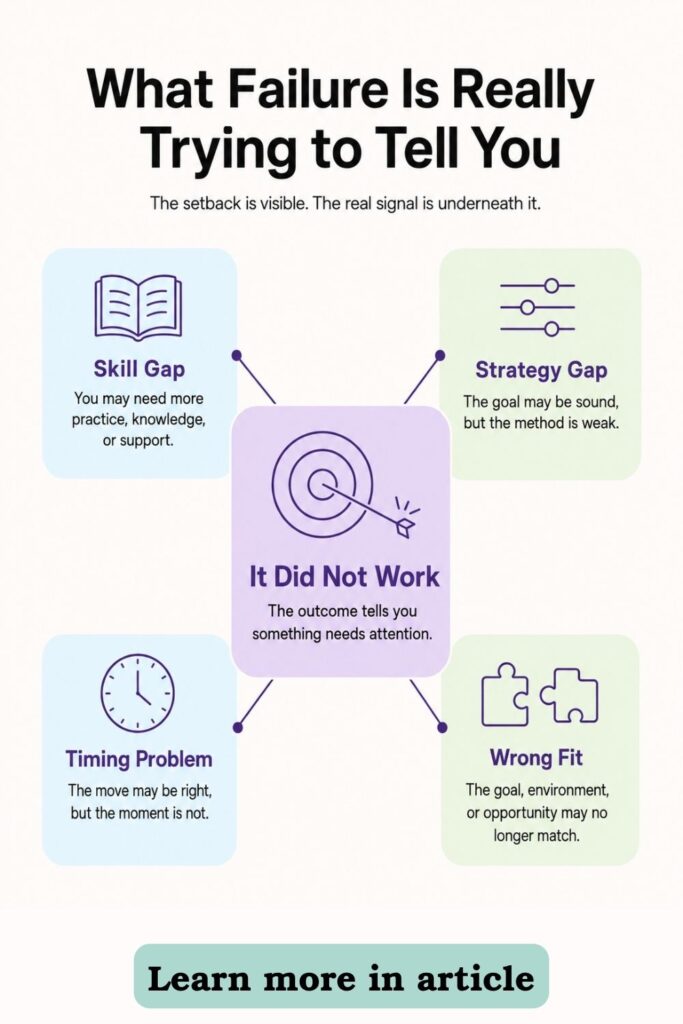
Not every painful outcome is evidence that you personally failed.
Some outcomes are influenced by your choices. Others are shaped by illness, timing, economic conditions, another person’s behavior, or circumstances you could not reasonably control.
A controllability filter can help you separate four kinds of factors:
- Decisions and preparation: What did you choose to do, postpone, avoid, or prioritize?
- Developable skills: What ability could you strengthen through practice, instruction, or feedback?
- Other people’s choices: What depended on a partner, employer, admissions committee, family member, or other decision-maker?
- Personal or external constraints: What was limited by health, finances, caregiving, timing, access, or larger conditions?
My inability to attend graduate school was not simply proof that I lacked discipline. I was seriously ill.
That did not remove every choice from the situation. I still had decisions to make about treatment, recovery, and what I would pursue later.
But calling the entire experience a personal failure would have hidden the most relevant fact. My health made the original plan unmanageable at that time.
The same distinction matters when someone loses a job during company-wide layoffs. They can review their performance and prepare for the next search, but they should not claim responsibility for a decision that eliminated an entire department.
It also matters in relationships.
If you want to get more from your life, and are looking for concrete action steps to get you there, check out our Request a Coach page. It’s a “cut the fence-sitting and take action” way to tackle your issues and actually find success. To get off the fence and start to take action, click or tap here.
You can work on expressing your needs clearly. You can learn to recognize warning signs sooner. You cannot force another person to respect a boundary they have repeatedly chosen to ignore.
A career coach might help someone returning after an illness create a realistic re-entry plan. That could include updating skills, explaining an employment gap, identifying suitable roles, and setting an application schedule.
The plan should address what is controllable without turning every constraint into a character judgment.
Did the Goal Fail, or Did One Attempt Fail?
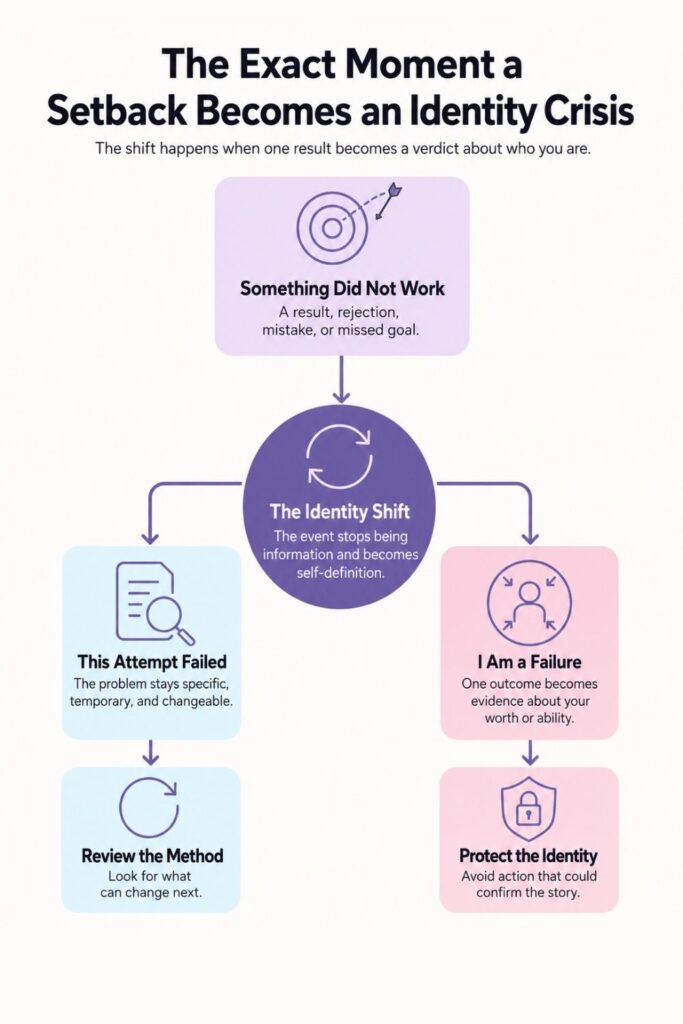
One failed attempt is not the same as a failed goal, and neither one makes you a failure.
People often collapse four separate conclusions into one:
- An attempt failed. One application, conversation, project, exam, or relationship did not produce the desired result.
- A strategy failed. The method used repeatedly produced weak results.
- A goal became unsuitable. New information showed that the original destination was unrealistic, harmful, or no longer wanted.
- An identity judgment formed. The person changed “this did not work” into “I do not work.”
These conclusions lead to very different decisions.
Suppose you apply for one job and do not get it.
That means one application was unsuccessful. It does not prove that your career goal is impossible.
If you want to get more from your life, and are looking for concrete action steps to get you there, check out our Request a Coach page. It’s a “cut the fence-sitting and take action” way to tackle your issues and actually find success. To get off the fence and start to take action, click or tap here.
After several similar rejections, you may discover that your strategy needs work. Perhaps you are applying for positions that require experience you have not demonstrated, or your résumé does not clearly show the results you produced.
That still does not mean you are a failure.
Relationships create the same confusion.
The end of one relationship does not prove that you cannot build a healthy partnership. It may reveal that this particular relationship was incompatible, that you ignored early warning signs, or that you need stronger boundaries.
A relationship coach might help a client review what happened without reducing the entire experience to “I always choose the wrong person.”
They could examine:
- What behavior appeared early
- How the client responded
- What consequence followed
- What boundary would change the pattern next time
This turns one failed relationship into specific information about future choices.
Should You Retry, Revise, or Release the Goal?
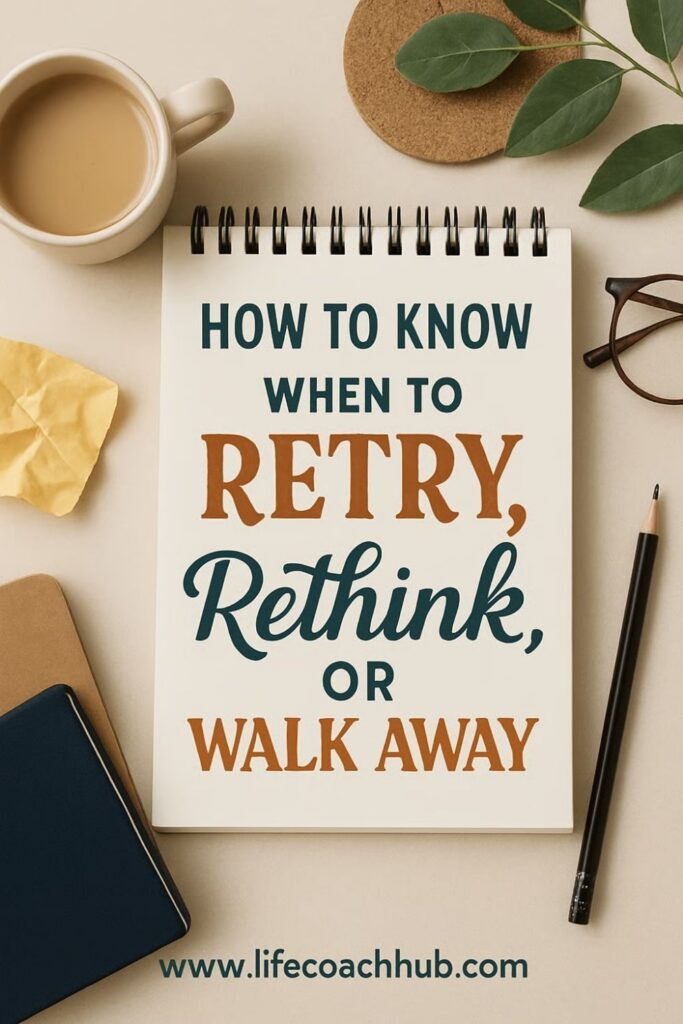
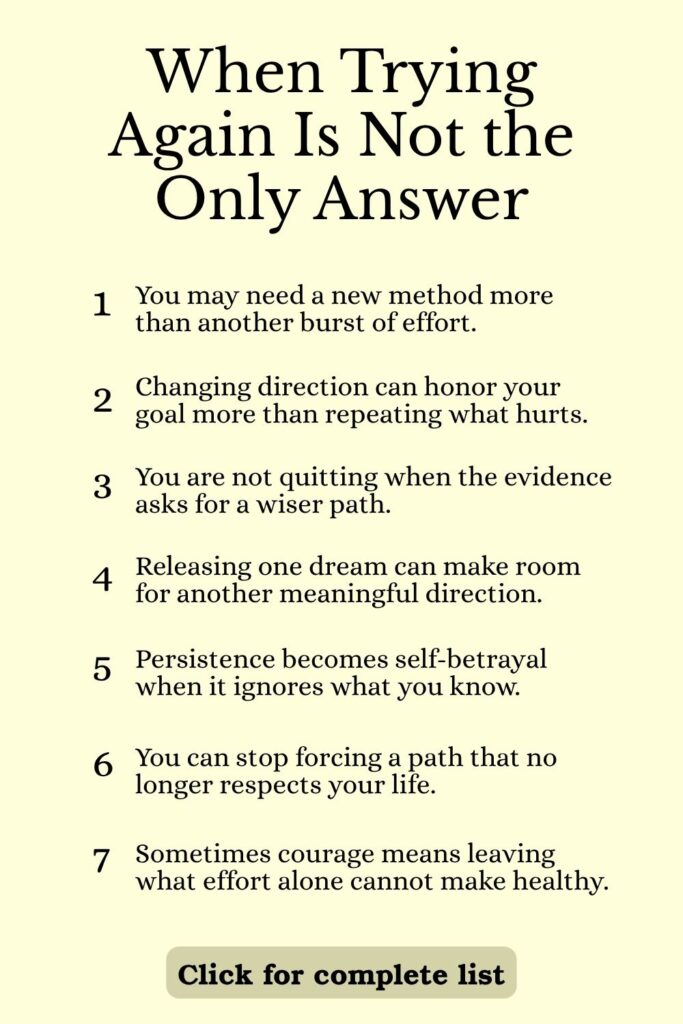
The useful question after a setback is not always, “How do I keep going?” It is, “Should I retry, revise, or release this goal?”
If you want to get more from your life, and are looking for concrete action steps to get you there, check out our Request a Coach page. It’s a “cut the fence-sitting and take action” way to tackle your issues and actually find success. To get off the fence and start to take action, click or tap here.
Persistence makes sense when another attempt has a reasonable chance of producing new information or a different result. Repeating the same approach indefinitely does not become wise simply because it requires effort.
Use three possible paths:
- Retry the goal when it still matters, the basic strategy remains sound, and more practice, preparation, or time could change the result.
- Revise the strategy when the goal still matters but your current method is repeatedly producing the same problem.
- Release the goal when it is genuinely unattainable, no longer fits your priorities, or requires you to keep accepting unacceptable costs.
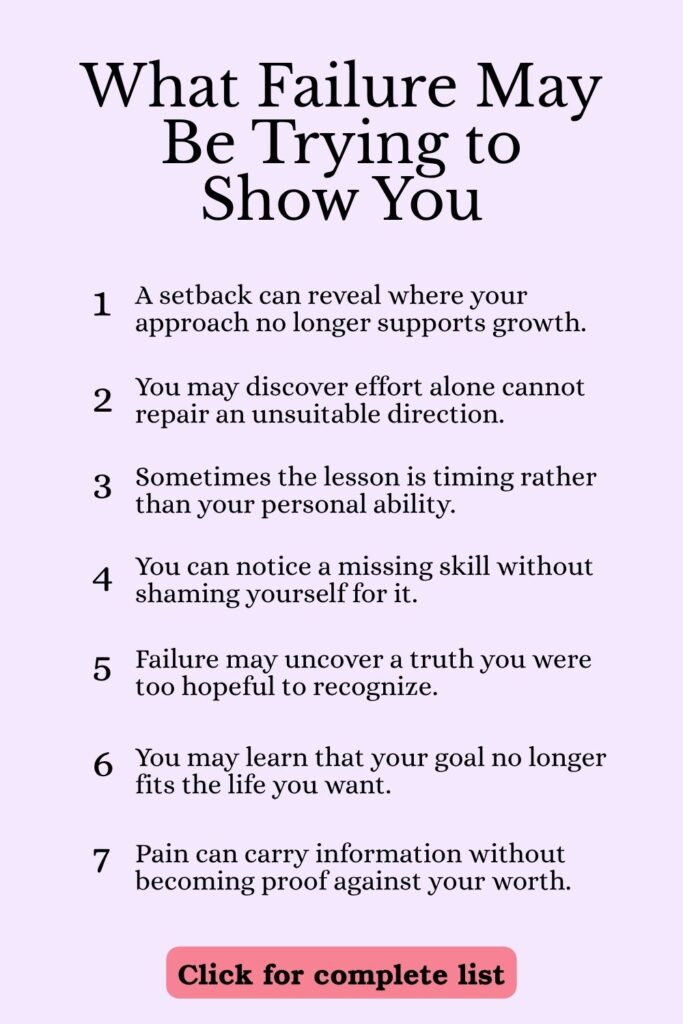
A 2020 meta-analysis by Meaghan A. Barlow, Carsten Wrosch, and Jennifer J. McGrath drew on 31 samples and found that the capacities to disengage from unattainable goals and reengage with meaningful alternatives were associated with better quality of life. Reengaging with another worthwhile goal showed a stronger association than disengagement alone.
Releasing a goal does not have to mean drifting without direction. The more useful move is often to redirect your effort.
A student rejected from a competitive graduate program might retry after building stronger experience.
A job seeker who keeps reaching final interviews might revise their interview preparation rather than abandon the career.
Someone pursuing a relationship with a person who repeatedly ignores their boundaries may need to release that relationship and reengage with the broader goal of finding a respectful partner.
A leadership coach might use the same decision process after a missed promotion.
If you want to get more from your life, and are looking for concrete action steps to get you there, check out our Request a Coach page. It’s a “cut the fence-sitting and take action” way to tackle your issues and actually find success. To get off the fence and start to take action, click or tap here.
The client could retry after developing a missing skill, revise by pursuing a different department, or release the promotion goal after recognizing that the position would move them away from the work they value.
The purpose is not to choose the toughest option. It is to choose the option that fits the evidence.
How Can You Move Forward After Failure?
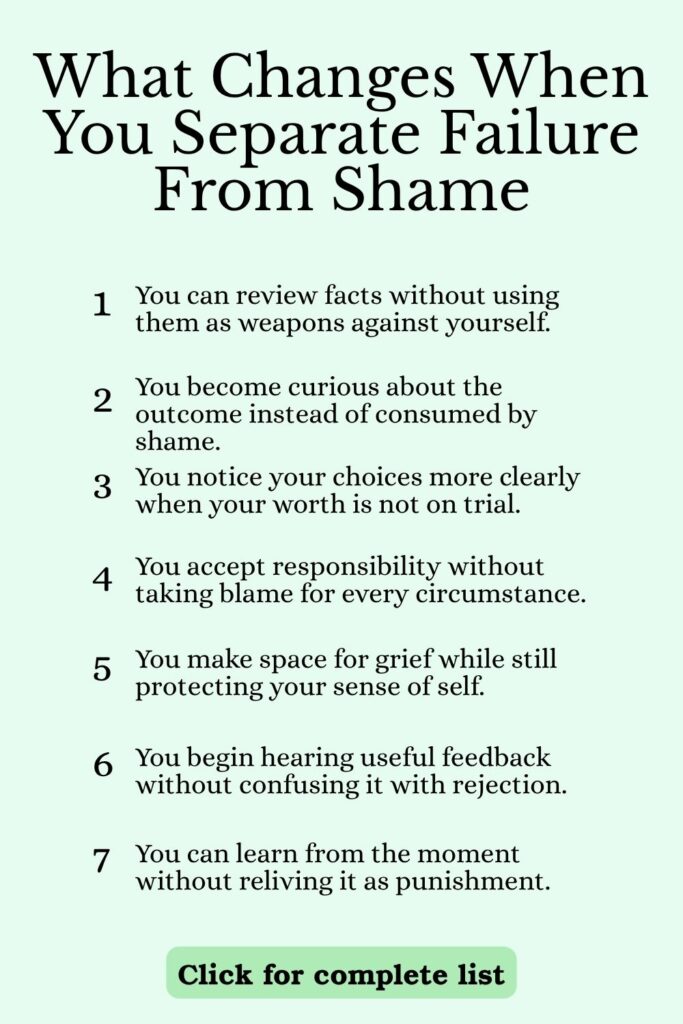
You move forward by treating failure as information and choosing one concrete next action.
Success in one part of life does not make every other part easy. Failure in one attempt does not make the next attempt pointless.
Life continues to require trial, error, adjustment, and work.
I like the image of getting knocked down and standing up again. But getting up does not mean standing in the exact same place and waiting for the same thing to happen.
Sometimes you stand somewhere else.
Sometimes you learn a new skill.
If you want to get more from your life, and are looking for concrete action steps to get you there, check out our Request a Coach page. It’s a “cut the fence-sitting and take action” way to tackle your issues and actually find success. To get off the fence and start to take action, click or tap here.
Sometimes you stop fighting for something that is hurting you.
Allow me to explain this with a short story.
A young woman, whom we will call Dylan, has struggled with failed relationships for years. She keeps trying to find the right romantic partner, but each relationship eventually falls apart.
Dylan sees a relationship coach who helps her review the relationships as a pattern rather than a collection of unrelated disasters.
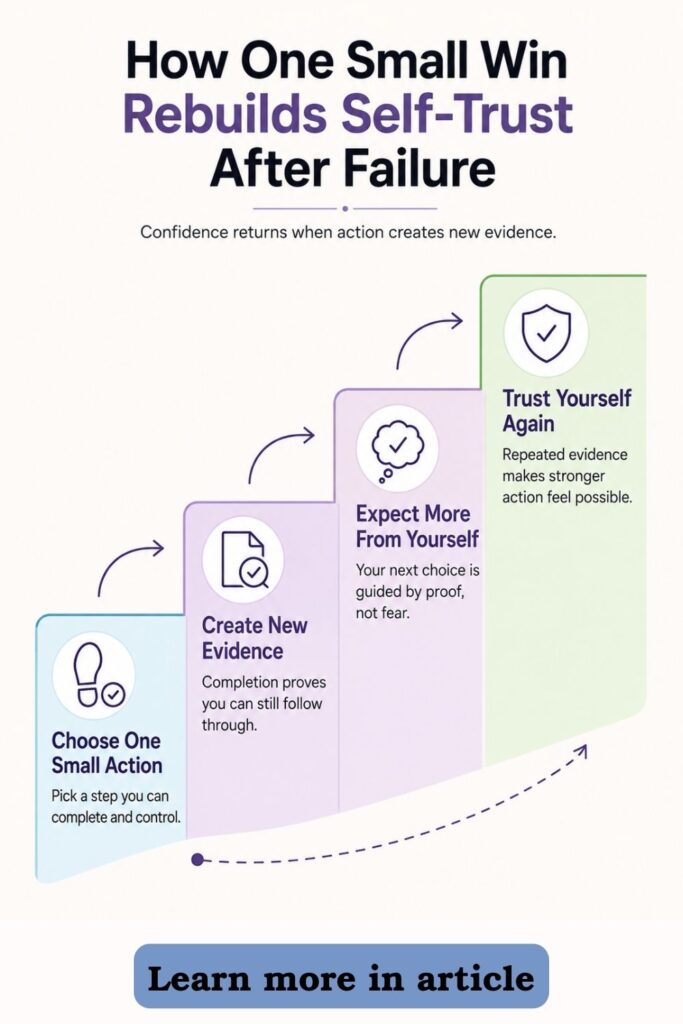
She begins journaling about each relationship using four questions:
- What warning sign appeared early?
- How did I respond?
- What did I tolerate because I feared losing the relationship?
- What boundary would I use now?
Dylan realizes that her self-esteem fell after each breakup. As her confidence decreased, she began accepting behavior she would previously have challenged.
Several partners treated her disrespectfully, but she stayed because she believed another failed relationship would prove that something was wrong with her.
That belief kept the pattern alive.
If you want to get more from your life, and are looking for concrete action steps to get you there, check out our Request a Coach page. It’s a “cut the fence-sitting and take action” way to tackle your issues and actually find success. To get off the fence and start to take action, click or tap here.
Dylan begins working with a confidence coach on observable behavior. They practise naming disrespect directly, setting a consequence, and following through when the behavior continues.
The change is not that Dylan suddenly feels confident every day.
The change is that she stops negotiating against her own standards.
When she begins another relationship, she pays attention to how the person responds to boundaries. She no longer treats chemistry as evidence that disrespect should be excused.
Eventually, she develops a healthy relationship with someone who respects her.
Her previous relationships did not automatically lead her there. The difference came from examining the pattern and making different decisions.
Failures can be painful, but they can lead to better choices when the next attempt is genuinely different.
Frequently Asked Questions About Failure
Is Failure Necessary for Success?
Failure is not required for every success, but unsuccessful attempts are common when people pursue difficult or unfamiliar goals.
If you want to get more from your life, and are looking for concrete action steps to get you there, check out our Request a Coach page. It’s a “cut the fence-sitting and take action” way to tackle your issues and actually find success. To get off the fence and start to take action, click or tap here.
You do not need to deliberately fail. You need a process for noticing problems, accepting accurate feedback, and adjusting before the same mistake becomes a pattern.
Can Failure Actually Be a Good Thing?
Failure can be useful when it reveals information that improves your next decision.
It is not good simply because it hurts. Its value comes from identifying what happened, what was controllable, and what should change.
What Is the Difference Between Failure and a Setback?
A setback delays or complicates progress, while failure usually means a particular attempt did not achieve its intended result.
Neither term has to describe the entire goal. A rejected application may be one failed attempt and a temporary setback within a longer career plan.
Why Does Failure Feel So Personal?
Failure feels personal because people often interpret an outcome as evidence about their worth, intelligence, or future.
Separating facts from identity judgments reduces this distortion. “My proposal was rejected” identifies an event. “I have nothing valuable to offer” turns that event into a global conclusion.
How Do You Learn From Failure?
You learn from failure by reviewing the facts, separating controllable factors from constraints, choosing one change, and testing it in another attempt.
If you want to get more from your life, and are looking for concrete action steps to get you there, check out our Request a Coach page. It’s a “cut the fence-sitting and take action” way to tackle your issues and actually find success. To get off the fence and start to take action, click or tap here.
Reflection without changed behavior can become rumination. The lesson becomes useful when it influences preparation, boundaries, decisions, or action.
How Do You Know Whether to Try Again or Change Direction?
You should try again when the goal still matters and a realistic change could improve the outcome.
Change direction when repeated evidence shows that the strategy is ineffective, the cost is unacceptable, or the goal no longer fits what you want.
When Should You Stop Pursuing a Goal?
You should stop pursuing a goal when it is genuinely unattainable, consistently harmful, or no longer aligned with your priorities.
Stopping one pursuit does not require giving up on growth. You can redirect the same effort toward another meaningful goal.
How Do You Rebuild Confidence After Repeated Failure?
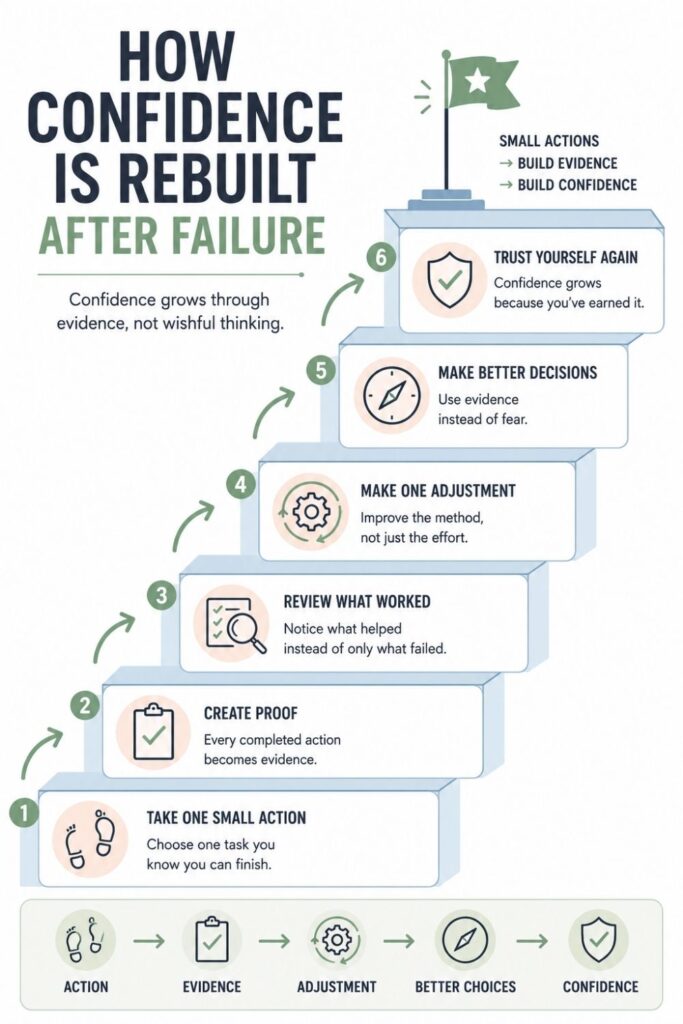
You rebuild confidence by creating evidence that you can respond differently, not by waiting to feel certain.
Choose a small action you control, complete it, review what happened, and increase the difficulty gradually. A coach can help define the action, provide feedback, and prevent one disappointing result from erasing visible progress.
Sources
Barlow, Meaghan A., Carsten Wrosch, and Jennifer J. McGrath. “Goal Adjustment Capacities and Quality of Life: A Meta-Analytic Review.” Journal of Personality, vol. 88, no. 2, 2020, pp. 307–323. Wiley Online Library, https://doi.org/10.1111/jopy.12492.
If you want to get more from your life, and are looking for concrete action steps to get you there, check out our Request a Coach page. It’s a “cut the fence-sitting and take action” way to tackle your issues and actually find success. To get off the fence and start to take action, click or tap here.
Eskreis-Winkler, Lauren, and Ayelet Fishbach. “Not Learning From Failure, the Greatest Failure of All.” Psychological Science, vol. 30, no. 12, 2019, pp. 1733–1744. Association for Psychological Science, https://doi.org/10.1177/0956797619881133.
If you want to get more from your life, and are looking for concrete action steps to get you there, check out our Request a Coach page. It’s a “cut the fence-sitting and take action” way to tackle your issues and actually find success. To get off the fence and start to take action, click or tap here.
Read this next

Love VS Fear: What’s the Difference Between Love & Fear
Do you know the difference between acting out of love and acting out of fear?
Read More
How to build self confidence
In this video I talk about How to build self confidence. How we feel about ourselves is very important to our lives and the way we live. And if you don’t […]
Read More
11 Last-Minute Halloween Costumes You Can Make Using Household Items for a Spooky Night
Halloween always sneaks up on us, doesn’t it? Maybe you forgot to shop for a costume, maybe you don’t want to spend money on something you’ll only wear once, or […]
Read More