


Talk to a coach about Stress management coaching

Dr Soraya Sawicki, DSW, CPC, RMT
DSW, CPC, CSC, RMT
Personalized wellness coaching for stress relief, energy, and inner harmony.

Robert Bradley Singleton
Certified Master Spiritual Life Coach, Neuropsychologist, and Existential Therapist
Train with the best to be the best you! Don't...

Crystal Faulk
ACC
I help overwhelmed women in transition gain clarity, confidence, and...

Dr. Kate Watson
B.A Psychology, M.Ed. Psychological Counseling, Dr.PH in Public Health, Certified Health Coach, Certified Life Coach, Certified Mind and Body Specialist, Certified Women's Empowerment Coach, Certified Neurodiversity Coach
Dr. Kate Watson helps people with boundaries, coping strategies, and...

A. Nya ~ Savvy Soul Life
CPC, MSLC
Life, wellness, creativity, mindfulness & spiritual coaching for personal strengthening...

Stephanie Peers
Somatic Coach | Midlife Transitions, Self-Trust & Personal Growth --> (Download my free Body-Led Clarity Guide in My Store!)
Body-led coaching for midlife women ready to trust themselves, set...

Menna Jones
Certified Health & Wellness Coach (Real Balance Global Wellness)
Health & Wellness Coaching For Women Going Through Menopause

Claudia Silver
HDIP CBH - Cognitive Behavioural Hypnotherapist (UK Higher Diploma)
Certified Hypnotherapist for evidence-based help with stress, specific fears and...



What Most People Get Wrong About Starting a Journal
So, you’ve heard about the emotional benefits of journaling, but how do you get started?
You may have heard that journaling can help you sort through your thoughts, process difficult experiences, or make clearer decisions. The practical question is how to begin without turning a blank notebook into another task you avoid.
You do not need beautiful handwriting, a complicated system, or an hour of uninterrupted time. You need a reason to write, a manageable container, and permission to put unfinished thoughts onto the page.
Key Takeaways
- Start with a purpose. Decide whether you want to record events, process feelings, make a decision, or plan a next step. Your purpose determines which prompts and format will be most useful.
- Make the session small enough to begin. Set a limit of ten minutes, one page, or three sentences. A clear boundary makes the blank page less intimidating.
- Write before you edit. Ignore spelling, handwriting, grammar, and organization while your ideas are moving. A private journal is a working space, not a finished product.
- Close with something usable. End by naming one insight, unanswered question, decision, or action. This helps reflection lead somewhere concrete.
- Know when writing is not enough. Journaling can clarify a problem, but persistent distress or traumatic material may need therapeutic support. A coach can help turn patterns into decisions, practice, feedback, and accountability.
How Do You Start Journaling for the First Time?
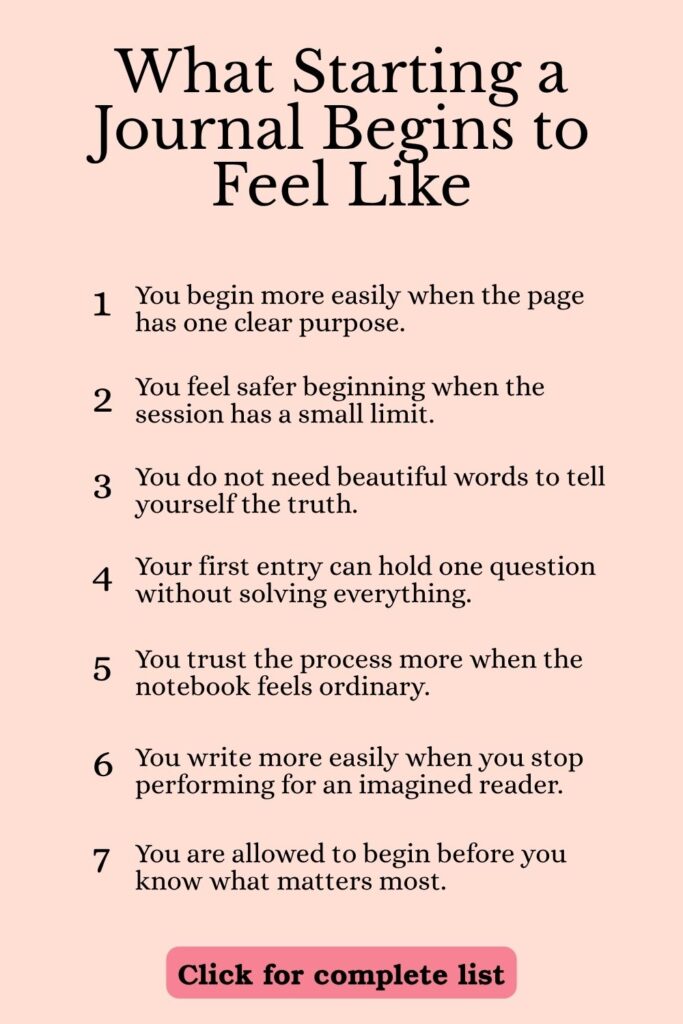
To start journaling, choose one reason for writing, select a format you can access easily, set a short limit, and write without correcting yourself. Finish by identifying one useful insight, question, decision, or next action.
A simple structure is the Four-Part Journaling Loop:
- Purpose: What do you need this entry to help you do?
- Container: How long or how much will you write?
- Freewrite: What comes up when you stop editing?
- Close: What is clearer now?
You do not need to journal every day or begin with your most painful experience. A ten-minute entry about one decision, conversation, or recurring problem is a useful place to start.
What Do You Need to Start Journaling?
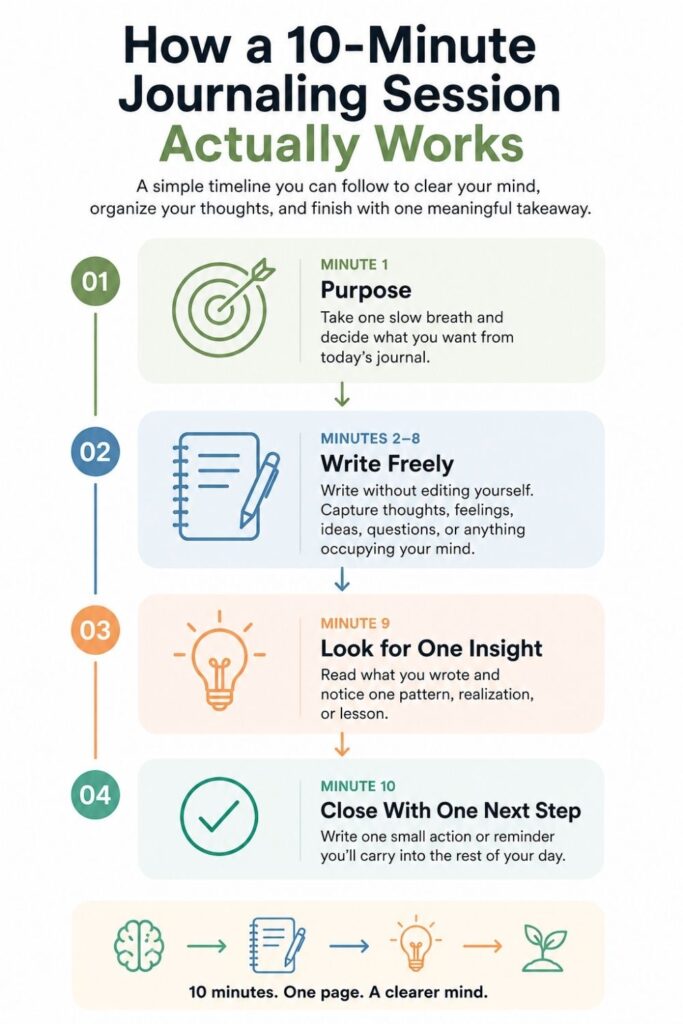
You need a writing format that feels easy to use and fits your reason for journaling.
Start by asking why you want to write. The answer affects what kind of journal will work.
If you want to get more from your life, and are looking for concrete action steps to get you there, check out our Request a Coach page. It’s a “cut the fence-sitting and take action” way to tackle your issues and actually find success. To get off the fence and start to take action, click or tap here.
You might want to keep a record of a particular stage in your life. Some people journal during pregnancy, while traveling, or as their children grow up. A durable, well-bound notebook may make sense for a journal you plan to keep, especially if you want space for photographs, tickets, drawings, or other mementos.
Digital journaling is another practical option. You can use a journaling app, a private document, or a folder containing both text and images. Typing may be easier when you want to write quickly, search old entries, or add photographs.
A beautiful notebook can sometimes make starting harder. Crisp pages may create pressure to write neatly, organize every thought, or produce something worth keeping.
For private reflection, an inexpensive lined notebook often works better. You can scribble, cross things out, and change direction without feeling that you have ruined anything.
An A5-sized notebook is less visually intimidating than a large page and is easy to carry. A spiral-bound notebook can also be folded back when you are writing on a train, sitting outside, or balancing it on your lap.
The notebook does not have to be expensive, but the pen should move comfortably across the page. When your thoughts begin moving quickly, a pen that scratches, skips, or dries out becomes an unnecessary interruption.
Which Type of Journaling Fits What You Need Right Now?
The right type of journaling depends on the job you need the entry to perform.
You can sort most journal entries into four practical purposes:
If you want to get more from your life, and are looking for concrete action steps to get you there, check out our Request a Coach page. It’s a “cut the fence-sitting and take action” way to tackle your issues and actually find success. To get off the fence and start to take action, click or tap here.
- Record: Capture events, conversations, milestones, or memories before you forget them.
- Process: Explore your response to something that happened and identify what is still unresolved.
- Decide: Compare options, question assumptions, and examine likely consequences.
- Plan: Turn a goal or problem into actions, dates, and checkpoints.
A travel journal might mainly record where you went, what surprised you, and what you want to remember. A journal entry after an argument has a different purpose. You may need to separate what was actually said from what you assumed the other person meant.
Decision journaling is especially useful when two options both feel risky. Suppose you are considering leaving your job. Instead of repeatedly writing, “I hate my job,” divide the issue into facts, assumptions, options, and small tests.
Your entry might reveal:
- Fact: You have been passed over for promotion twice.
- Assumption: No other employer will match your current salary.
- Option: Apply for three comparable roles before deciding whether to resign.
- Test: Speak with two recruiters this month.
A career coach might use those notes to examine your options, challenge unsupported assumptions, and create a realistic decision timeline. The journal supplies the raw material. Coaching helps you test it through action and accountability.
Do Grammar and Spelling Matter When You Journal?
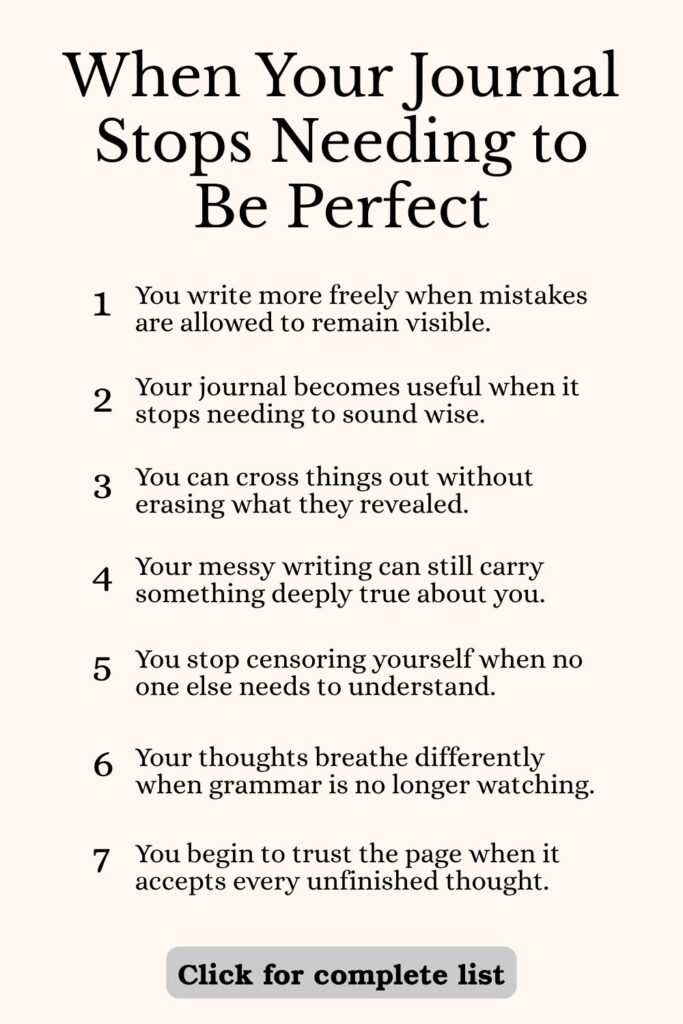
Grammar and spelling do not matter in a private journal unless correcting them helps you think.
Words usually come more easily when you stop worrying about presentation. Give yourself permission to doodle, scribble, repeat yourself, change your mind, and write in your untidiest handwriting.
The purpose is not to produce a polished account. It is to capture thoughts before your internal editor rearranges or rejects them.
This can be difficult if you are a perfectionist. You may feel that each entry should be insightful, organized, and worth reading later.
If you want to get more from your life, and are looking for concrete action steps to get you there, check out our Request a Coach page. It’s a “cut the fence-sitting and take action” way to tackle your issues and actually find success. To get off the fence and start to take action, click or tap here.
Try treating the page as a workbench rather than a display case. Workbenches contain rough pieces, discarded attempts, unfinished ideas, and tools in use. They are not meant to look complete.
No English teacher is going to mark your entry. No reader needs a clear introduction or a satisfying conclusion. You may never read it again.
That freedom allows you to write what you actually think, including contradictions such as:
“I want to accept the offer.”
“I do not trust the company.”
“I am afraid I will regret saying no.”
All three statements can be true enough to examine. Your journal does not need to resolve the contradiction immediately.
What Does a Useful 10 to 20-Minute Journaling Session Look Like?
A useful short journaling session gives you enough structure to begin without forcing you to reach a final answer.
If you want to get more from your life, and are looking for concrete action steps to get you there, check out our Request a Coach page. It’s a “cut the fence-sitting and take action” way to tackle your issues and actually find success. To get off the fence and start to take action, click or tap here.
Expressive-writing research has often used brief, bounded sessions rather than unlimited writing. In a foundational 1986 study published in the Journal of Abnormal Psychology, James W. Pennebaker and Sandra K. Beall asked university students to write for 15 minutes on four consecutive days about either personally difficult experiences or neutral subjects. The study does not establish 15 minutes as the right length for every person, but it shows that reflective writing can take place within a clear and manageable container.
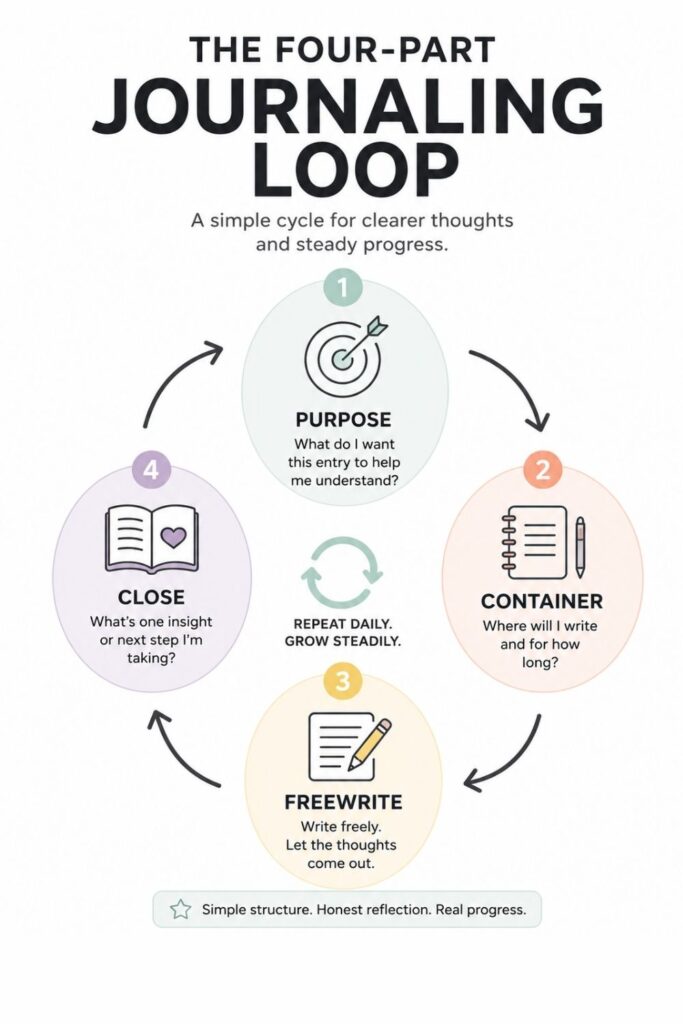
Use the Four-Part Journaling Loop to structure one session.
1. State the purpose
Complete this sentence:
“I am writing because I need to understand, decide, record, or plan…”
Keep the purpose narrow. “I need to understand why yesterday’s meeting bothered me” is easier to work with than “I need to fix my career.”
2. Set the container
Choose one limit:
- Ten minutes
- One page
- Three paragraphs
- A specific number of bullet points
Stop when you reach the limit, even if the issue is unresolved. You can return later.
3. Freewrite without correcting
Write what happened, what you noticed, and what you are thinking now. Leave grammar, structure, and word choice alone.
If you want to get more from your life, and are looking for concrete action steps to get you there, check out our Request a Coach page. It’s a “cut the fence-sitting and take action” way to tackle your issues and actually find success. To get off the fence and start to take action, click or tap here.
For example:
“My manager said the proposal needed more detail. I heard that as proof that she does not trust me. She did not actually say that. I noticed that I stopped asking questions and began defending every decision.”
That entry separates the observable comment from the meaning attached to it.
4. Close with one useful outcome
Finish with one of these statements:
- “What I understand now is…”
- “The question I still need to answer is…”
- “The conversation I need to have is…”
- “The next action I will take is…”
A leadership coach might help you examine the point where you became defensive, practice asking a clarifying question, and prepare for the follow-up conversation.
The entry does not need to solve the whole problem. It needs to make the next part of the problem more visible.
What Should You Write About in a Journal?
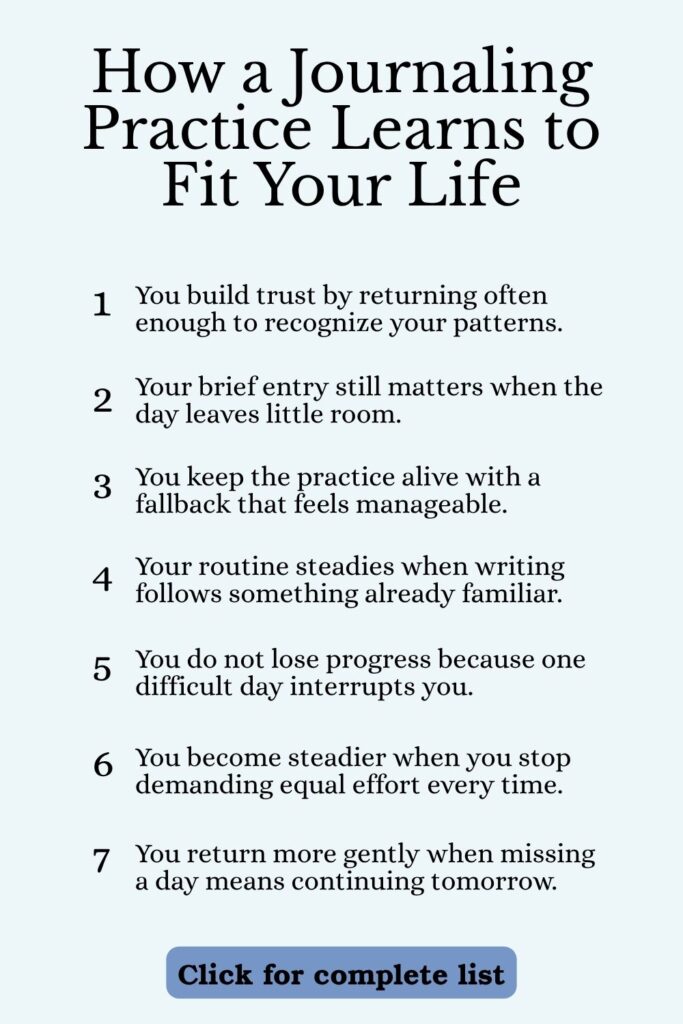
You can write about anything that becomes clearer when you see it outside your head.
A journal can be used to:
If you want to get more from your life, and are looking for concrete action steps to get you there, check out our Request a Coach page. It’s a “cut the fence-sitting and take action” way to tackle your issues and actually find success. To get off the fence and start to take action, click or tap here.
- Set goals: Define what you want and why it matters.
- Make lists: Capture tasks, possibilities, worries, or unfinished decisions.
- Plan: Map out a conversation, project, trip, or change.
- Record achievements: Note what worked and what helped you follow through.
- Tell yourself what you need to hear: Write the accurate response you would give a friend in the same position.
- Complain honestly: Put the uncensored version on the page before deciding what to do with it.
- Ask questions: Name what you do not yet understand.
- Examine a pattern: Compare what happened this time with what usually happens.
- Track behavior: Record actions, obstacles, and results rather than relying on memory.
- Capture ideas: Write them down before deciding whether they are useful.
A journal does not have to stay in one category. You might begin by complaining about a missed deadline, notice that the same problem has occurred three times, and finish by changing how you plan the work.
What Can You Write When Your Mind Goes Blank?
When your mind goes blank, move through four concrete questions: Event, Reaction, Meaning, and Response.
Event: What happened?
Describe only what a camera or audio recording could have captured.
“Alex canceled our meeting two hours before it began.”
This is more useful than beginning with, “Alex does not respect my time,” which is already an interpretation.
Reaction: What did you think, feel, or do?
Name your response without trying to justify it.
If you want to get more from your life, and are looking for concrete action steps to get you there, check out our Request a Coach page. It’s a “cut the fence-sitting and take action” way to tackle your issues and actually find success. To get off the fence and start to take action, click or tap here.
“I felt angry. I replied with one word and ignored the apology.”
Meaning: What are you assuming the event means?
Identify the story you attached to what happened.
“I assumed the cancellation meant the project was not a priority.”
Response: What needs to happen next?
Choose a question, action, request, or boundary.
“I need to ask whether the timeline has changed and agree on how much notice we both need for cancellations.”
This prompt ladder also works when you fail to follow through on a goal.
If you want to get more from your life, and are looking for concrete action steps to get you there, check out our Request a Coach page. It’s a “cut the fence-sitting and take action” way to tackle your issues and actually find success. To get off the fence and start to take action, click or tap here.
Suppose you planned to exercise four times but went once. Instead of writing, “I have no discipline,” examine the sequence:
- Event: You planned four 6 a.m. workouts.
- Reaction: You snoozed the alarm on three mornings.
- Meaning: You concluded that you cannot maintain a routine.
- Response: Test two evening sessions and one weekend session next week.
An accountability coach might help you determine whether the obstacle is scheduling, unrealistic expectations, avoidance, or a goal you do not genuinely want.
How Do You Build a Journaling Routine That Survives Real Life?
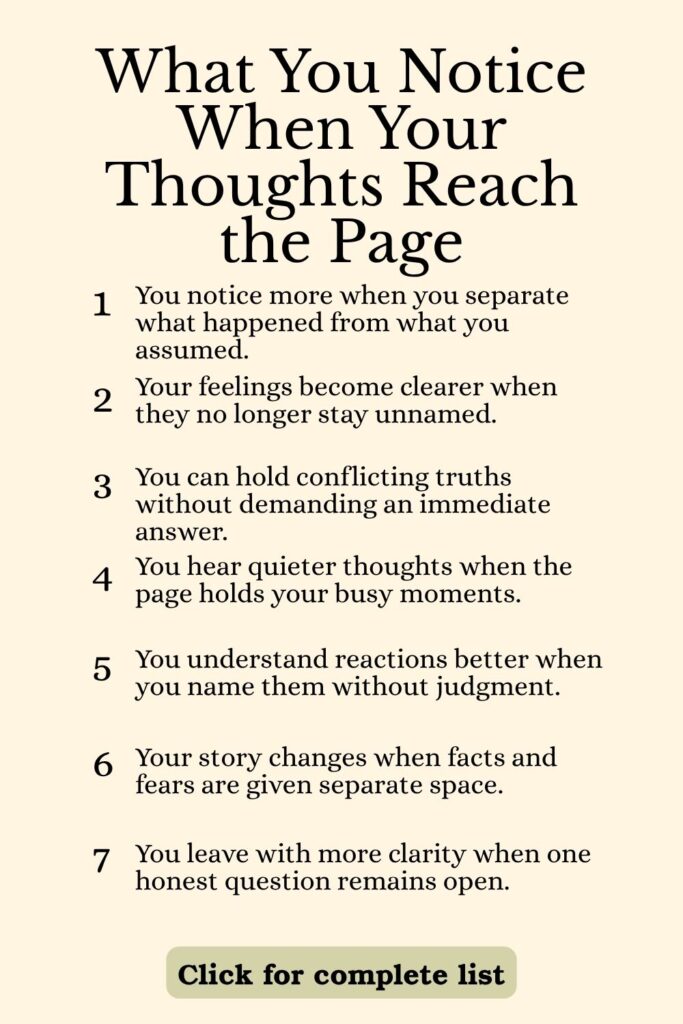
A sustainable journaling routine needs a reliable cue and a fallback option, not a perfect daily streak.
Build the routine from four parts:
- Trigger: What event will remind you to write?
- Place: Where will the journal be available?
- Duration: What is the normal session length?
- Fallback: What counts on a disrupted day?
Your trigger might be finishing your morning coffee, closing your laptop after work, or preparing for bed. Keep the notebook where the trigger happens rather than storing it somewhere that requires another decision.
Choose a duration that works on an ordinary day. Ten minutes three times a week may produce more useful writing than an ambitious daily hour that rarely happens.
Then create a fallback.
On a busy day, write three sentences:
If you want to get more from your life, and are looking for concrete action steps to get you there, check out our Request a Coach page. It’s a “cut the fence-sitting and take action” way to tackle your issues and actually find success. To get off the fence and start to take action, click or tap here.
- What happened?
- What am I carrying from it?
- What needs my attention next?
A parent with an unpredictable evening schedule might plan to journal after school drop-off on Monday, Wednesday, and Friday. When that plan falls apart, a brief phone entry keeps the thread without demanding a full session.
Resistance is information, but it is not always a command to push harder. You may be avoiding a useful question. You may also be tired, emotionally activated, or trying to write about something that needs more support than a private page can provide.
Notice the difference between “I do not feel like beginning” and “Writing about this is making it difficult to function.” The first may call for a smaller entry. The second may call for a pause and professional guidance.
How Can You Tell Whether Journaling Is Helping or Keeping You Stuck?
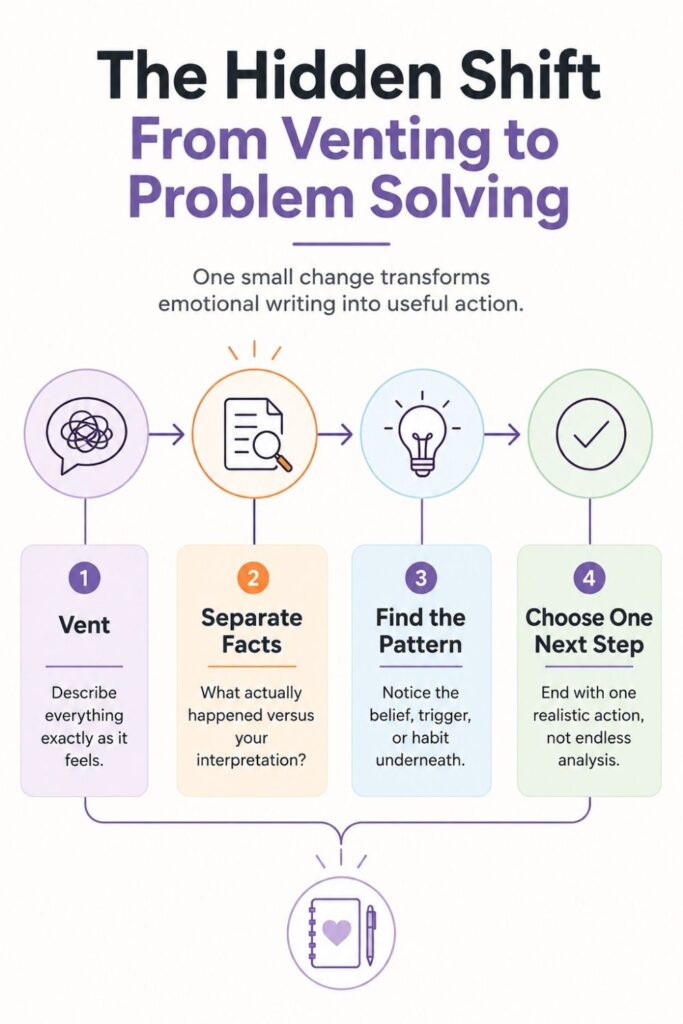
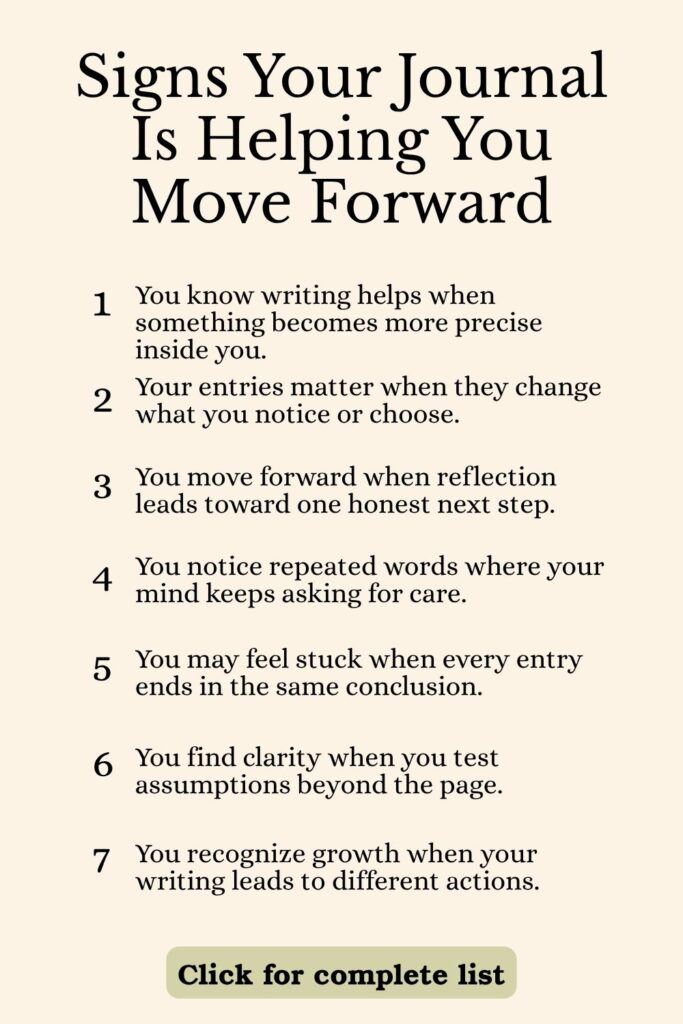
Journaling is helping when your entries create greater precision, a new question, or a change in what you do outside the journal.
Once a week, review the process rather than judging the quality of your writing.
Ask:
- Can I describe the problem more accurately than I could last week?
- Have I noticed a repeated trigger, assumption, or behavior?
- Did I gather any new information?
- Did I make a decision or test an option?
- Did I have a conversation, make a request, or change a boundary?
- Am I writing something new, or repeating the same conclusion?
A repeated topic is not automatically a problem. Some decisions take time, and some experiences need to be approached more than once.
The warning sign is a stuck loop. You write the same account, reach the same conclusion, become more activated, and take no action that could confirm, challenge, or change the situation.
If you want to get more from your life, and are looking for concrete action steps to get you there, check out our Request a Coach page. It’s a “cut the fence-sitting and take action” way to tackle your issues and actually find success. To get off the fence and start to take action, click or tap here.
For example, you might write for several weeks that a colleague is undermining you. A useful review would ask what specific behavior supports that conclusion, what evidence is missing, what outcome you want, and which conversation or documentation step comes next.
A leadership coach could help turn the entries into a factual timeline, a clear request, and a role-played conversation. That moves the issue from repeated private analysis into observable action.
When Is Journaling Not Enough on Its Own?
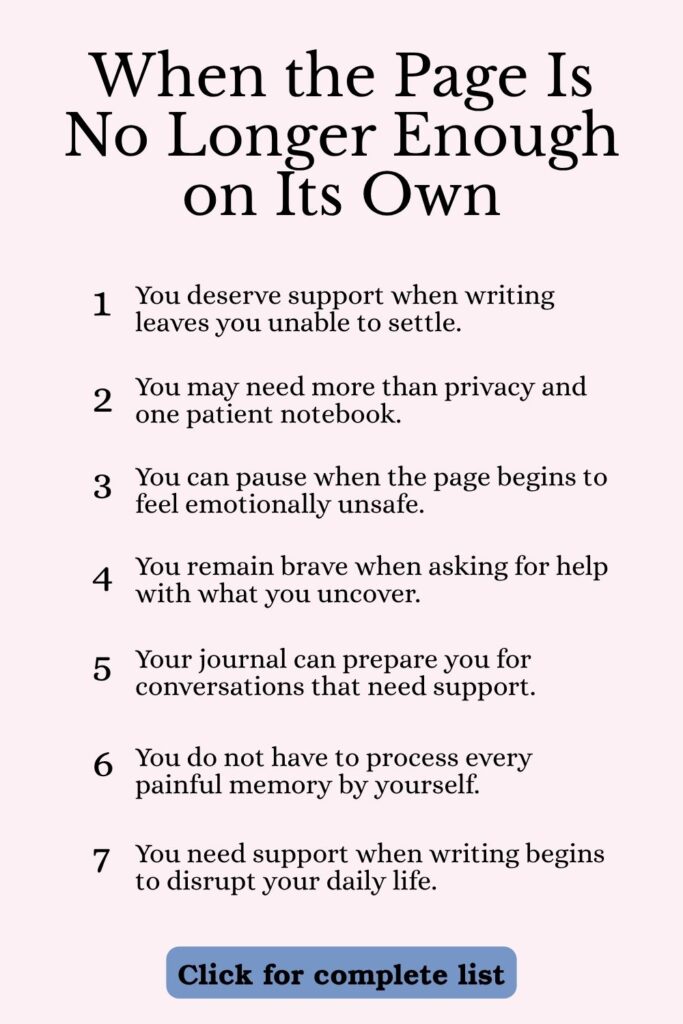
Journaling is not enough when writing repeatedly intensifies distress, interferes with daily functioning, or brings up experiences you cannot manage safely by yourself.
Research supports a measured view of expressive writing. Joanne Frattaroli’s 2006 meta-analysis in Psychological Bulletin reviewed 146 randomized studies and found a small positive average effect from experimental disclosure. Results varied according to factors such as the participants, writing instructions, timing, and outcomes being measured. Journaling may help some people under some conditions, but it is not a guaranteed treatment or a replacement for professional care.
A therapist or counselor is the appropriate person to contact when journaling brings up trauma, panic, severe depression, thoughts of self-harm, or symptoms that are disrupting sleep, work, relationships, or basic daily responsibilities.
A coach may be useful when the issue is not clinical but still requires structured change. For example, a career coach might help you test career options, a relationship coach might help you prepare for a boundary-setting conversation, and an accountability coach might help you follow through on decisions recorded in your journal.
Journaling can make professional conversations more focused. You may arrive with examples of repeated situations, the interpretations you tend to make, and the actions you have already tried.
You do not need to hand over your private journal. A short summary of the patterns you noticed is often enough.
If you want to get more from your life, and are looking for concrete action steps to get you there, check out our Request a Coach page. It’s a “cut the fence-sitting and take action” way to tackle your issues and actually find success. To get off the fence and start to take action, click or tap here.
Frequently Asked Questions About Journaling
How do I start journaling if I have never done it before?
Start with one specific question and write for ten minutes without editing. End by writing one sentence about what became clearer or what you need to do next.
What should I write in a journal every day?
Write about one event, reaction, decision, goal, or unresolved question from your day. You do not need to summarize everything that happened.
How long should a journaling session last?
A journaling session can last ten to twenty minutes when you are beginning. A page limit or three-sentence fallback also works when time is limited.
Is it better to journal in the morning or at night?
The better time is the one connected to a routine you can repeat. Morning writing may help with planning, while evening writing may help you review events and unfinished thoughts.
Is handwritten journaling better than typing?
Handwriting and typing are both workable formats for personal journaling. Choose handwriting when slowing down helps you think, and choose typing when speed, privacy, searchability, or easy access matters more.
Do I need to journal every day?
You do not need to journal every day for the practice to be useful. A consistent schedule of two or three sessions a week may be more realistic than forcing a daily streak.
Can journaling make difficult emotions feel worse?
Journaling can temporarily intensify difficult emotions, particularly when you write about distressing or traumatic experiences. Stop or change the topic if writing leaves you unable to settle, sleep, work, or carry out normal responsibilities.
Should I use a therapist, counselor, or coach for issues I discover through journaling?
Use a therapist or counselor for mental health symptoms, trauma, safety concerns, or serious emotional distress. A coach may help with goals, decisions, habits, conversations, role-play, feedback, and accountability when clinical treatment is not required.
If you want to get more from your life, and are looking for concrete action steps to get you there, check out our Request a Coach page. It’s a “cut the fence-sitting and take action” way to tackle your issues and actually find success. To get off the fence and start to take action, click or tap here.
Where Can You Go Next?
Start with one inexpensive notebook or a private digital document. Choose a ten-minute window and answer one question that is already occupying your attention.
Do not try to create a complete record of your life. Write one honest entry, close it with one useful takeaway, and notice what happens next.
You can also explore further resources on expressive writing, journaling prompts, goal setting, and using journal entries in coaching or counseling. The right next step may be another page, a practical experiment, or a conversation with someone qualified to help you work through what the page has uncovered.
Interested in getting started yourself? Read more of my articles about writing therapy and journaling. Please contact me for coaching or support with journaling.
Sources
Frattaroli, Joanne. “Experimental Disclosure and Its Moderators: A Meta-Analysis.” Psychological Bulletin, vol. 132, no. 6, 2006, pp. 823–865. American Psychological Association, doi:10.1037/0033-2909.132.6.823. View the source on PubMed.
Pennebaker, James W., and Sandra K. Beall. “Confronting a Traumatic Event: Toward an Understanding of Inhibition and Disease.” Journal of Abnormal Psychology, vol. 95, no. 3, 1986, pp. 274–281. American Psychological Association, doi:10.1037/0021-843X.95.3.274. View the source on PubMed.
If you want to get more from your life, and are looking for concrete action steps to get you there, check out our Request a Coach page. It’s a “cut the fence-sitting and take action” way to tackle your issues and actually find success. To get off the fence and start to take action, click or tap here.
Read this next

The ABC’s of Resilience
Everybody feels overwhelmed now and again. Learn the ABCs of Resilience!
Read More
Airing Versus Sharing: The Benefits of Journaling and Writing Therapy
Don’t feel able to share your feelings with anyone else? Try journalling or writing therapy.
Read More
How to Deal with Distress: 10 Tips
How to overcome distress Distress can quickly become overwhelming and sometimes even debilitating. The following list demonstrates how to deal with distress by overcoming stressful thoughts: As you read through […]
Read More